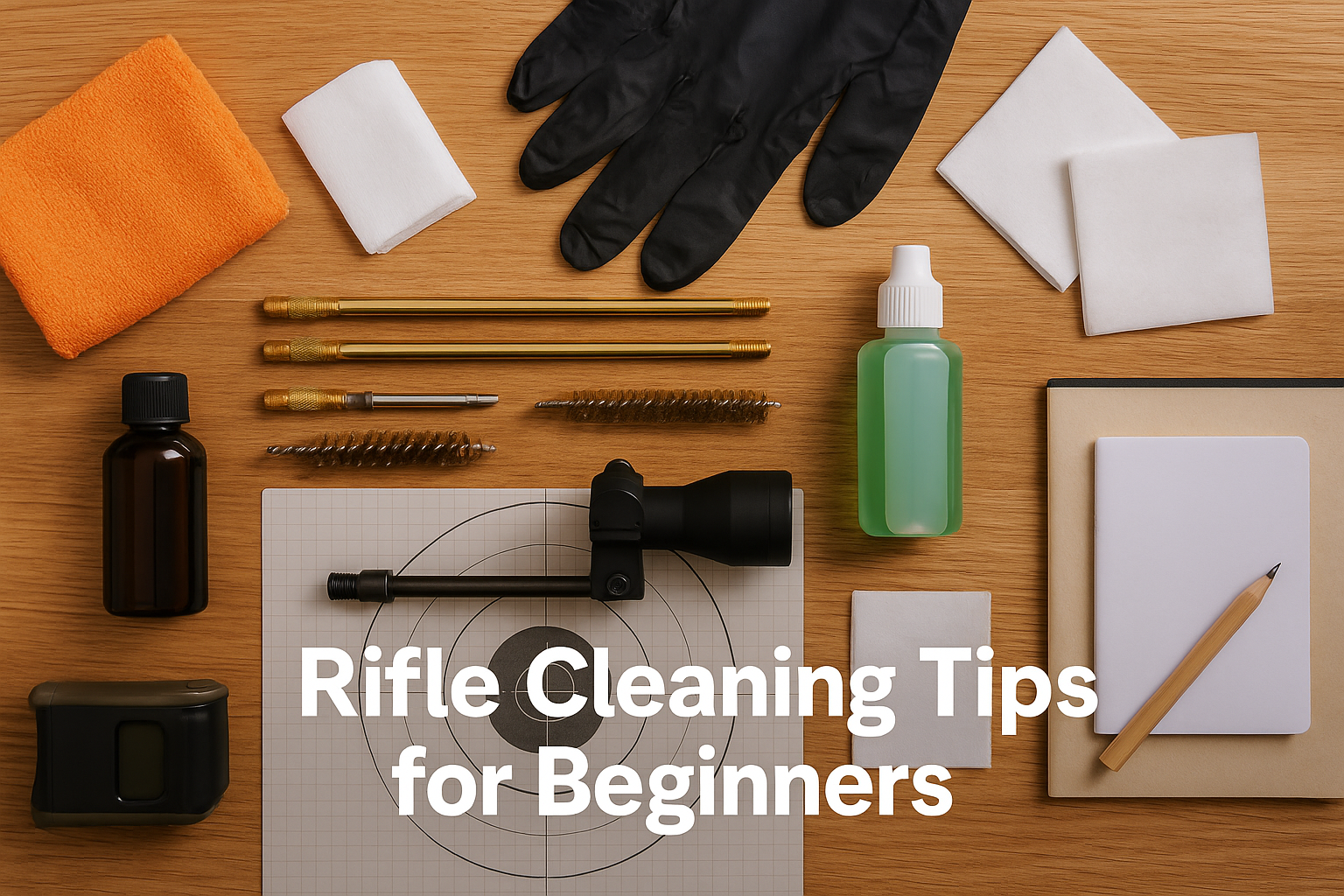
Rifle Cleaning Tips for Beginners

Beginner rifle cleaning starts with safety, the rifle manual, the right tools, and a calm routine. Unload and clear the rifle first, move ammunition away from the bench, work in a ventilated area, and use cleaning products according to their labels. This guide explains beginner-safe rifle cleaning habits without replacing your firearm manual, a qualified instructor, or a gunsmith.

Table of Contents
  1. Quick Answer
  2. Beginner Rifle Cleaning Checklist
  3. Before You Start Cleaning
  4. Tools and Supplies
  5. Safe Cleaning Routine
  6. Oil, Wipe-Down, and Storage
  7. Common Beginner Mistakes
  8. FAQ
  9. Final Takeaway

Quick Answer

To clean a rifle safely as a beginner, unload and clear it, remove ammunition from the cleaning area, follow the manual for any disassembly, use correctly sized rods, brushes, patches, solvent, and oil, clean from the recommended direction, wipe away residue, apply only the amount of oil the manual calls for, and store the rifle securely after inspection.

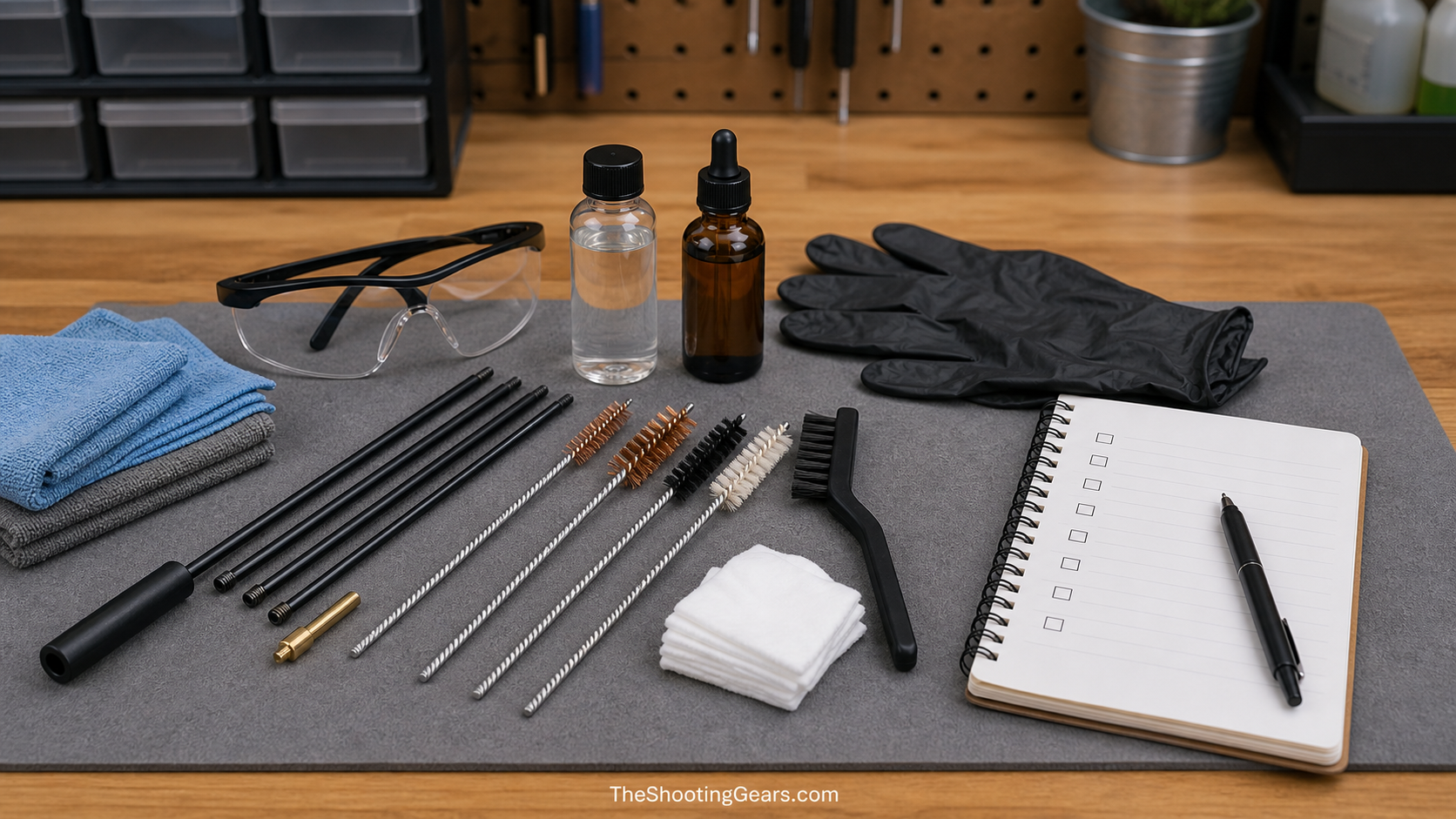
A beginner rifle-cleaning setup should include correct-size tools, patches, solvent, oil, gloves, eye protection, and the firearm manual.

Beginner Rifle Cleaning Checklist

  • Unload and clear: Confirm the rifle is unloaded before any cleaning work.
  • Remove ammunition: Keep ammunition off the cleaning bench and away from solvents.
  • Read the manual: Use the firearm maker’s cleaning and disassembly instructions.
  • Use correct-size tools: Match rods, brushes, jags, and patches to the bore.
  • Ventilate the area: Use solvent and oil in a space with airflow.
  • Protect yourself: Wear eye protection and gloves when using chemicals.
  • Store securely: Return the rifle and cleaning chemicals to safe storage when finished.

Start every cleaning session with firearm safety. The NSSF firearm safety rules are a useful reminder that maintenance begins with safe handling. If you clean after range sessions, residue hygiene matters too; CDC/NIOSH range guidance explains why lead and residue exposure should be taken seriously around shooting environments.

Before You Start Cleaning

Choose a stable bench, good lighting, and a surface you do not mind getting dirty. Put ammunition in another location before opening solvent or oil. Confirm the chamber and magazine are clear, then check again. If your rifle requires disassembly, follow the manual rather than memory or a random shortcut.

When to Stop and Ask for Help

Stop if a part does not move as expected, a screw feels stuck, the bore looks obstructed, the action does not function normally, or you are unsure how to reassemble the rifle. A gunsmith, qualified instructor, or manufacturer support is a better choice than forcing parts.

Tools and Supplies

A beginner kit should include a correctly sized cleaning rod or pull-through cable, bore brush, jag or patch loop, cotton patches, nylon utility brush, microfiber cloth, firearm-safe solvent, firearm oil, gloves, and eye protection. A bore guide can help on compatible rifles, but it must match the firearm and cleaning method.

Do not buy only by piece count. A large kit is not useful if the brushes are the wrong size, the rods are rough, or the case makes parts hard to identify. Correct fit and safe handling matter more than having the biggest kit on the shelf.

Solvent and Oil

Use solvent and oil according to their labels and the firearm manual. Avoid mixing chemicals, avoid over-oiling, and keep products capped when not in use. Eye protection and gloves are simple habits that keep residue and splashes under control.

Safe Cleaning Routine

A safe routine is slow and repeatable. After the rifle is clear and the bench is ready, follow the manual for access to the bore and action. Use properly fitted tools, work from the recommended direction, let solvent do its job, and use clean patches until heavy residue is removed. Do not scrape aggressively or force a brush through a bore that feels wrong.

Clean the chamber, bolt face, and accessible action areas only as your manual allows. Many beginners create problems by taking apart more than necessary. If the rifle has heavy rust, pitting, a bore obstruction, unusual wear, or a malfunction, cleaning is not a substitute for inspection by a qualified professional.

Keep Notes

A small maintenance note helps you remember when the rifle was cleaned, what products were used, and whether anything looked unusual. This is especially useful if you rotate several firearms or store a rifle for a season.

Oil, Wipe-Down, and Storage

Oil should protect parts without leaving the rifle wet or sticky. Too much oil can attract debris and may create problems in cold weather or dusty environments. Wipe exterior metal surfaces as appropriate, keep oil away from optics glass unless the product is made for that use, and check that the rifle functions normally after reassembly.

After cleaning, store the rifle securely and keep chemicals away from children, guests, and heat sources. General safety programs such as Project ChildSafe are useful reminders that safe maintenance and safe storage belong together.

Before putting everything away, do a simple bench reset: cap the chemicals, throw away dirty patches, wipe the mat, check that no small parts or tools are left in the action area, and return the manual and notes to the same place each time. Beginners build confidence faster when the cleaning area is organized and repeatable.

Common Beginner Mistakes

  • Cleaning before fully unloading and clearing the rifle.
  • Keeping ammunition on the bench during cleaning.
  • Using the wrong brush, jag, or patch size.
  • Forcing rods or brushes instead of stopping to diagnose resistance.
  • Over-oiling parts until they feel wet or gummy.
  • Mixing chemicals or ignoring solvent labels.
  • Taking apart more of the rifle than the manual recommends.

FAQ

How often should a beginner clean a rifle?

Follow the firearm manual first. Many rifles benefit from cleaning after range use, exposure to moisture, dusty conditions, or long storage, but the exact routine depends on the firearm and ammunition.

Can too much cleaning hurt a rifle?

Careless cleaning can cause wear or damage if tools are wrong, chemicals are misused, or parts are forced. Careful manual-based maintenance is different from aggressive scrubbing.

Should I clean from the muzzle or chamber end?

Use the direction recommended by your firearm manual and the tools designed for that method. When unsure, ask the manufacturer, a gunsmith, or a qualified instructor.

Do I need expensive cleaning tools?

You need correct, safe, well-finished tools more than expensive tools. A small quality kit that fits your rifle is better than a large kit full of parts you cannot use.

Final Takeaway

Good rifle cleaning habits are simple: unload and clear first, follow the manual, use correct-size tools, respect solvents and residue, avoid forcing parts, apply oil carefully, and store the rifle securely. Beginners do not need a complicated routine; they need a safe, repeatable one.
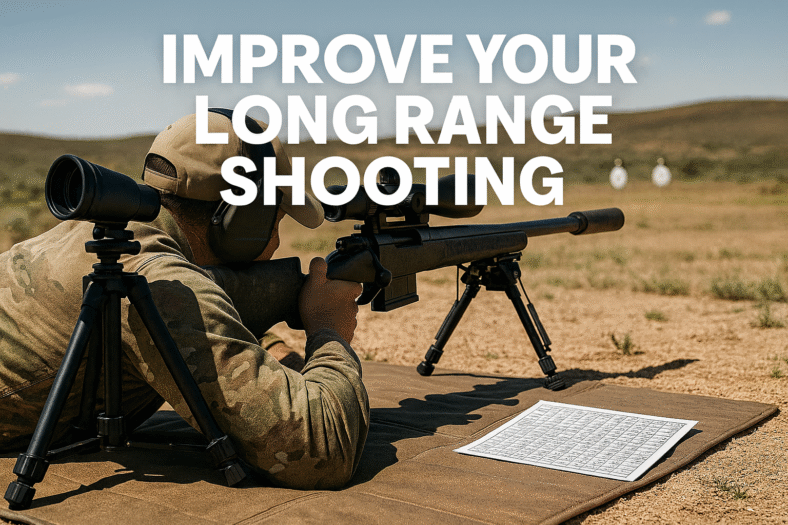
Improve Your Long Range Shooting: Expert Tips & Guide


You improve long range shooting by tightening the fundamentals first: a stable position, consistent breathing, a clean trigger press, a steady natural point of aim, and honest reading of wind and distance. Equipment matters less than repeatable technique. The shooters who connect at distance are the ones who do the same simple things the same way on every shot, and who only take a shot when they are confident in it.

This guide stays on the safe, learnable parts of long range shooting. It does not give specific elevation or windage prescriptions, because every rifle, load, and condition is different, and following someone else’s numbers is how people miss or worse. Build your own confirmed data on a controlled range, follow the firearm safety rules from the National Shooting Sports Foundation, and treat every session as practice in discipline as much as accuracy.

Contents

What Counts as Long Range Shooting

Long range shooting generally means engaging targets far enough that bullet drop, wind drift, and your own stability become the limiting factors rather than the rifle’s mechanical accuracy. For many centerfire rifles that begins somewhere past 300 yards, though the exact point depends on the cartridge, the rifle, and the shooter. The label matters less than the principle: at distance, small errors at the trigger turn into large misses downrange.

That is why improvement at distance starts close in. A shooter who cannot hold a tight group at 100 yards will not suddenly tighten up at 500. Earn each step of distance by proving your consistency at the step before it.

Range Safety Comes First

No accuracy tip outranks safety. Long range shooting often happens on larger ranges where targets and impact areas are farther away and harder to see, which makes the basic rules even more important. Always treat every firearm as loaded, keep the muzzle pointed in a safe direction, keep your finger off the trigger until your sights are on target and you have decided to fire, and be certain of your target and what lies beyond it. The full set is laid out by the NSSF firearm safety rules.

  • Confirm a safe, known backstop or berm behind every target. Distance increases the area you are responsible for.
  • Follow the specific range’s rules, cease-fire commands, and downrange procedures without exception.
  • Wear eye protection and hearing protection on every shot, including spotting from beside the firing line.
  • Verify the firearm is clear before transporting, cleaning, or handing it to anyone.

Build a Stable Shooting Position

A stable position is the single largest physical contributor to long range accuracy. The goal is to support the rifle so it returns to the same point of aim with minimal muscular effort from you. The more your bones and gear hold the rifle, and the less your muscles strain to do it, the more repeatable each shot becomes.

Use a Solid Front Rest and Rear Support

A bipod, bench rest, sandbag, or stable improvised rest supports the front of the rifle. A rear bag or your supporting hand stabilizes the buttstock so you can make fine elevation adjustments without straining. The aim is a rifle that sits where you put it.

Find Your Natural Point of Aim

Natural point of aim is where your sights settle when your body is relaxed. Get into position, close your eyes, breathe, then open them. If the reticle has drifted off target, shift your whole body rather than muscling the rifle back. Forcing the rifle onto target with muscle introduces movement that shows up at distance.

Master the Fundamentals Before Distance

The fundamentals of marksmanship are sight alignment, breathing, trigger control, and follow-through. They are simple to describe and take real practice to make automatic. They matter more, not less, as distance grows.

Breathing

Your body moves slightly as you breathe, and that movement is visible through a scope at distance. Most shooters fire during the natural pause at the bottom of an exhale, when the body is briefly still. Do not hold your breath so long that you start to shake or strain.

Trigger Control

Press the trigger straight back with steady, increasing pressure so the shot almost surprises you. Jerking or slapping the trigger pushes the muzzle off target in the instant the bullet leaves. Dry practice with a verified unloaded firearm, following safe handling rules, is one of the best ways to refine a clean press.

Follow-Through

Stay on the rifle and keep your eye on the sight picture through the shot and for a moment after. Reacting before the bullet has cleared the barrel introduces movement. Good follow-through also lets you call your shot, meaning you know where the reticle was at the break.

Read Wind and Conditions

Wind is usually the hardest variable to manage at distance because it pushes the bullet sideways the entire way to the target and can differ between you and the target. Reading it is a skill built over many sessions, not a formula you apply once. The National Weather Service publishes useful background on how wind behaves and is measured.

  • Watch indicators downrange: grass, flags, mirage, dust, and moving vegetation tell you direction and rough strength.
  • Note that wind can vary along the bullet’s path, so the condition at your position is not always the whole story.
  • Build your own feel by observing conditions, making a call, firing, and comparing the result. Honest record keeping teaches faster than guessing.

This guide does not give wind hold values, because they depend on your specific cartridge, velocity, range, and conditions. Learn to read wind and develop your own confirmed corrections on a safe range.

Know Your Rifle and Build Your Own Data

Accuracy at distance depends on knowing how your specific rifle and ammunition behave, which is something only you can confirm. Borrowed numbers from another shooter, a forum, or a different rifle and load are not your data. Use only ammunition that is correct and safe for your firearm, and verify safe cartridge and chamber combinations through the firearm manual and resources such as SAAMI.

  • Confirm your zero at a known distance with the exact ammunition you intend to use, then verify it again on a later day.
  • Keep a simple log of your confirmed results in different conditions so your data reflects reality, not theory.
  • Maintain the rifle and check that the scope and mounts are secure, following the manufacturer’s torque and setup guidance.

Shoot Within Your Ability

Improving at long range is not the same as taking longer shots than you can make. The ethical and safe approach is to extend your maximum distance only as your confirmed, repeatable accuracy supports it. A shot you can make on a calm day at the range is not the same as a shot in wind, in a hurry, or on a live animal.

For hunters, this discipline is part of an ethical, humane approach to the field, and hunter education programs such as Hunter-Ed stress knowing and respecting your effective range. If you are not confident in a shot, the right answer is to pass on it. Confidence should come from proven practice, not optimism.

Common Mistakes That Cost Accuracy

  • Chasing equipment instead of practicing fundamentals. Gear cannot fix an inconsistent position or a poor trigger press.
  • Stretching distance faster than skill, which builds bad habits and unsafe shots.
  • Using another shooter’s drop or wind numbers instead of confirming your own.
  • Ignoring follow-through and reacting to recoil before the shot has cleared.
  • Skipping the wind read and treating a calm-range zero as if it applies everywhere.

Frequently Asked Questions

What is the most important factor in long range accuracy?

Consistent fundamentals applied from a stable position. A repeatable position, steady breathing, and a clean trigger press matter more than any single piece of gear. Master those first, then refine wind reading and your own confirmed data.

How far is considered long range?

It varies by rifle and cartridge, but for many centerfire rifles long range begins past about 300 yards, where drop and wind become the dominant factors. The exact distance depends on your equipment and skill, so judge it by your own confirmed accuracy.

Can I use someone else’s scope settings or drop chart?

No. Settings depend on your specific rifle, ammunition, velocity, and conditions. Using another shooter’s numbers leads to misses and unsafe shots. Build and verify your own confirmed data on a controlled range.

How do I practice wind reading safely?

Observe downrange indicators like flags, grass, and mirage, make a call, fire on a safe range with a proper backstop, then compare the result and keep notes. Reading wind is a skill built over many sessions, not a formula.

Final Takeaway

Improving long range shooting comes down to doing simple things consistently: build a stable position, master the fundamentals, learn to read wind, and confirm your own data on a safe range. Extend your distance only as your proven accuracy allows, follow every range safety rule, and pass on any shot you are not confident in. Discipline is what separates a shooter who hits at distance from one who hopes to.

GPS Devices for Tracking Hunting Locations: Safe Navigation Guide

GPS devices can help hunters mark stands, return to camp, track routes, save blood-trail notes, and avoid getting turned around in unfamiliar terrain. They are useful tools, but they should not be your only navigation plan. Batteries fail, screens break, maps can be outdated, and signal conditions vary.

The best approach is redundancy: use a GPS or hunting app, carry a paper map and compass, preload offline maps, keep backup power, and tell someone your plan before you leave. This guide explains how to choose and use GPS tools without depending on them blindly.

Table of Contents

Quick Answer

A hunting GPS is worth using if it helps you mark locations, navigate safely, and plan routes without replacing basic woods skills. The most useful features are offline maps, waypoint marking, track-back routing, battery life, weather resistance, map layers, and emergency communication options where available.

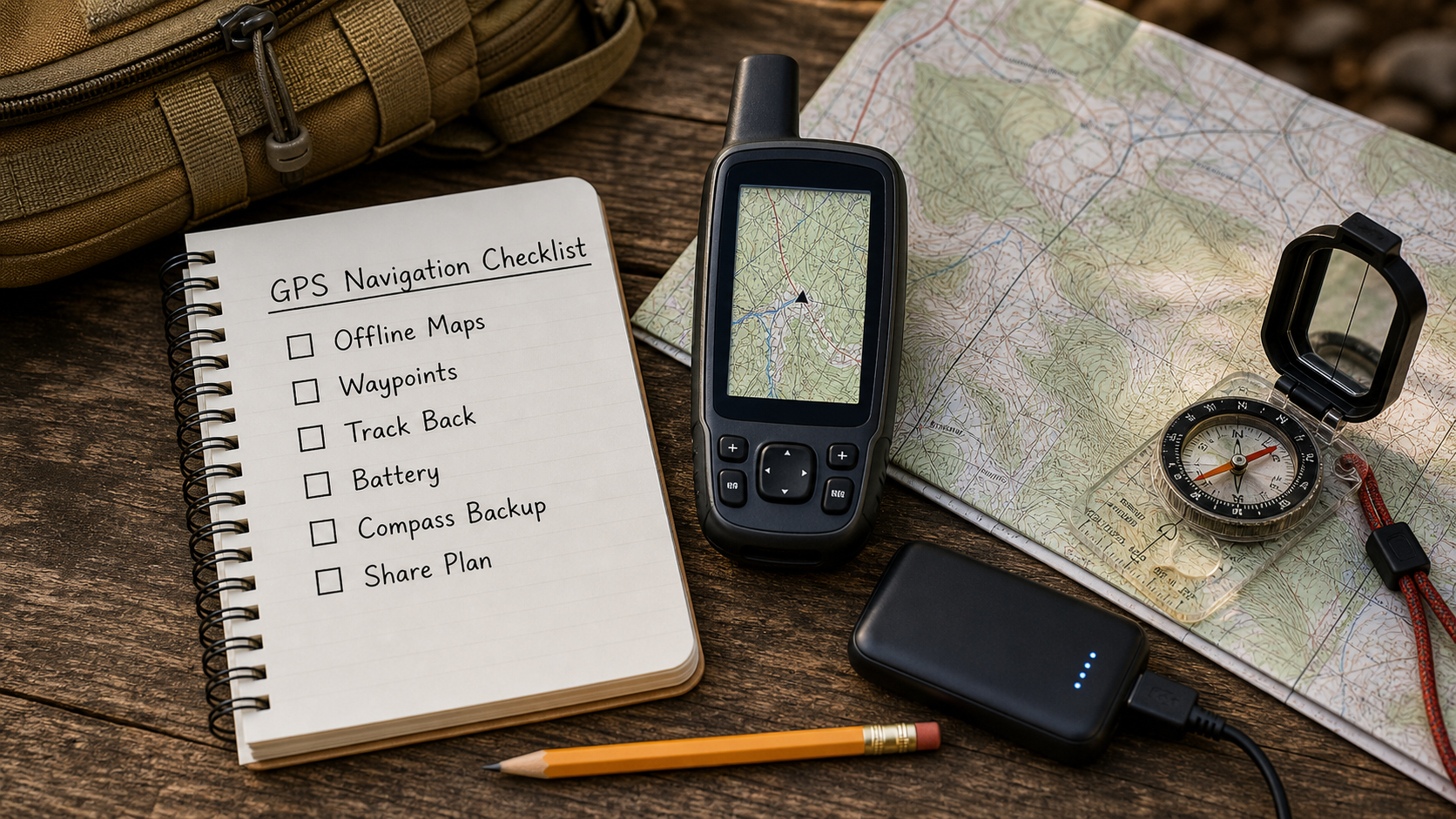
Before a hunt, confirm offline maps, waypoints, track-back, battery power, compass backup, and a shared trip plan.

Before relying on any device in the field, run through this checklist. It is simple, but it prevents the most common navigation failures.

  • Offline maps: Download the full area before leaving service.
  • Waypoints: Mark truck, camp, stand, blind, water crossing, and hazard locations.
  • Track back: Test route recording and return navigation before the hunt.
  • Battery: Start with full charge and carry backup power or spare batteries.
  • Compass backup: Carry a real compass and know the general direction to safety.
  • Trip plan: Tell someone where you are going and when you expect to return.

Why Hunters Use GPS

Hunters use GPS tools to reduce uncertainty. A device can help you return to the truck in the dark, find a stand without wandering, mark sign, measure access routes, avoid property boundaries, and record how you entered an area. It also helps when fog, snow, timber, or flat terrain makes landmarks harder to read.

GPS stands for Global Positioning System, a satellite-based positioning system. A basic GPS overview is useful background, but hunters should care less about the technical details and more about whether the device works reliably in their terrain.

Features That Matter

Do not choose a hunting GPS only because it has a long feature list. Choose the features that support your actual hunt.

Offline Maps and Boundaries

Offline maps are critical because cell service can disappear quickly in hills, timber, and remote access roads. Boundary layers can help with public/private land awareness, but you should still verify legal access from official sources because map layers can lag behind current rules.

Waypoints and Tracks

Waypoints mark specific spots. Tracks record your path. Together, they help you understand how you moved through an area and how to return. Use clear names such as Truck North Gate, Creek Crossing, Buck Sign, or Stand 2 instead of vague labels you will forget later.

Battery and Weather Resistance

Battery life matters more than novelty features. Cold weather, screen brightness, route recording, and satellite messaging can drain power. Weather resistance also matters because hunting gear gets wet, dirty, and bumped around in packs.

Types of GPS Tools

Hunters commonly use handheld GPS units, smartphones with hunting apps, satellite communicators, GPS watches, and vehicle-mounted navigation. Each has trade-offs.

Handheld GPS vs. Phone Apps

A handheld GPS may be more rugged and battery-friendly. A phone app may have better map layers and easier planning. Many hunters use both: the phone for detailed maps and the handheld or compass as backup. The best setup is the one you practice with before you need it.

Satellite Communicators

Satellite communicators can add messaging or SOS features in remote areas, depending on device and subscription. Do not treat them as permission to take careless risks. They are backup tools, not a replacement for route planning, weather checks, and telling someone your plan.

Field Workflow

Use a consistent workflow. Before leaving the vehicle, mark the truck, confirm the map is loaded, start a track if needed, and check battery level. During the hunt, mark sign, hazards, trail junctions, and recovery points. After the hunt, clean up duplicate waypoints and save useful notes while the memory is fresh.

Keep your system simple. Too many waypoints can become clutter. Use names and icons that make sense at a glance, especially in the dark or bad weather.

Safety and Backup Navigation

A GPS is only one part of outdoor safety. The National Park Service lists navigation, illumination, first aid, fire, shelter, extra food, extra water, and extra clothes among the Ten Essentials. Hunters should also carry season-appropriate survival gear and know how to navigate without a screen.

For hunting-specific preparation and safe decision-making, resources such as Hunter Ed can help reinforce trip planning, legal access, and responsible behavior. Tell someone your route, expected return time, vehicle location, and what to do if you do not check in.

Common Mistakes

The biggest mistake is assuming the device will solve every problem. Other common mistakes include forgetting offline maps, letting the battery run low, failing to mark the truck, trusting outdated property layers, ignoring weather, and never practicing track-back until lost.

Another mistake is staring at the screen instead of reading the land. Use the GPS to confirm your plan, but still watch wind, terrain, light, trails, and landmarks. A hunter who combines map sense with device discipline is much safer than one who only follows a glowing line.

FAQ

Do I need a GPS for hunting?

You do not always need one, but it is very useful in unfamiliar terrain, public land, big woods, mountains, swamps, or low-light exits. Carry backup navigation either way.

Is a phone enough for hunting navigation?

A phone can work if maps are downloaded and the battery is protected, but it should not be your only plan. Carry a compass, backup power, and basic route knowledge.

What waypoints should hunters mark?

Mark the truck, camp, stand, blind, trail junctions, hazards, water crossings, sign, and recovery points. Use clear names so the map still makes sense later.

Should I still carry a compass?

Yes. A compass and paper map are lightweight backups when batteries die, phones break, or screens become hard to use in weather.

Final Takeaway

GPS devices are excellent hunting tools when you use them as part of a complete navigation plan. Preload maps, mark important points, carry backup power, keep a compass, and share your trip plan. The best navigation system is not the most complicated one; it is the one you understand before the woods get dark.

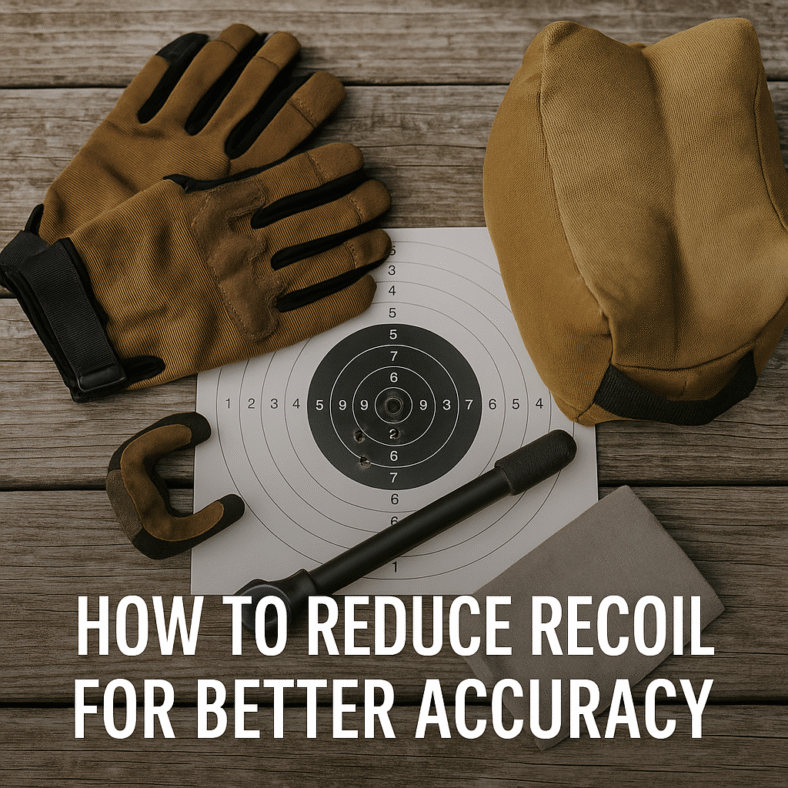
How to Reduce Recoil for Better Accuracy

Reducing recoil for better accuracy starts with fit, stance, grip, trigger control, and realistic practice. Gear can help, but it cannot replace safe fundamentals. The goal is to manage recoil consistently so the sights lift predictably, return naturally, and your shots stay repeatable.

Table of Contents
  1. Quick Answer
  2. Safety First
  3. Fit and Setup
  4. Stance, Grip, and Body Position
  5. Trigger Control and Follow-Through
  6. Ammunition and Load Choice
  7. Recoil-Reducing Gear
  8. Diagnose Recoil Anticipation
  9. Practice Plan
  10. Common Mistakes
  11. FAQ

Quick Answer

To reduce recoil for better accuracy, use a firearm that fits, keep a stable stance, hold consistent grip pressure, press the trigger smoothly, and practice with ammunition you can control. If recoil causes flinching, step down to a lower-recoil setup for training before returning to heavier loads.

Most Important Fix

The biggest improvement usually comes from consistency. A repeatable grip, shoulder position, cheek weld, and trigger press will do more for accuracy than chasing every accessory.

When Gear Helps

Recoil pads, proper stock fit, muzzle devices where legal, heavier firearms, and appropriate ammunition can help. They work best after the shooter already has safe fundamentals.

Safety First

Before working on recoil control, review the NSSF firearm safety rules. Keep the muzzle pointed in a safe direction, keep your finger off the trigger until ready to shoot, know your target and what is beyond it, and follow range commands.

Use the Right Ammunition

Only use ammunition that matches the firearm markings and manual. For safety context, SAAMI explains why unsafe firearm and ammunition combinations must be avoided.

Stop When Fatigue Shows Up

Recoil fatigue can create bad habits. If you start flinching, pushing the muzzle, blinking hard, or losing safe control, pause the session. More rounds are not always better practice.

Fit and Setup

Fit is one of the most overlooked recoil factors. A rifle or shotgun that is too long, too short, too light, or poorly shaped can make recoil feel sharper and make accurate shooting harder.

Rifle and Shotgun Fit

Length of pull, comb height, recoil pad shape, and cheek weld all matter. The firearm should mount naturally without stretching your neck, lifting your head, or placing the butt awkwardly on the shoulder.

Handgun Fit

For handguns, grip size and trigger reach affect recoil control. If the grip is too large or too small, the shooter may steer the gun during the trigger press or lose control during recoil.

Stance, Grip, and Body Position

Good recoil control uses the whole body. The firearm should recoil into a stable structure, not into loose joints or a collapsing position.

Rifle Position

Keep the butt seated firmly in the shoulder pocket, maintain a consistent cheek weld, and support the rifle so it tracks straight back. Avoid leaning away from recoil.

Handgun Position

Use a balanced stance, firm support-hand pressure, and locked-in wrist alignment. The goal is not to freeze the gun in place, but to let it recoil and return consistently.

Trigger Control and Follow-Through

Recoil anticipation often hurts accuracy before recoil actually happens. A clean trigger press and good follow-through help you avoid pushing, jerking, or dipping the muzzle before the shot breaks.

Watch the Sights

Watch what the sights do during and after the shot. If they dip before recoil, the issue is anticipation. If they lift and return predictably, your recoil management is improving.

Do Not Rush the Next Shot

Accuracy comes from seeing the sights return and confirming the next shot. Speed should come after control, not before it.

Ammunition and Load Choice

Ammunition changes recoil. Bullet weight, velocity, powder charge, firearm weight, and stock design all affect how recoil feels. For practice, a manageable load can help you build skill without developing a flinch.

Training Loads

Lower-recoil training ammunition, rimfire practice, or reduced-power options can help when used safely and legally. Confirm point of impact again before switching back to hunting or defensive loads.

Hunting Loads

For hunting, choose ammunition that is legal, accurate, and appropriate for the animal. Do not choose the hardest-kicking load if it makes you flinch or shoot poorly.

Recoil-Reducing Gear

Gear can reduce felt recoil, but every option has tradeoffs. A recoil pad may help comfort. A heavier firearm may move less but carry worse. A muzzle brake may reduce recoil but increase blast and noise. Use proper eye and ear protection, and follow range rules.

Recoil Pads and Stock Fit

A good recoil pad can spread force and improve comfort. Stock fit can be even more important because poor fit sends recoil into the shooter awkwardly.

Muzzle Brakes and Suppressors

Muzzle devices may be regulated and can change noise, blast, length, and handling. Verify local rules and range policies before using them.

Diagnose Recoil Anticipation

Recoil problems often start before the shot. If the shooter expects pain, noise, or blast, the body may tighten, blink, dip the muzzle, or pull the shot off target. The fix is to make practice observable. Watch the sights, slow the pace, and use a setup that lets you see what happens instead of simply enduring more recoil. Treat each session as skill-building, not punishment.

Use Short Strings

Short practice strings help you stay honest. Fire a few careful shots, pause, and check whether the sights are lifting and returning predictably. If accuracy gets worse as the session continues, fatigue or anticipation may be taking over. Record what changed between good and bad groups so the next session has a clear focus.

Separate Noise From Push

Some shooters react more to blast than recoil. Better hearing protection, outdoor practice where appropriate, or lower-blast setups can help the shooter focus on sight movement and trigger control. Keep proper hearing protection on every time you shoot.

Practice Plan

  • Start with safe handling and a firearm you can control.
  • Use short practice strings instead of long fatigue-heavy sessions.
  • Mix dry practice with live fire where appropriate and safe.
  • Use manageable ammunition while building fundamentals.
  • Watch the sights during recoil and recovery.
  • Stop when flinching or fatigue begins to take over.

Common Mistakes

  • Buying recoil gear before fixing fit and fundamentals.
  • Practicing with ammunition that causes flinch.
  • Leaning away from the firearm.
  • Changing grip pressure at the moment of firing.
  • Shooting too many rounds after fatigue starts.
  • Ignoring noise and blast as part of recoil sensitivity.

FAQ

Does heavier firearm weight reduce recoil?

Usually, yes. A heavier firearm often has less felt recoil, but it may be harder to carry or hold steady for some shooters.

Can a muzzle brake improve accuracy?

It can help some shooters by reducing recoil, but it also increases blast and may not be allowed everywhere. Accuracy still depends on fundamentals, ammunition, and firearm setup.

Why do I flinch before recoil?

Flinching usually comes from anticipating noise, blast, or recoil. It can happen before the firearm moves. Lower-recoil practice, dry practice, and instructor feedback can help.

Should beginners start with smaller calibers?

Often, yes. A manageable caliber helps beginners learn sight picture, trigger control, and follow-through without building recoil anxiety.

Final Takeaway

Recoil control is a system: fit, stance, grip, trigger control, ammunition, gear, and practice all work together. Start with safety and consistency, then use gear and load choices to support the fundamentals you can already repeat.

How to Choose Binoculars for Deer Hunting: A Comprehensive Guide

The best binoculars for deer hunting are the ones that match your terrain, your light conditions, and how long you carry them, not the ones with the highest magnification number on the box. For most whitetail hunters, an 8×42 or 10×42 pair balances brightness, steadiness, and weight well enough to glass from before dawn until last light. No single magnification is correct for every hunter, and no binocular removes your legal and ethical duty to positively identify your target before you ever consider a shot.

This guide walks through the specifications that actually change what you see in the field: magnification, objective lens size, glass and coatings, exit pupil and low light performance, field of view, weight, and durability. It also covers the ethics of using optics responsibly.

Table of contents

Magnification: what 8x and 10x really mean

Magnification is the first number in a binocular spec such as 8×42, and it tells you how many times closer an object appears compared to your naked eye. An 8×42 makes a deer at 200 yards look about as large as it would at 25 yards. Higher magnification shows more detail, but it also narrows your view, amplifies hand shake, and can make a dim image look dimmer.

8x for timber and close cover

An 8x binocular gives a wider field of view and a steadier image when you glass freehand. In thick timber, river bottoms, and tree stands where most shots are under 150 yards, 8x usually lets you find and follow moving deer faster than a higher power. The steadier picture also reduces eye fatigue during long sits.

10x for open country and long glassing

A 10x binocular resolves more detail at distance, which helps when you are picking apart far hillsides, agricultural fields, or open western terrain to judge antlers or confirm what you are looking at. The tradeoff is a tighter field of view and more visible shake. If you spend long sessions on 10x, a tripod adapter steadies the image and reduces fatigue.

There is no single best magnification. Match the power to where you hunt most. If you split time between thick cover and open ground, 8x is the more forgiving all-around choice for handheld use.

Objective lens size and brightness

The second number in a spec such as 8×42 is the objective lens diameter in millimeters. The objective lens gathers light, so a larger objective can deliver a brighter image, which matters at the low light edges of the day when deer move most. The cost is added size and weight.

  • 42mm: The common all-around choice for deer hunting. Good low light performance with manageable weight.
  • 50mm or 56mm: Brighter at dusk and dawn, but noticeably heavier and bulkier, often paired with a tripod.
  • 32mm or smaller: Light and compact for active hunters who cover ground, with less low light reach.

Objective size alone does not decide brightness. Glass quality and lens coatings matter just as much, which is why a well coated 42mm can outperform a cheap 50mm at the same price point.

Exit pupil and low light performance

Exit pupil is the width of the beam of light that reaches your eye, and it predicts how bright a binocular looks in dim conditions. You find it by dividing the objective size by the magnification. An 8×42 has a 5.25mm exit pupil, while a 10×42 has 4.2mm.

In bright daylight your eye pupil is small, so a small exit pupil is fine. As light fades, your pupil dilates, and a larger exit pupil keeps the view bright and easy to hold on target. For the first and last legal shooting minutes when deer are active, an exit pupil around 5mm or larger is a practical target. This is one reason 8×42 is so popular for low light hunting.

Glass quality, coatings, and prism type

Glass quality is where binoculars at different price points separate the most. Two pairs with identical 8×42 specs can look very different because of the glass, the coatings, and the prism design inside.

Lens coatings

Coatings reduce reflection and increase light transmission. Look for the term fully multi coated, which means every air to glass surface has multiple coating layers. Lesser binoculars may only be coated or multi coated on some surfaces, which lowers brightness and contrast.

ED or HD glass

Extra low dispersion glass, often labeled ED or HD, reduces color fringing around high contrast edges, such as a dark antler against a bright sky. The result is sharper, more accurate detail, which helps when you are trying to confirm exactly what an animal is.

Roof versus porro prism

Most modern hunting binoculars use roof prisms, which allow a slim, straight barrel design that packs and carries well. Porro prisms can give strong depth perception and value but are bulkier. For deer hunting, a quality roof prism pair is the typical choice. You can read a neutral overview of prism designs on Wikipedia’s binoculars article.

Field of view and eye relief

Field of view is how wide an area you can see, usually stated in feet at 1,000 yards. A wider field helps you pick up movement and follow walking deer, which favors lower magnification. As you increase power, field of view typically shrinks.

Eye relief is the distance you can hold the binocular from your eye and still see the full image. If you wear glasses, look for longer eye relief, often listed around 15mm or more, and twist down eyecups so you can use the full field of view with your glasses on.

Weight, size, and how you carry them

Weight is easy to ignore in a store and impossible to ignore on a long hunt. A heavy pair pulls on your neck, bounces while you walk, and gets left in the pack when you need it most. Think about how you hunt before you choose size.

  • Treestand or blind hunting: You can carry a heavier, brighter pair because you are not covering ground.
  • Spot and stalk or long hikes: A lighter pair, or a 32mm, may serve you better even with slightly less low light reach.
  • Carry method: A binocular harness distributes weight across your shoulders, keeps the optics secure, and protects them better than a neck strap.

Durability and weather sealing

Hunting binoculars take rain, frost, drops, and temperature swings. Look for waterproof and fog proof construction. Waterproofing comes from sealed housings with O rings, and fog proofing comes from purging the interior with a dry gas such as nitrogen or argon so the inside lenses do not fog when you move between cold and warm air. A rubber armored body adds grip and shock resistance.

A strong, transferable warranty is a sign the maker stands behind the build. Many quality optics brands repair or replace damaged binoculars regardless of how the damage happened, which can matter more over years of hard use than a small spec difference.

Optics and ethical target identification

Binoculars help you hunt ethically, but they do not replace your responsibility to follow safe firearm and hunting practices. The most basic rule of hunter safety is to positively identify your target and what is beyond it before you ever raise a firearm. Good optics make that identification easier in poor light, but the duty is yours, not the equipment’s.

Use binoculars, not your rifle scope, to scan and study animals. Glassing with a scope means pointing a firearm at things you have not identified, which violates basic muzzle discipline. The National Shooting Sports Foundation firearm safety rules and the hunter education materials at Hunter-Ed both stress target identification and safe muzzle handling. For legal shooting hours, identification requirements, and what counts as a legal animal in your area, follow your state wildlife agency. This article is general information, not legal advice.

Quick buying checklist

  • Pick magnification by terrain: 8x for cover and handheld use, 10x for open country and tripod glassing.
  • Choose 42mm objectives for the best all-around balance of brightness and weight.
  • Aim for an exit pupil near 5mm or larger for low light hunting.
  • Prioritize fully multi coated lenses and ED or HD glass within your budget.
  • Confirm waterproof and fog proof construction.
  • Check eye relief if you wear glasses.
  • Match weight and size to how far you walk and where you sit.
  • Plan to carry them in a harness for comfort and protection.

Frequently asked questions

Is 8x or 10x better for deer hunting?

Neither is universally better. 8x gives a wider, steadier view that suits timber and handheld use, while 10x resolves more distant detail for open country. If you hunt mixed terrain by hand, 8x is the more forgiving choice.

What objective lens size is best for low light?

A 42mm objective offers a strong balance of brightness and weight for most hunters. Larger 50mm or 56mm lenses gather more light at dusk and dawn but add bulk, and they often pair best with a tripod.

Do expensive binoculars actually help in the field?

Higher quality glass and coatings usually produce brighter, sharper images in the low light minutes when deer move and identification is hardest. Whether that gain is worth the price depends on your budget and how often you hunt those conditions.

Can I just glass with my rifle scope instead?

No. Scanning with a rifle scope points a firearm at things you have not identified, which breaks basic muzzle safety. Use binoculars to find and study animals, and only bring up the firearm once you have positively identified a legal target.

Final takeaway

Choose deer hunting binoculars by working from your terrain and light conditions back to the specs. For most hunters, an 8×42 with fully multi coated, quality glass and waterproof, fog proof construction covers nearly every situation while staying light enough to carry all day. Step up to 10x or larger objectives only when open country or long glassing sessions justify the tradeoffs. Whatever you choose, the optics are a tool to help you identify your target safely and legally, never a substitute for that responsibility.

How to Mount a Rifle Scope Step by Step


Mounting a rifle scope means securing the optic to the rifle in a way that is level, holds zero, and gives you proper eye relief, and the first step every single time is to confirm the firearm is unloaded. The basic process is to clear and secure the rifle, attach a base and rings, set the scope for eye relief and level, then tighten the rings to the manufacturer’s published torque value. This article is a safe overview and checklist, not a model-specific manual. When you are unsure, a qualified gunsmith is the right call.

Mounting a scope correctly affects how comfortable the rifle is to shoot and how reliably it returns to point of aim, but no mounting procedure guarantees accuracy on its own. Ammunition, the rifle, and the shooter all matter.

Table of contents

Step 1: Clear and secure the firearm first

Before you touch a tool, confirm the firearm is unloaded. Point the muzzle in a safe direction, remove the magazine if there is one, open the action, and visually and physically check the chamber to confirm it is empty. Keep your finger off the trigger throughout. These are core firearm safety rules, and you can review them through the National Shooting Sports Foundation.

Once the firearm is confirmed clear, secure it in a stable rifle vise or cradle so it cannot shift while you work. A wobbling rifle makes leveling impossible and invites tools to slip.

Step 2: Gather tools and read the manuals

Gather the right tools before you start so you are not improvising mid job. A typical setup includes the correct screwdriver or hex bits, a torque wrench or torque driver, two small bubble levels, and the cleaning supplies to degrease screws and threads.

  • Scope rings and a base or rail matched to your rifle and scope tube diameter
  • A torque wrench that covers the small in pound values used for optics screws
  • Two bubble levels, or a level and a reference flat
  • Thread locker only if the ring or base maker specifies it
  • The printed or downloaded instructions for your scope, rings, and base

Read the instructions for each component. Ring makers, base makers, and scope makers each publish their own guidance, and those documents are the authority for screw torque, thread locker use, and ring lapping. Do not rely on a single universal number you read somewhere.

Step 3: Install the base and lower rings

Clean the receiver’s mounting holes and the base screws so threads are free of oil unless the maker says otherwise. Attach the base or one piece rail to the receiver and tighten the base screws to the value listed by the base manufacturer. Then set the lower halves of the rings in place.

If your ring instructions call for lapping or a specific seating procedure, follow them. Some ring systems require it for proper contact, and others are designed not to be lapped. The maker’s document decides.

Step 4: Level the rifle and the base

A level rifle is the reference for everything that follows. Place a bubble level on a flat reference surface on the rifle, such as the scope base rail or the action, and adjust the rifle in the vise until that surface reads level. Lock the rifle in place once it is true.

Getting the rifle level first means that when you later level the scope reticle, the reticle will be square to the rifle and to gravity. A canted reticle introduces aiming errors at distance, so this step is worth doing carefully.

Step 5: Set eye relief and level the reticle

Set the scope into the rings without final tightening so it can still slide and rotate. Get into your normal shooting position with the rifle in the vise and slide the scope forward or back until you see a full, clear image with no dark edge ring. This is your eye relief. Proper eye relief is also a safety point, since it keeps the scope from striking your brow under recoil.

With eye relief set, level the reticle. Use a second small level on a flat part of the scope’s turret cap or compare the vertical crosshair to a plumb line, and rotate the scope until the reticle is square to the already level rifle. Recheck eye relief after leveling, since adjustments can shift it slightly.

Step 6: Tighten ring caps to the manufacturer torque spec

Tighten the ring cap screws gradually in a cross pattern, alternating between screws so the cap seats evenly and the gaps on each side stay equal. Bring the screws up in stages rather than fully tightening one at a time.

Use the torque value published by your ring manufacturer for the cap screws, and the value published by your base manufacturer for the base screws. These numbers vary by product, and there is no single correct universal torque for all rings and bases. Over tightening can dent or distort a scope tube, and under tightening lets the scope shift under recoil. A calibrated torque wrench set to the maker’s specification is the way to get this right.

Step 7: Verify and bore sight before live fire

After everything is torqued, confirm the reticle is still level and eye relief is still correct. Check that the scope does not rotate or slide by hand. Many shooters then bore sight the rifle to get the reticle roughly aligned with the bore, which saves ammunition when you sight in at the range.

Final sighting in must happen at the range with the firearm loaded only when you are ready to shoot safely. Follow all range safety rules, use eye and ear protection, confirm a safe backstop, and use only ammunition that matches the firearm. For ammunition compatibility context before any live-fire session, review SAAMI’s guidance on unsafe firearm and ammunition combinations. Bore sighting only gets you on paper. It does not replace live fire to establish a true zero, and a clean mount does not by itself guarantee a tight group.

When to use a gunsmith

Use a qualified gunsmith whenever you are unsure. Mounting looks simple, but stripped receiver threads, the wrong base, a canted reticle, or over torqued rings can damage equipment or cost you accuracy. Specific cases where professional help makes sense include rifles that need drilling and tapping, receivers with damaged threads, unfamiliar or expensive optics, and any situation where you do not have the correct torque tools.

There is no shame in paying a professional. A correct mount done once is cheaper than a damaged scope or a season of unexplained misses.

Scope mounting checklist

  • Confirm the firearm is unloaded and the chamber is empty.
  • Secure the rifle in a stable vise or cradle.
  • Gather correct bits, a torque wrench, and two levels.
  • Read the scope, ring, and base instructions.
  • Install and torque the base to the base maker’s spec.
  • Level the rifle using a flat reference surface.
  • Set eye relief in your shooting position.
  • Level the reticle square to the level rifle.
  • Tighten ring caps in a cross pattern to the ring maker’s spec.
  • Verify level, eye relief, and security, then bore sight.
  • Establish a true zero at the range under full safety rules.

Frequently asked questions

How tight should rifle scope rings be?

Tighten ring and base screws to the torque value published by that component’s manufacturer, using a calibrated torque wrench. There is no single universal number that applies to all rings and bases, so always follow the maker’s specification rather than a remembered figure.

Do I need thread locker on scope screws?

Only if the ring or base manufacturer calls for it. Some systems specify a thread locker and others do not, so follow the component instructions rather than applying it by default.

Why is leveling the reticle important?

A canted reticle causes your point of impact to drift left or right as distance increases, even when your hold looks correct. Leveling the reticle square to a level rifle keeps your adjustments true at longer ranges.

Can I mount a scope without a torque wrench?

It is not recommended. Guessing at torque risks denting the scope tube if you go too tight or losing zero if you go too loose. A torque wrench that covers small in pound values is the reliable way to match the manufacturer spec.

Final takeaway

Mounting a rifle scope is a methodical job that rewards patience. Clear the firearm first, level the rifle, set eye relief, level the reticle, and torque every screw to the value the manufacturer publishes for that exact component. Use the right tools, read every instruction sheet, and hand the job to a qualified gunsmith whenever you are uncertain. A careful mount sets you up for a comfortable, repeatable rifle, but remember that final accuracy still comes down to live fire sighting in at the range.

Tracking Animals: How to Read Tracks, Scat, Rubs, and Trails


Tracking animals means reading the marks they leave behind, including tracks, scat, rubs, scrapes, beds, feeding sign, and worn trails, to understand which animals use an area, where they travel, and when. Good tracking is woodsmanship, not a guarantee. Reading sign well puts you in better places at better times and helps you recover an animal after a shot, but no skill removes the uncertainty of hunting wild animals. Before you act on any of it, confirm seasons, legal species, and methods with your state wildlife agency.

This guide explains how to read the most common sign, how to judge how fresh it is, how to connect the clues into a picture of animal movement, and how to track ethically after a shot. The fieldcraft applies broadly, but the rules that decide what you may legally do are set by your wildlife agency. Hunter education programs like Hunter-Ed and IHEA-USA are good places to build the foundation.

Table of contents

Why reading sign matters

Reading sign turns a stretch of woods from a blank into a map of animal activity. Tracks and trails show travel routes, feeding sign shows where animals eat, and bedding sign shows where they rest. Put together, these clues tell you where to set up and when an area is likely to be active.

It is honest to say what tracking is not. It is not a guarantee of a harvest, and it does not let you predict exactly where an animal will be. Wild animals shift with weather, food, pressure, and the breeding season. Tracking improves your odds and your understanding, and it is essential for recovering an animal after a shot, but it rewards patience and observation over certainty.

Reading tracks

A track is the clearest sign of which animal passed and which way it went. Start with the basic shape, then look at size, spacing, and direction.

What to look for in a track

  • Shape: Cloven, two-part hoof prints point to deer and similar animals, while paw prints with or without claw marks point to predators or other mammals.
  • Size: Larger tracks generally mean larger or older animals, though ground softness affects how big a print looks.
  • Direction and stride: The pointed end and the spacing between prints show direction and whether the animal was walking or moving fast.
  • Depth: Deeper prints suggest a heavier animal or softer ground, and toes splayed wide can suggest speed or a steep slope.

Soft surfaces such as mud, wet sand, and snow hold the best detail. Field guides and resources from state wildlife agencies and references like National Park Service wildlife pages can help you learn the track shapes of local species. The more tracks you study in person, the faster you read them.

Reading scat and feeding sign

Scat, or droppings, tells you what animals are present and roughly how recently. Shape, size, and content vary by species and by what the animal has been eating, so scat helps confirm both the animal and the food source nearby.

Feeding sign is just as useful. Browsed plant tips, stripped bark, dug-up ground, cracked nuts, and trampled crop edges all show where and what animals eat. When feeding sign, fresh scat, and tracks all cluster in one spot, you have found an active food source, which is one of the most reliable places to focus. Fresh, moist scat indicates recent use, while old, dry, or weathered scat means the activity may have shifted.

Rubs, scrapes, and territorial sign

Some sign is made deliberately by animals marking territory or communicating, and it is especially useful during the breeding season. For deer, rubs and scrapes are the classic examples.

A rub is a spot where a buck has rubbed bark off a tree or sapling with its antlers, leaving a scarred, exposed patch. A scrape is a cleared area of ground, often under an overhanging branch, that a buck paws and scent-marks. A line of fresh rubs can show a travel route and direction, and active scrapes can indicate a buck working an area during the rut. Treat this sign as evidence of recent activity and travel, not as a promise that the animal will return on schedule.

Trails, beds, and bedding areas

Animals that use an area repeatedly wear trails between food, water, and bedding. A well-worn trail with packed dirt, matted vegetation, and overlapping tracks is a travel corridor worth understanding.

Beds are flattened, oval areas in grass, leaves, or snow where an animal has rested, often in thick cover, on benches, or in spots with a view and an escape route. Knowing where animals bed and how they travel to feed helps you set up along the route rather than crowding the bedding area, which tends to push animals out. The general principle is to position yourself on travel between bedding and feeding, with the wind in your favor.

Judging how fresh sign is

Sign only helps if you can estimate how old it is, because fresh sign means recent activity. A few cues help you judge age, though weather changes them.

  • Edges of tracks: Sharp, crisp edges suggest fresh prints, while crumbled, rounded, or rain-pocked edges suggest older ones.
  • Moisture and color: Fresh scat is often moist and dark, while old scat dries, fades, and hardens.
  • Rubs and cuts: A bright, light-colored rub or a green, freshly browsed plant tip is recent, while gray, weathered wood and browned tips are older.
  • Weather context: A track on top of fresh snow, after recent rain, or over your own earlier prints tells you it was made very recently.

Use the weather as a clock. If you know when it last rained or snowed, sign made after that event is fresh. Comparing sign to your own tracks or to known recent disturbances is one of the most reliable freshness checks.

Putting the clues together

No single sign tells the whole story. The skill is connecting tracks, scat, feeding sign, rubs and scrapes, trails, and beds into a picture of how animals use the area through the day.

A useful mental model is a daily loop: animals bed in cover, travel established trails to feed, and return. When you find a fresh trail linking a bedding area to an active food source, with the freshest sign concentrated along it, you have found a high-percentage area. Set up downwind of the travel route, keep your intrusion low so you do not pressure the animals, and let observation over several trips sharpen the picture. Trail observation over time usually beats a single walk-through.

Ethical tracking and recovery after a shot

Tracking is most important after a shot. Recovering an animal you have hit is an ethical responsibility, and patient, careful tracking is how you meet it.

  • Mark where the animal stood and where it was last seen before you move.
  • Wait an appropriate time before following so a hit animal can settle, rather than pushing it farther.
  • Follow the trail slowly and carefully, marking your progress so you can return to the last confirmed point if the trail thins.
  • Read the ground and vegetation patiently and work in good light when possible.
  • If the trail gives out, grid-search the likely direction and ask for help rather than giving up early.

The ethical standard is simple: make a clean, well-placed shot within your proven range, then make every reasonable effort to recover the animal. Knowing your local recovery and trespass rules matters too, since following an animal onto neighboring land may require permission. Confirm those rules with your wildlife agency and landowners.

Reading sign is a skill, but when and how you may hunt is set by law. Seasons, legal species, allowed methods, tagging, and land access rules vary by state and change from year to year.

Confirm the current rules with your state wildlife agency before you hunt, including season dates, licenses and tags, legal methods, and any recovery or trespass rules. Federal resources such as the U.S. Fish and Wildlife Service can point you to the right agency, and Hunter-Ed covers regulation basics. This article is general information, not legal advice.

Frequently asked questions

How can I tell how old a track is?

Look at the edges and the weather. Sharp, crisp track edges suggest fresh prints, while crumbled or rain-pocked edges suggest older ones. Comparing sign to the last rain or snowfall, or to your own tracks, is the most reliable way to judge freshness.

What is the difference between a rub and a scrape?

A rub is bark scarred off a tree by a buck’s antlers, leaving an exposed patch. A scrape is a pawed, scent-marked spot of cleared ground, often under an overhanging branch. Both are deer sign that signals recent activity, especially during the rut.

Does good tracking guarantee a successful hunt?

No. Tracking improves your odds by putting you in active areas at better times, but wild animals respond to weather, food, pressure, and the breeding season. It is a skill that raises your chances and is essential for recovery, not a guarantee.

How long should I wait before tracking an animal I shot?

It depends on the shot and the animal, so there is no single number. The general principle is to mark the spot, wait an appropriate time so a hit animal can settle rather than be pushed, then follow slowly and carefully. Learn recovery practices through hunter education and experienced mentors.

Final takeaway

Tracking animals is reading the story the ground tells: tracks and trails for travel, scat and feeding sign for food, rubs and scrapes for territory, and beds for rest, all weighed against how fresh the sign is. Connect those clues into a picture of daily movement, set up along travel routes with the wind in your favor, and treat recovery after a shot as a duty, not an option. Tracking sharpens your woodsmanship and your odds, but it is not a guarantee. Confirm seasons, methods, and land rules with your state wildlife agency before every season.

How to Field Dress a Deer Step by Step: Complete Hunter’s Guide


Field dressing a deer means removing the internal organs soon after harvest so the carcass cools quickly and the meat stays safe to eat. The priorities are simple: work cleanly with a sharp knife and protective gloves, avoid contaminating the meat, cool the carcass as fast as you can, and follow your state’s tagging and transport rules. This guide gives a safe, high level overview of the process. It is not a graphic walkthrough, and it focuses on the parts that protect your safety and your meat.

Take a hunter education course or learn hands on from an experienced hunter before doing this on your own. Reading is a starting point, not a substitute for supervised practice. For food safety specifics, defer to the CDC and your state agency, and for tagging and transport, defer to your state wildlife agency.

Table of contents

Why speed and cooling matter

A deer’s body holds a lot of heat after harvest, and warmth combined with the bacteria in the digestive tract is what spoils meat. Removing the organs promptly lets the carcass shed heat, and getting the meat cool is the single most important factor in keeping it safe and good to eat. The longer the carcass stays warm, the higher the risk of spoilage.

This is why hunters field dress in the field rather than waiting until they get home. The goal is to start cooling as soon as it is safe and legal to do so.

Gear and hygiene before you start

Good hygiene protects both you and the meat. Wild game can carry bacteria and parasites, so wear protective gloves and avoid contact with the animal’s blood and fluids on cuts or your face. Bring the gear that keeps the job clean and controlled.

  • A sharp fixed blade knife, plus a backup blade or a small sharpener
  • Disposable nitrile gloves, and arm length gloves if you have them
  • Paper towels or clean rags and zip ties or cord
  • Game bags to keep the meat clean and let it breathe
  • Clean water or wipes and a small first aid kit

Put gloves on before you begin and keep your hands away from your eyes, nose, and mouth. The CDC publishes guidance on handling wild game safely, and following basic hygiene reduces the risk of illness from contact and from the meat itself.

Tagging and legal steps first

Before you field dress, handle the legal steps your state requires. Many states require you to validate and attach a tag to the animal before moving it or before field dressing, and some require specific evidence of sex or species to remain attached during transport. These rules vary widely.

Confirm the exact requirements with your state wildlife agency for the species, season, and area you are hunting. Hunter education resources such as Hunter-Ed can help you understand general concepts, but the binding rules on tagging, evidence of sex, and transport are the ones your wildlife agency publishes. This article is general information, not legal advice.

Knife safety

Most field dressing injuries come from the knife, not the animal. A sharp knife is safer than a dull one because it cuts predictably and needs less force, which reduces slips. Keep your free hand and your legs out of the blade’s path and always cut away from your body.

Work slowly and deliberately, especially on uneven ground or in cold weather when your hands are stiff. If you use a gut hook or a caping blade, understand how it cuts before you rely on it. Take your time. There is no rush that is worth a deep cut miles from help.

The field dressing process, step by step

The general process is to open the body cavity carefully, separate and remove the internal organs without puncturing the digestive tract or bladder, and keep the edible meat clean throughout. The key principle at every step is to avoid spilling the contents of the stomach, intestines, and bladder onto the meat, because that is the main source of contamination.

Open the cavity carefully

Position the deer so the cavity can drain, often on its back or angled downhill. Make a shallow, controlled opening through the abdominal wall, lifting the skin and muscle away from the organs as you go so the blade does not nick the stomach or intestines underneath. Keeping the cut shallow and lifting as you cut is what protects the digestive tract.

Remove the organs cleanly

Free the organs from their connections and roll or lift the organ mass out of the cavity in one controlled motion, working to keep the digestive tract and bladder intact. Many hunters tie off the lower digestive tract to prevent spillage. If anything ruptures, do not panic; rinse the affected meat with clean water as soon as you can and trim away contaminated portions later.

Clean and prepare for cooling

Once the cavity is empty, drain excess blood and wipe the cavity with paper towels or rinse with clean water if available. Prop the cavity open so air can circulate. Keep dirt, hair, and debris out of the cavity, and get the carcass into game bags or ready for transport as soon as the legal steps are complete.

Cooling, handling, and transport

After dressing, cooling becomes the priority. Get the carcass out of the sun and allow air to move through the open cavity. In warm weather, the urgency is higher, and you may need to skin the animal and pack the meat with ice to bring the temperature down quickly. The aim is to reduce the meat temperature steadily and keep it cold until processing.

  • Keep the meat shaded, ventilated, and off hot ground or hot vehicle surfaces.
  • In warm conditions, plan to skin and ice the meat sooner rather than later.
  • Use breathable game bags to keep insects and debris off the meat.
  • During transport, keep the meat as cold as you can, with ice or cold packs in warm weather.
  • Deliver to a processor or your home refrigeration promptly.

Food safety and when to discard meat

Treat game meat with the same care as any raw meat, and a little more caution because of how it is harvested. Keep it cold, keep it clean, and cook venison thoroughly to a safe internal temperature before eating. Refer to the CDC and to FoodSafety.gov for safe handling and cooking temperatures.

Discard meat that is the wrong choice to keep. Trim away and discard meat heavily soaked with digestive contents that cannot be cleaned, badly bloodshot tissue around the wound, and any meat that develops an off smell, a slimy surface, or a sour odor before processing. When you are unsure whether meat is safe, the safe answer is to discard it. Some areas also test for or restrict consumption due to wildlife disease, so check your state wildlife agency’s current guidance for the area you hunt.

Field dressing checklist

  • Complete required tagging before moving or dressing the animal.
  • Put on nitrile gloves and protect cuts and your face.
  • Use a sharp knife and cut away from your body.
  • Open the cavity shallow, lifting skin and muscle away from the organs.
  • Remove organs without puncturing the digestive tract or bladder.
  • Rinse and trim any contaminated meat as soon as possible.
  • Prop the cavity open and start cooling immediately.
  • Use game bags and keep the meat shaded and ventilated.
  • Ice the meat in warm weather and keep it cold during transport.
  • Cook venison to a safe internal temperature and discard questionable meat.

Frequently asked questions

How soon should you field dress a deer?

Field dress as soon as you have completed any required tagging and it is safe to do so. Prompt dressing lets the carcass start cooling, and faster cooling is the main factor in keeping the meat safe, especially in warm weather.

Do I need gloves to field dress a deer?

Gloves are strongly recommended. Wild game can carry bacteria and parasites, and disposable nitrile gloves reduce your contact with blood and fluids. Keep your hands away from your face and wash up afterward.

What if I cut the stomach or intestines?

Stay calm and limit the spread of contents. Rinse the affected meat with clean water as soon as you can and trim away contaminated portions during processing. Meat that cannot be cleaned should be discarded.

Do I have to tag the deer before field dressing?

In many states, yes, but the rules vary. Some states require validating and attaching a tag before moving or dressing the animal. Confirm the exact requirement with your state wildlife agency before you hunt.

Final takeaway

Field dressing a deer comes down to a few priorities done well: handle the legal tagging first, protect yourself with gloves and a sharp, carefully used knife, remove the organs without contaminating the meat, and start cooling immediately. Keep the meat clean and cold all the way to processing, cook venison thoroughly, and discard anything you are not confident is safe. Learn the hands on technique from an experienced hunter or a hunter education course, and let the CDC and your state wildlife agency guide you on food safety and the legal steps.

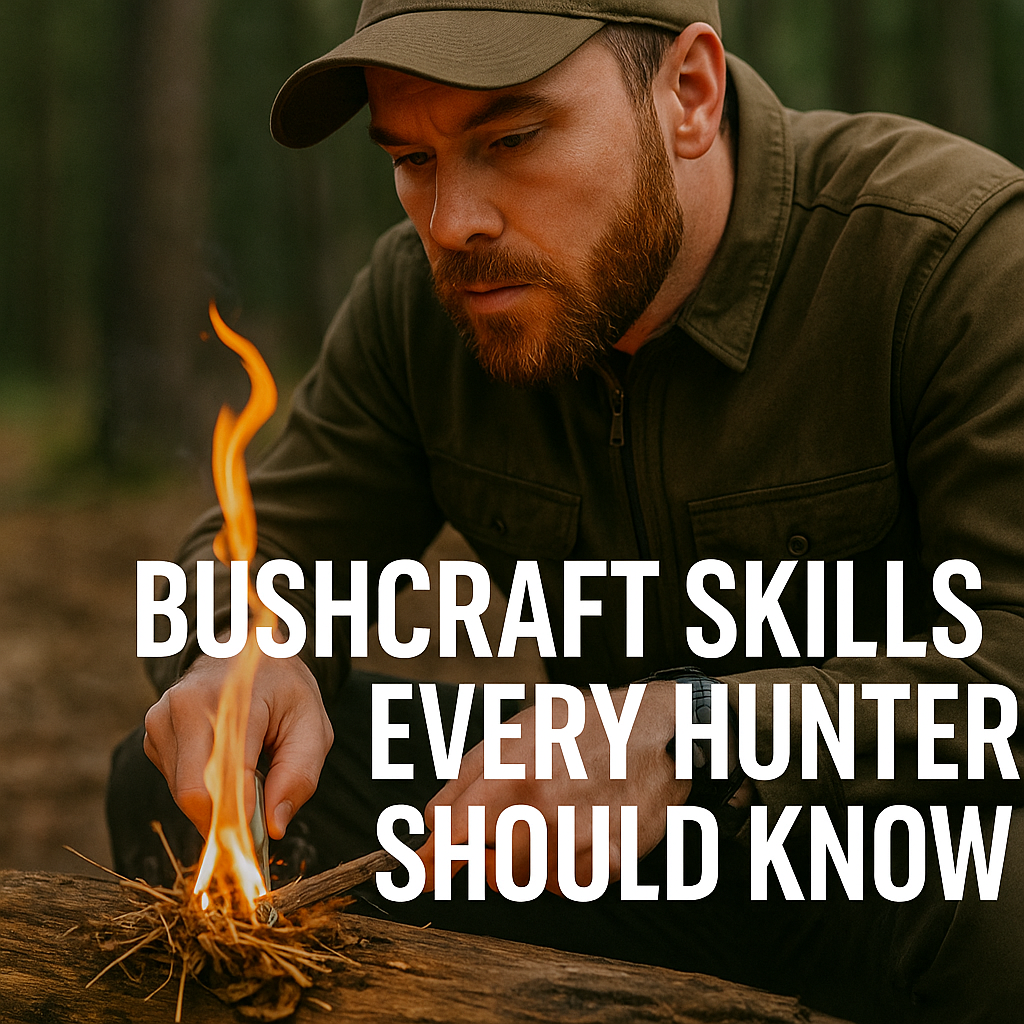
Bushcraft Skills Every Hunter Should Know: Navigation, Shelter, Fire, and Water


Bushcraft skills every hunter should know are the field basics that keep you safe and self-reliant away from the truck: navigation, simple shelter, safe fire use, finding and treating water, basic first-aid awareness, and low-impact travel under Leave No Trace. None of these replace proper training, and the single most protective habit is preparation, telling someone your plan and expected return time before you go. These skills lower your risk and help you stay calm if a hunt runs long or the weather turns, but they are not a substitute for professional medical care or formal wilderness training.

This guide covers the core skills, how they fit a hunting trip, and where to get real training. The principles here are general preparation, not survival-medical certainty. For first aid and wilderness medicine, learn from qualified instructors, and follow established outdoor guidance such as the National Park Service Ten Essentials and the Leave No Trace seven principles.

Table of contents

Preparation comes first

The most valuable bushcraft skill happens before you leave home. Tell someone reliable exactly where you are going, your planned route, and when you expect to be back, then check in when you return. If you do not come back on time, that person can get help to the right place quickly.

Round out that habit by checking the weather forecast, knowing the terrain and access, carrying the right gear for the conditions, and keeping your phone charged with a backup power source. Cell coverage is unreliable in the backcountry, so consider a map and compass and, for remote areas, a satellite communicator or personal locator beacon. Preparation prevents far more emergencies than any improvised survival trick resolves.

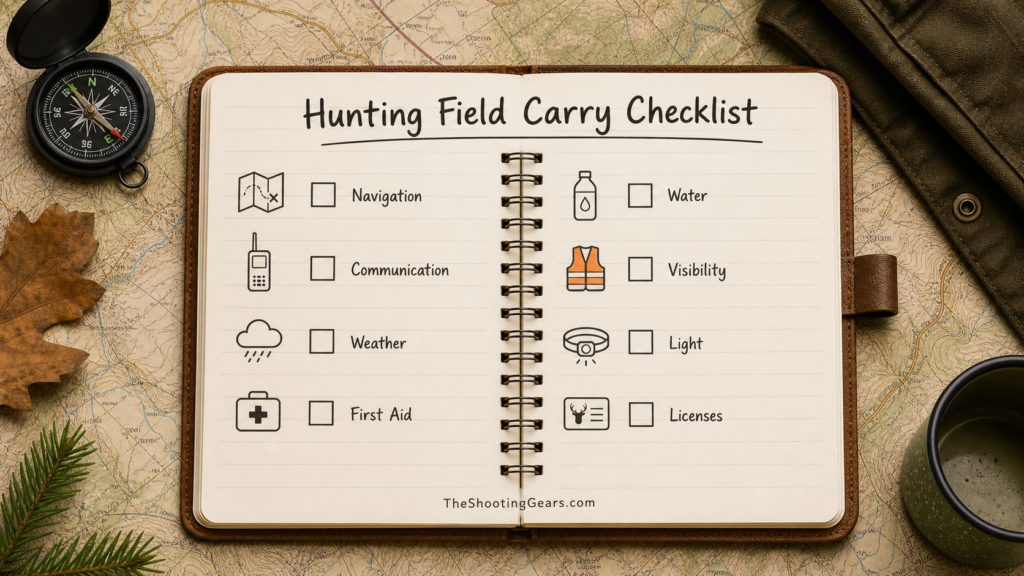
The Ten Essentials for hunters

The Ten Essentials is a widely used outdoor packing framework that covers the categories of gear you may need if a trip goes wrong. It is a sound base for any hunter heading into the backcountry.

  • Navigation: map, compass, and a charged GPS or phone.
  • Headlamp or flashlight, with spare batteries.
  • Sun protection: hat, sunglasses, and sunscreen.
  • First-aid supplies suited to your trip and training.
  • A knife and a basic repair kit.
  • Fire: a reliable lighter or matches and a fire starter.
  • Emergency shelter, such as a bivy or space blanket.
  • Extra food beyond what you plan to eat.
  • Extra water and a way to treat more.
  • Extra insulating clothing for the worst likely conditions.

See the full, current list and explanations on the National Park Service Ten Essentials page. Adapt it to your hunt, your season, and your distance from help.

Navigation is the skill that keeps you found. Before the hunt, study a map of the area and identify clear landmarks, the road or trailhead you started from, and natural boundaries like ridgelines, creeks, and field edges that can guide you back.

Carry a physical map and compass and know how to orient the map and take a bearing, because batteries die and signal fails. A GPS or phone app is a strong primary tool, but treat the map and compass as the backup that always works. If you become unsure of your location, the standard guidance is to stop, stay calm, and avoid wandering deeper. Many lost-person situations get worse from continuing to move without a plan. Learn basic map and compass skills from a qualified course or experienced mentor before you rely on them.

Shelter basics

Shelter protects you from wind, rain, cold, and heat, which is why an emergency shelter belongs in your pack even on a day hunt. A lightweight bivy sack, an emergency space blanket, or a compact tarp can preserve body heat and keep you dry if you are stuck out longer than planned.

If you ever need to improvise, the priorities are getting out of the wind and off the cold or wet ground, and creating a barrier that traps warmth. A simple lean-to or a debris shelter using natural material and a tarp can work, but practicing the basics at home in good conditions is far better than learning under stress. The reliable move is to carry an emergency shelter so you rarely have to improvise at all.

Fire safety

Fire provides warmth, the ability to dry gear, a signal, and a morale boost in a hard situation, but it carries real responsibility. Carry at least two reliable ignition sources, such as a lighter and waterproof matches, plus a dedicated fire starter, and keep them dry in your pack.

  • Check current fire restrictions and burn bans before your trip, since dry conditions often close fires entirely.
  • Build fires only where allowed, clear the area down to bare ground, and keep the fire small and controlled.
  • Never leave a fire unattended, and keep water or dirt on hand to extinguish it.
  • Put the fire out completely, until it is cold to the touch, before you leave.

Wildfire risk is serious, and an escaped fire can cause harm and legal liability. Follow the fire rules from the land manager for your area, and follow the campfire guidance in the Leave No Trace principles.

Water awareness

Staying hydrated keeps you thinking clearly and moving safely, so carry enough water for your planned trip plus a margin, and carry a way to treat more if you may run out. Dehydration impairs judgment and stamina well before it becomes an emergency.

Backcountry water can carry pathogens that cause illness, so treat any water you collect rather than drinking it untreated. Common methods include filtering, chemical treatment, and boiling. The right choice depends on your gear and the water source, so learn proper treatment before you depend on it. The Centers for Disease Control and Prevention publishes general guidance on safe water practices that is a useful reference for understanding the risks.

First-aid awareness

First-aid awareness means knowing the basics, carrying a kit you can actually use, and recognizing when a situation needs professional help. This article does not teach medical treatment. The right step is hands-on training from a qualified provider.

Carry a first-aid kit matched to your trip and your training, and consider a wilderness first aid or first-aid and CPR course, especially if you hunt far from a road. Knowing how to manage a minor wound, stay warm, and stabilize a situation while you get help is realistic and valuable. Treating a serious injury yourself in the backcountry is not, so plan to reach professional care, and in a true emergency, call for help and follow the instructions of emergency services. Look for recognized training such as American Red Cross courses or a wilderness first aid program.

Weather, clothing, and warmth

Cold and wet are common and dangerous in the field, and managing them is a core skill. Dress in layers you can add or shed, favor materials that stay warm when damp over cotton, which loses insulation when wet, and pack a layer for worse conditions than you expect.

Watch for early signs of getting too cold, such as persistent shivering and clumsiness, and act before it worsens by adding layers, getting out of the wind, drying off, and warming up. Hot weather brings its own risks, so manage heat, sun, and hydration as deliberately as you manage cold. Knowing the forecast and matching your clothing to it prevents most weather problems before they start.

Leave No Trace for hunters

Low-impact travel protects the places you hunt and the access you depend on. Leave No Trace is a set of principles for minimizing your impact outdoors, and it fits hunting well.

  • Plan ahead and prepare so you do not improvise at the land’s expense.
  • Travel and camp on durable surfaces, and pack out all trash.
  • Dispose of waste properly, and follow local rules for any game remains.
  • Minimize campfire impact, and follow current fire restrictions.
  • Respect wildlife and other people sharing the area.

Read the full guidance on the Leave No Trace seven principles page. Following these habits keeps hunting areas healthy and helps protect access for everyone.

Frequently asked questions

What is the single most important thing to do before a backcountry hunt?

Tell someone reliable your exact plan, route, and expected return time, then check in when you get back. If you do not return on time, that person can direct help to the right area. This one habit prevents and shortens more emergencies than any field trick.

Do I really need a map and compass if I have a GPS?

Yes. A GPS or phone is a great primary tool, but batteries die and signal fails in the backcountry. A physical map and compass always work, so carry both and learn to use the map and compass as your reliable backup.

Is it safe to drink water from a stream while hunting?

Not without treating it. Backcountry water can carry pathogens that cause illness even when it looks clean. Filter, chemically treat, or boil water before drinking, and learn proper treatment for your gear before you rely on it.

How much first aid should a hunter know?

Enough to handle minor issues, stay warm, stabilize a situation, and recognize when to get professional help. Carry a kit you can use and consider a first-aid, CPR, or wilderness first aid course. Serious injuries need professional care, so plan how to reach it.

Final takeaway

The bushcraft skills that matter most for hunters are practical and preventive: prepare and tell someone your plan, navigate with a map and compass backup, carry emergency shelter, use fire safely, treat your water, build real first-aid awareness, manage cold and heat, and travel under Leave No Trace. These skills lower your risk and raise your self-reliance, but they do not replace professional medical care or formal training. Build them through qualified courses and steady practice, prepare for the conditions you will face, and always leave a plan behind before you head into the field.

Hunting Field Carry Checklist: What to Bring for Safety and Weather

A hunting field carry checklist is the set of safety, navigation, weather, water, light, and paperwork essentials you bring so a normal hunt stays manageable if conditions change. Here, “EDC” simply means everyday field essentials for a lawful hunt, not tactical gear or self-defense carry.

Use this checklist as a starting framework, then adapt it to your season, terrain, weather, distance from help, physical needs, and current local rules. It is general preparedness information, not legal or medical advice.

What This Checklist Means by Field Essentials

Field essentials are the practical items that help a hunter stay oriented, reachable, warm and dry, hydrated, visible, and prepared for minor problems. A short morning sit close to the truck does not need the same pack as a long backcountry day, so the goal is a thoughtful kit rather than a huge one.

Recognized outdoor preparedness frameworks cover similar ground. The National Park Service Ten Essentials is a useful high-level reference, and IHEA-USA is a good starting point for hunter education context.

Carry a way to know where you are and how to get back. Many hunters use a GPS device or phone app, but electronics can fail, lose signal, or run out of battery. A map and compass remain useful backups if you know how to use them.

Before you leave, tell someone where you are going, your expected return time, and what vehicle you are using. For device-specific context, see our guide to GPS devices for tracking hunting locations.

Communication

A charged phone is the common primary communication tool, and a power bank is a simple backup. In areas with poor or no cell service, hunters may consider a two-way radio, satellite communicator, or personal locator beacon and should learn how it works before relying on it.

An emergency contact card in your pack is also useful. Include your name, emergency contact, relevant medical notes, and the area you planned to hunt.

Weather Protection

Weather can change quickly in the field. Pack for conditions worse than the forecast, especially when cold, rain, wind, or heat could affect your return. A layered clothing system, waterproof or wind layer, and season-appropriate hand and head protection are common starting points.

Cold and wet conditions raise exposure risk, while hot weather increases dehydration and heat-stress risk. Check the forecast before leaving and adjust your route, clothing, and water plan accordingly.

First Aid

Carry a basic first aid kit sized to the hunt and know how to use what is inside. Common contents include supplies for cuts, blisters, minor wound care, and any personal medications you need. The kit should match your skill level; gear you cannot use is not much help under stress.

This is general preparedness, not medical advice. For remote hunts or longer trips, a first aid or wilderness first aid course is worth considering.

Water and Hydration

Bring enough water for the planned hunt plus a margin. Dehydration reduces focus, stamina, and decision-making, and it can make both heat and cold stress worse. On longer hunts, carry a way to filter or treat water and follow the product instructions.

Plan water by hunt length, exertion, temperature, and available refill options. There is no single amount that fits every hunter or every day.

Visibility and Safety Marking

Visibility gear helps other people see you in shared hunting areas. Many states require hunter orange or blaze orange for certain seasons and species, but the exact rule depends on the state, hunt type, and current regulation.

Confirm the current requirement with your state wildlife agency before you go. A whistle or other simple signaling item can also help others locate you if you need assistance.

Light

Carry a headlamp or flashlight plus spare batteries or a backup light, even on a day hunt. Hunters often move near dawn or dusk, and plans can run longer than expected. A headlamp keeps your hands available for navigation and pack work.

Licenses, Tags, and Rules

Carry the licenses, tags, permits, and identification your hunt requires. Rules differ by state, season, species, public/private land, and weapon type, and they can change. Check current official regulations before the hunt rather than relying on memory from last season.

For broader gear planning, our guides on key hunting gear essentials and a crucial hunting gear checklist can help you build the rest of the pack.

Safe Transport Considerations

Transport rules for hunting equipment, firearms, bows, ammunition, vehicles, and public land vary by state and situation. This guide cannot give legal certainty. Follow current state wildlife agency rules, applicable transport laws, and manufacturer guidance for safe carry and storage.

When rules are unclear, check the official source or ask the relevant authority before traveling. Do not treat a general gear article as legal advice.

Hunting Field Carry Checklist

Use this as an adaptable starting checklist. Add, remove, or change items based on your hunt, conditions, and local rules.

CategoryStarting Items to Consider
NavigationMap and compass, GPS device or app, known route, shared plan
CommunicationCharged phone, power bank, radio or satellite messenger where coverage is poor, emergency contact card
WeatherLayered clothing, waterproof or wind layer, hand and head protection
First aidBasic kit sized to the hunt, personal medications, wound-care basics
WaterEnough for the trip plus margin, treatment method on longer hunts
VisibilityHunter orange where required, simple signaling item
LightHeadlamp or flashlight, spare batteries or backup light
Licenses and rulesRequired licenses, tags, permits, and current regulations reviewed
TransportCurrent state rules and manufacturer guidance for safe carry and storage
Save the categories, then customize the actual items for your hunt and local rules.

Frequently Asked Questions

What should every hunter carry in the field?

Most hunters plan around navigation, communication, weather protection, first aid, water, visibility, light, and required licenses or tags. Scale each category to your terrain, weather, hunt length, and local rules.

Is this a tactical or self-defense EDC list?

No. In this article, EDC means everyday field essentials for safety, navigation, and comfort on a lawful hunt. It is not a tactical loadout or self-defense carry guide.

Do I have to wear hunter orange?

It depends on your state, season, and species. Many states require hunter orange for certain hunts, and the rules vary. Confirm the current requirement with your state wildlife agency before you go.

How much water should I bring hunting?

Bring enough for your planned time outdoors plus a margin, adjusted for exertion and temperature. On longer hunts, carry a way to filter or treat water and know how to use it.

Carry a reliable way to know your location and route, commonly a map and compass plus a GPS device or app. Learn the area first and share your plan and expected return time with someone you trust.

Final Takeaway

A good hunting field carry checklist is practical, legal, and adaptable. Start with navigation, communication, weather protection, first aid, water, visibility, light, licenses, and transport rules, then adjust the kit to the specific hunt instead of copying a fixed loadout.

Exit mobile version