To clean a handgun properly, start by unloading it, verifying it is clear, and removing all ammunition from the workspace. Then follow the owner manual for your exact handgun. The manual controls how far to field strip it, which surfaces to clean, where lubricant belongs, and how to reassemble it.
This guide covers safe, manual-led basics only. It does not provide model-specific takedown steps, gunsmithing, trigger work, modifications, or repair instructions. If anything is unclear or a part looks damaged, stop and consult the manual, the manufacturer, a qualified instructor, or a gunsmith.
Table of Contents
Safety Checks Before Cleaning A Handgun
Every cleaning session begins with confirming the firearm is unloaded and safe. Treat the handgun as if it is loaded until you have personally verified otherwise.
Point the muzzle in a safe direction at all times.
Remove the magazine, then visually and physically check the chamber to confirm it is empty.
Remove all ammunition from the cleaning area so live rounds and cleaning are never mixed.
Keep your finger off the trigger and follow basic firearm safety rules throughout.
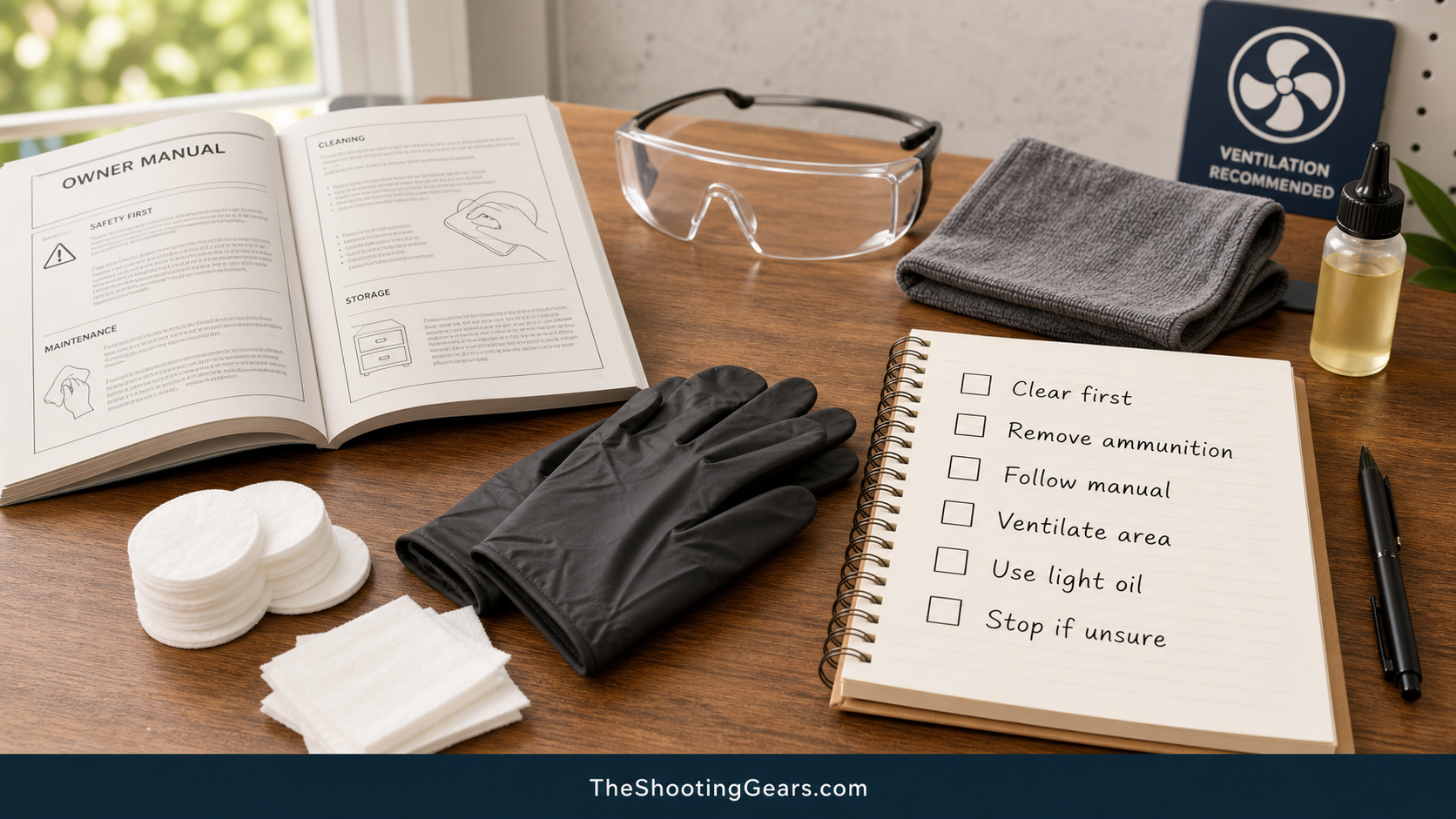
A safe cleaning setup starts with a clear-first checklist, the owner manual, ventilation, and no ammunition on the bench.
Tools And Supplies You Need
Basic handgun cleaning uses a small set of general supplies. Match sizes and products to your owner manual and to the cleaning-product labels.
Cleaning patches and a patch holder or jag.
A correctly sized bore brush.
A cleaning rod or cable.
Bore solvent and a light firearm oil or lubricant.
A cleaning mat to protect the surface and catch debris.
Disposable gloves and eye protection.
Use solvents and oils according to their labels and safety data sheets. This is not a product ranking, so choose supplies that match your handgun, your manual, and your workspace.
Basic Handgun Cleaning Process
The basic order is simple: confirm the gun is clear, field strip per the manual, clean the major parts, then lubricate and reassemble. Keep the work at a routine-maintenance level unless a qualified gunsmith or the manufacturer tells you otherwise.
Clear The Firearm And Remove Ammunition From The Workspace
Before any disassembly, confirm again that the magazine is out and the chamber is empty. Keep all ammunition in a separate location. This separation prevents the most serious cleaning mistakes.
Follow The Manual For Field Stripping
Field stripping differs by handgun, so your owner manual is the authority. Follow the manual for slide removal, recoil spring handling, barrel removal, and reassembly. Do not force parts, and do not disassemble farther than the manual describes for routine cleaning.
Clean The Barrel, Slide, Frame, And Magazines At A High Level
With the handgun field stripped per the manual, clean the major surfaces. Use a solvent-dampened patch and an appropriately sized brush as the manual recommends, then follow with clean patches. Wipe the slide, frame rails, and contact surfaces according to the manual. Wipe magazines only as the manual allows, and avoid soaking them with solvent or oil.
Lubrication And Reassembly
Lubrication and reassembly should follow the exact points and amounts your manual lists. Apply a light film of oil only where the manual indicates, since too much oil can attract debris. Reassemble in the manual’s order, then perform any function check the manual describes with the firearm unloaded and pointed in a safe direction. If reassembly does not feel right, stop and recheck the manual.
Solvent, Lead, And Workspace Safety
Cleaning solvents and oils are chemicals, so handle them according to their labels and safety data sheets. Work in a ventilated area, wear gloves and eye protection when appropriate, and keep solvents away from food, drink, and children. OSHA hazard communication resources explain why labels and SDS information matter when chemicals are used.
Firing-range and cleaning residue can include lead, so basic hygiene matters. Avoid eating or drinking while cleaning, and wash your hands afterward. CDC/NIOSH firing range guidance provides background on range-related lead awareness. This is general safety context, not medical advice.
Common Handgun Cleaning Mistakes
The most common mistakes are skipping the safety check, over-lubricating, and going beyond the manual’s instructions. Other frequent problems include using the wrong brush size, forcing tools through the bore, mixing solvents, using unlabeled chemicals, and trying to repair a damaged part during a routine cleaning session.
If a part is worn, damaged, or behaving abnormally, do not try to modify it yourself. Take the handgun to a qualified gunsmith or contact the manufacturer.
Frequently Asked Questions
How often should I clean my handgun?
Cleaning frequency depends on how often you shoot, ammunition type, conditions, storage, and your manual’s guidance. Many owners clean after range sessions and inspect periodically during storage, but your owner manual should guide the routine.
Can I use any solvent or oil on my handgun?
Use products labeled for firearm cleaning, follow the product label and SDS, and check your manual for product cautions. Avoid improvised chemical mixes and do not combine solvents.
Do I need to fully disassemble my handgun to clean it?
No. Routine cleaning usually only requires field stripping to the level described in your owner manual. Going farther than the manual covers can create reassembly problems and is better left to a qualified gunsmith.
What should I do if a part looks damaged?
Stop and do not fire or force the firearm. Note the issue and take the handgun to a qualified gunsmith or contact the manufacturer. Cleaning is routine maintenance, not repair.
Yes, a 3-9x rifle scope is still a very practical choice for deer hunting when your shots are close to moderate range and you want a simple, familiar optic. It gives enough magnification for many woods, field-edge, and stand-hunting situations without the weight and complexity of larger scopes.
The honest answer depends on your terrain. A 3-9x scope makes sense for many deer hunters, but it is not the best optic for every hunt. Open-country shots, very low light, or precision work at longer ranges may call for a different magnification range or better glass.
A 3-9x rifle scope is still good for deer hunting because it covers the most common field needs: low magnification for closer shots, higher magnification for more careful aiming, manageable size, and a simple setup that many hunters already understand. It is a balanced choice, not a magic answer.
A 3-9x scope remains useful when its magnification, reticle, glass quality, and mounting setup match your actual deer-hunting distances.
3-9x Deer Scope Decision Checklist
Use this checklist before deciding whether a 3-9x is enough for your rifle. The goal is to match the optic to the hunt, not to chase a spec sheet.
Typical distance: Most shots are close to moderate rather than extreme range.
Terrain: You hunt timber, field edges, food plots, or mixed cover.
Light: You need useful dawn/dusk performance but not maximum detail at very high power.
Weight: You prefer a scope that does not make the rifle feel top-heavy.
Simplicity: You want a familiar optic with fewer settings to manage under pressure.
Ethical shot limit: You are willing to pass shots when the target is not clear enough.
What 3-9x Means
A 3-9x scope adjusts from 3x to 9x magnification. At 3x, it gives a wider field of view and is easier to use at closer distances. At 9x, it gives more target detail for careful aiming. For general background on scope design, this telescopic sight overview explains the basic concept of optical sights.
Why Hunters Like the Range
The range is useful because deer hunting rarely happens at one fixed distance. A deer may step out close in timber or appear farther across a field edge. A 3-9x scope lets you keep the scope low while scanning and turn it up only when the shot requires more detail.
Where a 3-9x Scope Works Well
A 3-9x scope is strongest in mixed terrain. It is at home in eastern hardwoods, farm country, food plots, ladder stands, box blinds, and general rifle setups where shots are usually reasonable and the hunter wants speed plus enough magnification for shot placement.
Woods and Field Edges
In woods, lower magnification helps you find the deer faster in the scope. On field edges, 6x to 9x may give enough detail for a more deliberate shot. The exact setting should follow the distance, light, and how clearly you can identify the target and what is beyond it.
Lightweight Rifle Setups
Many 3-9x scopes are lighter and simpler than larger long-range optics. That can help a rifle carry better and shoulder more naturally. Weight matters most for still-hunting, long walks, steep terrain, and hunters who do not want a bulky optic on a compact rifle.
Low-Light Strengths and Limits
Low-light performance is not only about magnification. Glass quality, coatings, objective size, exit pupil, reticle visibility, and your eye position all matter. A good 3-9x hunting scope can be very usable at dawn and dusk, but a cheap scope at 9x may look dim or fuzzy.
The safety rule is simple: if you cannot clearly identify the deer and what is beyond it, do not shoot. The NSSF firearm safety rules are a useful reminder that every optics choice still sits under basic target-identification and backstop responsibility.
Where It Falls Short
A 3-9x scope may not be ideal for hunters who regularly shoot across large open country, need detailed antler evaluation at distance, or want exposed turrets and reticles built for dialing. It may also be less flexible than a lower-power optic for very close, fast shots in thick cover.
That does not make the 3-9x outdated. It means the scope should match the hunt. A western rifle, a thick-woods carbine, and a farm-country deer rifle may all benefit from different optics.
Setup Matters More Than Hype
A well-mounted, properly zeroed 3-9x scope beats a poorly mounted expensive optic. Ring height, eye relief, level reticle, torque, bore-sighting, zero confirmation, and real practice all matter. If the scope does not come to your eye naturally, fix the setup before blaming the magnification range.
Practice at Realistic Distances
Practice at the distances and positions you expect to hunt from. A 3-9x scope can feel easy from a bench and different from a stand, kneeling position, or field rest. Confirm your zero and know where your confidence ends before the hunt.
Ethical Shot Fit
The right scope is the one that helps you identify the animal, pick a clean aiming point, and understand the background before the shot. A 3-9x scope may be plenty for a short field lane, but it may not give enough detail across a wide cutover or open hillside. If magnification, light, or reticle clarity leaves doubt, pass the shot.
Optics do not replace hunting judgment. Hunter education resources such as Hunter Ed emphasize preparation, safe decisions, and knowing your target. Treat the scope as one part of that system, along with rifle fit, ammunition, zero, shooting position, local laws, and the hunter’s real skill.
FAQ
Is a 3-9x scope enough for deer hunting?
Yes, for many deer hunters. It is especially useful in woods, food plots, and mixed terrain where shots are close to moderate range.
Is a 3-9x scope outdated?
No. Newer optics offer more choices, but a clear, reliable 3-9x scope still fits many deer rifles very well.
What magnification should I use in the woods?
Keep it on the low end, often around 3x, so you can find the deer quickly. Turn it up only when distance and time allow.
Should I buy more than 9x for deer?
Consider more magnification if you hunt open country or need more detail at distance. For many common deer setups, 9x is still enough when the shot is ethical and clear.
Final Takeaway
A 3-9x rifle scope is still a smart deer-hunting optic when your terrain and shot distances fit it. Choose clear glass, mount it correctly, practice at real hunting distances, and pass shots when the target is not clear enough. That matters more than chasing a bigger magnification number.
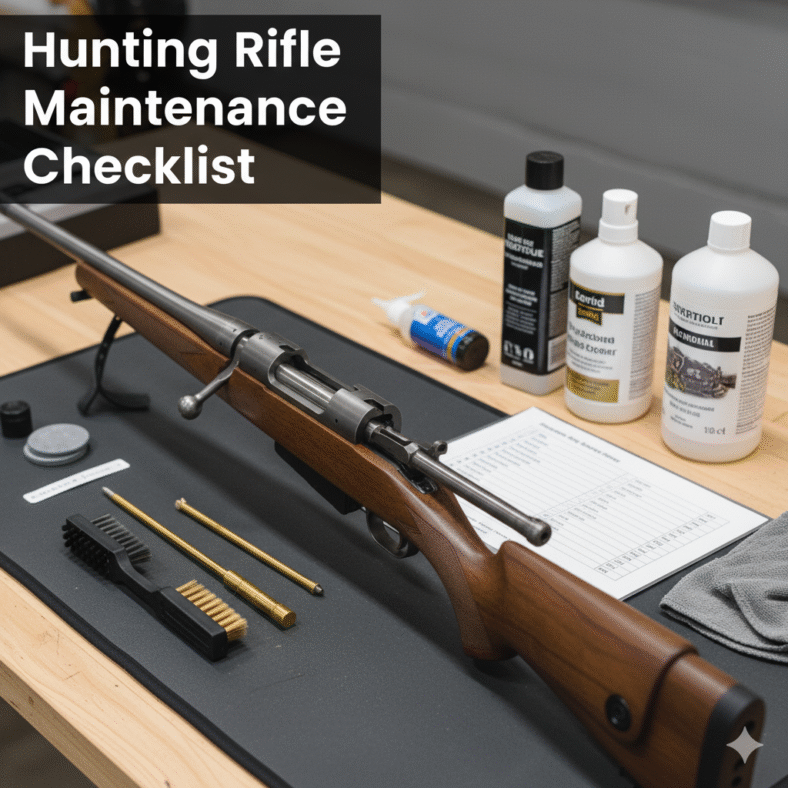
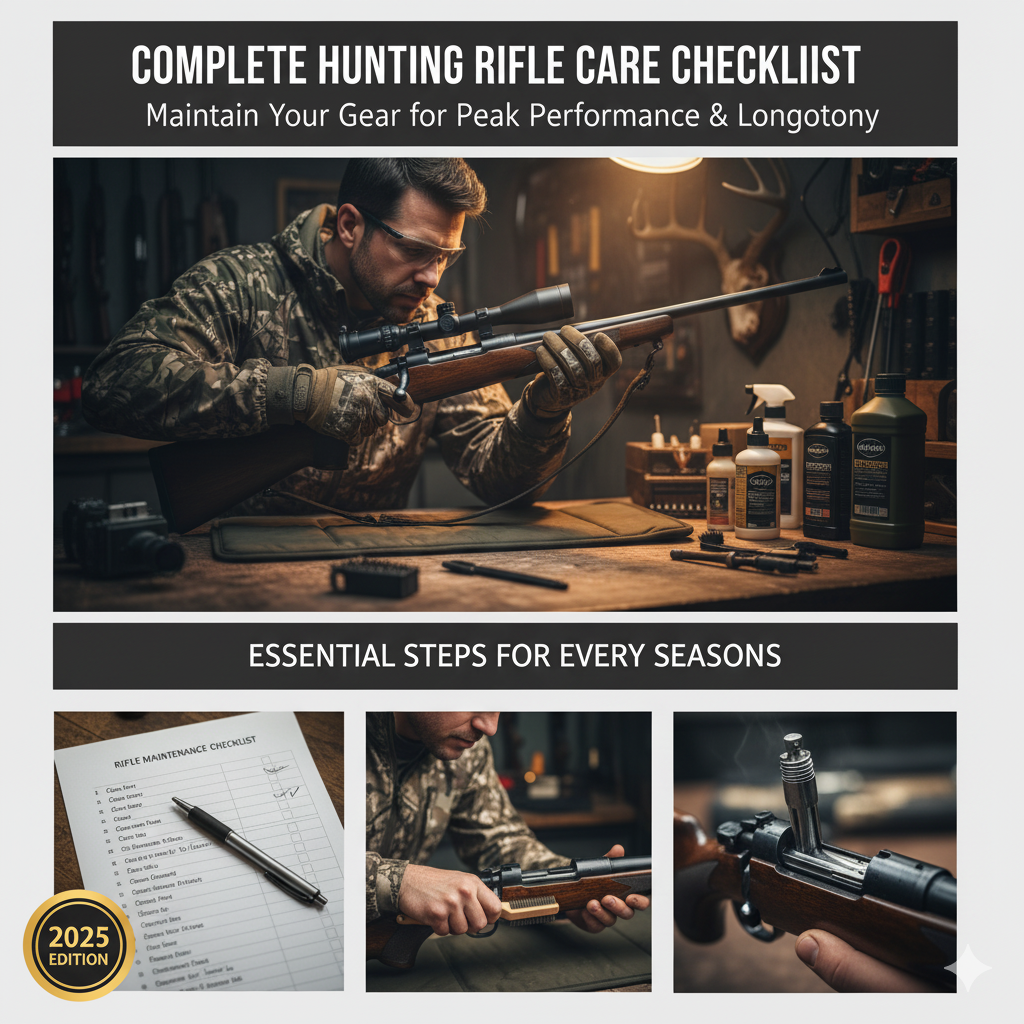
A good hunting rifle maintenance checklist starts with safety, then moves through unloading, inspection, cleaning, lubrication, optic/mount checks, ammunition storage, field protection, and post-hunt care. The goal is not to over-clean or modify the rifle; it is to keep the rifle reliable, protected, and ready for the next legal hunt or range session.
This guide is written for hunters who want a simple routine. Always follow your rifle manual, ammunition guidance, and local range rules. If you find damage, abnormal wear, stuck parts, a blocked bore, or repeated malfunctions, stop using the rifle and get help from a qualified gunsmith or manufacturer support.
Before any maintenance, point the rifle in a safe direction, remove the magazine if applicable, open the action, and verify the chamber is clear according to the manual. Do not rely on memory or assume the rifle is unloaded because it was stored that way.
Separate Ammunition
Move live ammunition away from the cleaning bench. This keeps maintenance work focused and reduces the chance of a handling mistake. The NSSF firearm safety rules are a useful baseline before cleaning or inspecting any firearm.
Before the Hunt
Check the Bore and Action
Confirm the bore is clear, the action cycles normally, and the safety/control functions feel normal. If mud, snow, water, oil, or debris enters the bore, stop and clear it safely before firing.
Confirm Zero
A rifle can shift zero after travel, bumps, new ammunition, or mount changes. Confirm zero at the range before the season when possible. Do not discover an issue on a live animal.
Inspect Ammunition
Use ammunition that matches the rifle markings and manual. Avoid cartridges with corrosion, dents, loose bullets, oil contamination, or moisture damage. SAAMI’s firearm safety information is a good reference for safe ammunition matching and handling principles.
After the Hunt
Dry Moisture First
Rain, snow, sweat, and condensation can create rust risk. After a wet hunt, unload safely, wipe exterior metal, dry the stock and sling area, and let the rifle return to room temperature before long-term storage.
Look for Damage
Check for loose screws, cracked stock areas, damaged sling studs, shifted optic mounts, rust spots, and unusual marks on the bolt or cycling parts. If anything looks abnormal, stop and get qualified help.
Cleaning and Lubrication
Clean for the Conditions
A rifle used in dry, clean conditions may not need the same cleaning as one exposed to rain, dust, mud, salt air, or heavy shooting. Follow the manual for bore cleaning, solvent use, and parts that should or should not be lubricated.
Use Light Lubrication
Too much oil can attract dust, migrate into places it does not belong, or affect ammunition if stored carelessly. Use the correct lubricant sparingly and wipe away excess according to the manufacturer’s guidance.
Avoid Unneeded Disassembly
Field-stripping or basic owner cleaning is different from gunsmithing. Do not remove trigger components, bedding parts, or safety-related parts unless the manual allows it and you are qualified.
Optic and Mount Checks
Check that the scope, rings, bases, and lens covers are secure. Do not guess torque values. If screws are loose or mounts have shifted, follow the optic/ring instructions or ask a gunsmith. After any mount adjustment, confirm zero again.
Clean lenses with lens-safe tools only. Shirt sleeves, rough cloth, dirt, and paper products can scratch coatings. Keep caps closed during rough travel and wet weather.
Seasonal Maintenance Plan
Pre-Season
Before the season, inspect the rifle slowly instead of waiting until the night before opening day. Check screws, sling, optic, bore condition, ammunition, and zero. If you changed ammo, rings, bases, or scope settings, schedule range time before the hunt.
In-Season
During the season, keep the routine simple: protect the muzzle from debris, wipe off moisture, check the optic, and inspect the rifle after rough travel. A quick inspection after every outing prevents small problems from becoming field problems.
Post-Season
After the season, do a more complete cleaning and inspection before storage. Look for rust beginning under sling swivels, around scope mounts, near the muzzle, and in areas touched by wet hands or clothing. Store the rifle only after it is dry and protected.
Storage and Transport
Store the rifle unloaded, protected from unauthorized access, and in conditions that reduce rust risk. Project ChildSafe provides practical secure storage resources for firearm owners. Use a case for transport, but avoid leaving a damp rifle sealed in a soft case for long periods.
Common Maintenance Mistakes
Cleaning while rushed: hurried work leads to missed chamber checks, spilled solvent, and skipped inspection steps.
Using too much oil: excess lubricant can collect grit and move into places where it is not wanted.
Skipping the optic: loose rings or a shifted scope can ruin an otherwise good rifle setup.
Forgetting the sling and stock: water can hide around sling studs, stock inlets, and soft-case contact points.
Changing ammunition without checking zero: a new load can shift point of impact.
Storing after wet weather: a rifle that looks dry outside can still have moisture in hidden areas.
The best habit is to keep maintenance boring and repeatable. Use the same safe order every time: unload, verify, separate ammunition, inspect, clean only as needed, lubricate lightly, and store securely. A short written checklist can help you avoid skipping steps when travel or weather makes the day hectic.
Quick Checklist
Unload and verify chamber clear.
Move ammunition away from the cleaning bench.
Inspect bore, crown, action, and safety/control feel.
Check optic, rings, bases, sling, and stock condition.
Wipe moisture and dirt after every field outing.
Clean bore and action based on use and conditions.
Lubricate lightly according to the manual.
Inspect ammunition before loading for range or hunt use.
Confirm zero after travel, bumps, mount work, or ammo changes.
Store unloaded and secured from unauthorized access.
FAQ
Should I clean my hunting rifle after every hunt?
At minimum, inspect and wipe it down after every hunt. A full bore cleaning depends on weather, dirt, moisture, number of shots, and the rifle manual.
Can over-cleaning hurt accuracy?
Aggressive or improper cleaning can damage crowns, bores, or finishes. Use correct tools and follow the manual instead of scrubbing blindly.
When should I confirm zero?
Confirm zero before hunting season, after travel, after hard bumps, after scope/mount work, and when changing ammunition.
Should I oil the inside of the barrel for storage?
Follow the rifle manual and product instructions. If a bore is stored with oil, clear and inspect it according to the manual before firing.
What if my rifle gets soaked?
Unload safely, dry exterior surfaces, inspect for water in the bore or action, and clean/lubricate according to the manual. If you suspect hidden water, rust, or damage, get qualified help.
Final Takeaway
Hunting rifle maintenance is mostly about safe habits and regular inspection. Keep the rifle unloaded during maintenance, protect it from moisture and dirt, clean according to use, confirm zero when needed, and store it securely. A simple routine done consistently is better than rushed cleaning right before the hunt.
Scouting upland birds means learning where pheasant and quail find cover, food, water, and escape routes, then planning safe, legal field movement before the hunt. Good scouting is mostly habitat reading, access planning, and safety awareness. It never guarantees birds will be there, and it never replaces target identification.
This guide focuses on pheasant and quail habitat clues, safe movement with partners and dogs, and the regulation checks every hunter should make through current official sources. Season dates, bag limits, blaze-orange rules, licenses, access rules, and legal methods vary by state and year.
Table of Contents
Upland Bird Scouting Basics
Scouting for upland birds is the process of identifying likely habitat, safe access points, and field boundaries before the hunt. The goal is to narrow a large area down to a few spots worth walking, based on cover quality, food, water, pressure, and safe shooting layout.
Cover: birds need protection from weather and predators.
Food: crop edges, weed seeds, insects, and waste grain can concentrate birds.
Water: moist low spots and water edges matter more in dry country.
Edges: transitions between cover and food often deserve extra attention.
Escape routes: birds need somewhere to run or fly when pressured.
Pressure: heavily walked areas may push birds into thicker or less obvious cover.
Treat these as clues, not promises. Regional habitat differs, so compare what you see with habitat guidance from groups such as Pheasants Forever and Quail Forever.
Pheasant Habitat and Sign
Pheasants favor dense nesting or loafing cover near reliable food, with thick escape cover close by. Look for grassy fields, cattail sloughs, shelterbelts, weedy fence lines, and the edges of standing or harvested crops.
Cover, food, water, and escape routes
The most useful spots usually combine thick cover, a nearby food source, and a way for birds to escape pressure. Grassy or weedy strips that connect larger cover blocks can act as travel lanes. In dry regions, low wet areas can also draw birds.
Pressure, weather, and time of day
Hunting pressure can push pheasants into the thickest cover and make them run before flushing. Early and late in the day, birds often move toward food. Midday, they may sit tighter in heavier cover. Wind, rain, and snow can change where birds shelter, so re-scout after major weather or pressure changes.
Quail Habitat and Sign
Quail are covey birds that favor a patchwork of low woody cover, open ground underneath, and seed-producing plants nearby. Brushy edges, field borders, fence rows, and shrubby draws are common places to start looking.
Covey cover and edge habitat
Quail need overhead cover for protection, room at ground level to move, and food close enough that they do not have to expose themselves for long. Edge habitat where brush meets field or grassland often provides that mix in a small area.
Regional differences to verify
Quail species and habitat vary widely by region. Before relying on one pattern, confirm what local quail habitat looks like through Quail Forever, local habitat programs, and your state wildlife agency. Good-looking cover improves odds, but it does not guarantee a covey is present.
Safe Field Movement and Shot Awareness
Safe upland hunting depends on muzzle control, partner awareness, dog awareness, and clear target identification. Follow established firearm safety rules from sources such as the NSSF firearm safety rules and your hunter education program.
Keep the muzzle pointed in a safe direction, including when crossing fences or ditches.
Agree on safe zones of fire before walking.
Identify the bird and confirm a safe background before mounting the gun.
Know where partners and dogs are before any shot.
Do not shoot at sound, movement, low birds, skylined birds, or unknown ground.
Upland gear should support safe walking, clear communication, and comfort without turning the hunt into a heavy loadout. Common considerations include sturdy boots, brush-resistant clothing, hearing and eye protection, water, and a way to carry birds. Many states require hunter-orange clothing for upland hunting, but the exact rule must be checked through the current state source.
For dogs, plan around conditioning, water, weather, terrain, and clear handling. A dog can help locate birds, but the hunter remains responsible for target identification, safe zones of fire, and knowing what is beyond the bird. Plan shots around the dog’s position, not the other way around.
Season, Land Access, and Regulation Checks
Season dates, bag and possession limits, license and stamp requirements, blaze-orange rules, shooting hours, dog rules, and public/private land access all change by state and season. Check your current state wildlife agency pages before scouting or hunting.
For access planning context, our public land hunting guide is a useful companion, even though upland access rules still need to be verified for the exact state and property. For broader beginner hunting habits, see deer hunting tips for beginners.
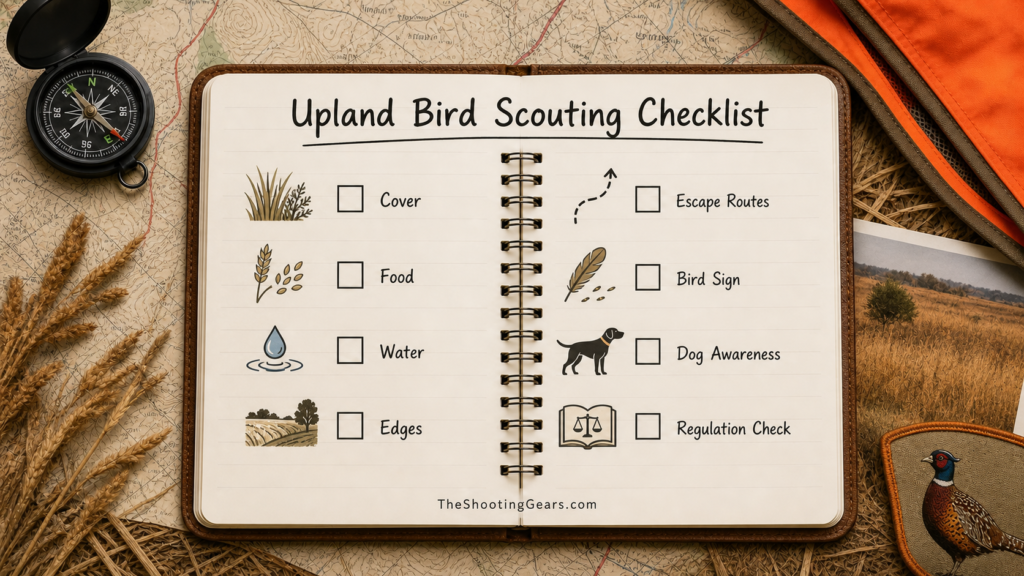
Upland Bird Scouting Checklist
Scouting Check
What to Look For
Cover
Grass, cattails, brush, shelterbelts, fence rows, and shrubby draws
Food
Crop edges, weed seeds, insects, waste grain, and seed-producing plants
Water
Moist low spots, nearby water, and cover close to water in dry country
Edges
Transitions where food, cover, and open ground meet
Escape routes
Thicker cover birds can run or fly into when pressured
Bird sign
Tracks, droppings, dusting areas, feathers, flushes, and calls
Dog awareness
Dog position, range, hydration, and safe zones of fire
Regulation check
Season, license, limits, blaze orange, access, and legal methods
Use the checklist to plan the walk, then verify current rules and safe shooting lanes before hunting.
Frequently Asked Questions
When is the best time of day to scout upland birds?
Early morning and late afternoon are often useful because birds may move toward food. Midday scouting can still reveal cover, sign, and access points even when birds are sitting tight.
How do I find pheasant or quail without trespassing?
Start with public hunting lands and access programs listed by your state wildlife agency. For private land, get clear permission before scouting or hunting. Access rules vary, so verify them through official sources.
Does good habitat guarantee I will find birds?
No. Habitat tells you where birds are more likely to be, not that they are present. Pressure, weather, food availability, and season timing all affect whether birds are using a spot.
Do I still need to identify my target if I am hunting with a dog?
Yes. A dog can help locate and flush birds, but you must always identify the bird, confirm a safe background, and know where the dog and partners are before any shot.
What clothing color is required for upland hunting?
Many states require hunter orange or blaze orange for upland hunting, but the amount and placement vary. Check your state wildlife agency’s current rules before hunting.
Final Takeaway
Scout upland birds by reading cover, food, water, edges, escape routes, pressure, and bird sign, then layer in safe field movement and current regulation checks. Habitat can guide your plan, but safe target identification, dog awareness, partner communication, and official rules decide whether the hunt is responsible.
A safe hunting rifle maintenance routine starts by unloading the rifle, opening the action, removing all ammunition from the cleaning area, and following your rifle’s manufacturer manual. Basic post-hunt care then means drying exterior metal, checking for moisture, cleaning the bore only as the manual directs, applying light lubrication only where specified, and storing the rifle unloaded in a secure place.
This checklist is for manual-led basic care and rust prevention. It does not cover trigger work, headspace, bedding, chamber work, or model-specific disassembly. If anything looks damaged, functions oddly, or is unclear in the manual, stop and take the rifle to a qualified gunsmith.
Table of Contents
Safe Rifle Maintenance Starts Before Cleaning
Every maintenance session begins with making the rifle safe. Unload it, open the action, visually and physically confirm the chamber and magazine are clear, and move all ammunition away from the work surface before any cleaning tool comes out. Keep the muzzle pointed in a safe direction throughout the process.
Before you clean, review established firearm safety rules such as the NSSF firearm safety rules, then read the cleaning section in your rifle manual. The manual is the authority for what can be opened, what should be left alone, and how to handle your exact model.
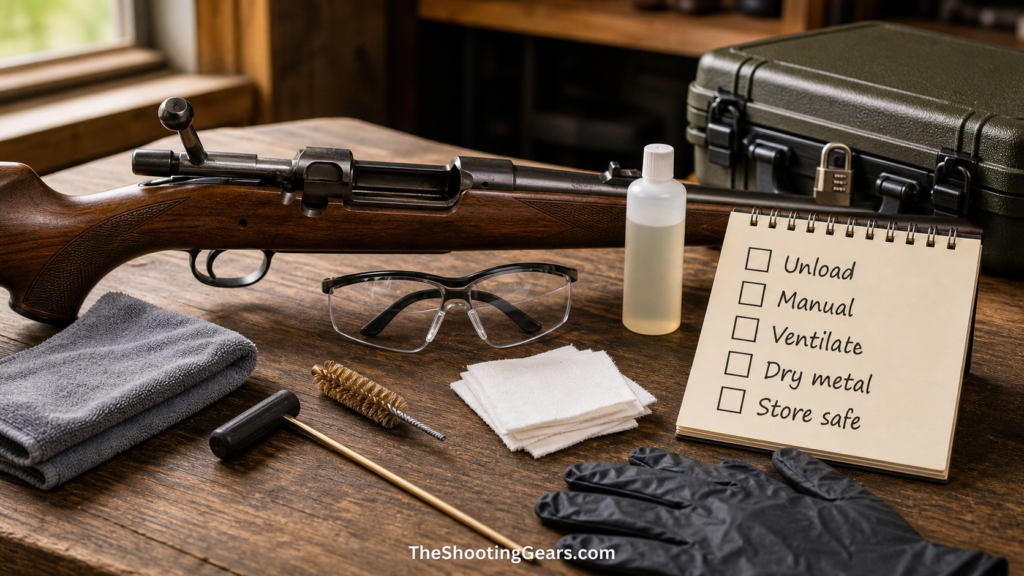
A safe maintenance routine starts with an unloaded rifle, the manual, ventilation, dry metal, and secure storage.
Unload the rifle and open the action.
Confirm the chamber and magazine are empty.
Remove all ammunition from the cleaning area.
Keep the muzzle pointed in a safe direction.
Have the specific rifle manual on hand.
Set up in a ventilated area suitable for solvents.
Basic Post-Hunt Maintenance Checklist
Basic post-hunt maintenance focuses on moisture, fouling, visible wear, and safe storage. After confirming the rifle is unloaded and clear, work slowly through the checklist instead of rushing straight to the bore.
Unload, Clear, and Separate Ammunition
Confirm again that the rifle is unloaded and the action is open. Keep ammunition separated from the cleaning bench for the entire session. Never have live rounds near solvents, lubricants, or the cleaning surface, and never store the rifle loaded.
Dry Exterior Metal and Inspect for Moisture
Wipe down exterior metal to remove water, sweat, fingerprints, and field grime, especially after rain, snow, or humidity. Look for early rust or pitting, and check that the bore is free of obstructions before storage. Do not dry-fire or function-test unless the manual specifically allows it and all safety checks are complete.
Bore, Action, and Exterior Care
Bore, action, and exterior care should follow the rifle manual’s procedure for your model. Use proper tools, correct patch and brush sizes, and cleaning chemicals according to their labels. Do not force rods, brushes, or patches, and do not improvise procedures the manual does not describe.
Follow the Rifle Manual for Bore Cleaning
Clean the bore according to the manual using a proper rod or cable, jag or brush, and patches sized for the bore. Stop if a tool binds, a patch will not pass normally, or you suspect a bore obstruction. For cartridge and chamber terminology, SAAMI technical information is a useful standards reference, but your rifle manual still controls the actual cleaning method.
Use Solvents and Lubricants Carefully
Cleaning solvents and lubricants are chemicals. Use them only as directed, work with ventilation, avoid eating or drinking while cleaning, and wash your hands afterward. Lead residue can be part of shooting environments; the CDC/NIOSH publication on preventing lead and noise exposures at indoor firing ranges and OSHA hazard communication guidance are helpful references for why labels and safety data sheets matter.
Apply lubricant lightly and only where the manual specifies. Over-lubrication can attract debris, and using improvised chemicals can create avoidable problems. Never spray oil into ammunition.
Storage and Rust Prevention
Rust prevention depends on drying the rifle, applying a light protective film where the manual allows, storing it securely in a dry environment, and inspecting it periodically. Moisture is the main enemy after wet hunts, sweaty handling, or transport through changing temperatures.
Make sure the rifle is fully dry before storage.
Apply a light protective oil to exterior metal where the manual allows.
Store the rifle unloaded in a secure, dry, temperature-stable place.
Avoid sealed cases for long-term storage if they trap humidity.
Inspect stored firearms periodically for moisture or rust.
Use secure storage to keep firearms away from unauthorized users.
For secure storage practices, Project ChildSafe is a useful public safety resource. A cleaned and oiled rifle still needs periodic checks because storage conditions change with the seasons.
What to Leave to a Gunsmith
Anything beyond manual-led cleaning, light lubrication, and exterior care should be left to a qualified gunsmith, especially work involving internal parts, function, fit, or safety-critical adjustments. Trying model-specific disassembly without the right training and tools can create safety problems.
Damaged, worn, broken, or missing parts.
Failure to feed, extract, or eject.
A suspected bore obstruction.
Trigger feel that has changed or seems unsafe.
Disassembly the manual does not clearly describe.
Any uncertainty about whether the rifle is safe to use.
This guide does not cover trigger adjustment, bedding, headspace, chamber work, or model-specific disassembly. Cleaning is not a substitute for a professional safety inspection, so a gunsmith is the right call whenever something seems off.
Frequently Asked Questions
How often should I clean my hunting rifle?
Cleaning frequency depends on how much you shoot, the conditions you hunt in, and your manufacturer’s guidance. Many hunters do basic care after each hunt or range session, with more thorough cleaning as the manual recommends. Clean sooner if the rifle was exposed to rain, snow, mud, or saltwater.
What do I need to clean a rifle safely?
At a basic level, you need the rifle manual, a proper cleaning rod or cable, a jag or brush and patches sized for the bore, appropriate solvent, light lubricant, eye protection as appropriate, and a ventilated work area. Remove all ammunition before cleaning.
Can I store my rifle after oiling it without further checks?
No. Even a cleaned and oiled rifle should be inspected periodically because temperature and humidity changes can still cause moisture problems. Store the rifle unloaded, dry, and secure, then check it from time to time.
Is it safe to take apart my rifle for a deep clean?
Only to the extent your manufacturer manual clearly describes for your exact model. Disassembly beyond manual basics, along with trigger, bedding, headspace, and chamber work, is gunsmithing and should be left to a qualified professional.
Do I need eye protection and ventilation to clean a rifle?
Yes, as appropriate. Solvents and lubricants are chemicals, and residue from shooting can be present. Work in a ventilated area, use eye protection where appropriate, avoid eating or drinking while cleaning, follow product labels and safety data sheets, and wash your hands afterward.
When dark clouds roll in and rain starts falling, many hunters pack up their gear and call it a day. But experienced hunters know something most don’t rainy days can be some of the most productive times to hunt. The wet weather often dampens sound, masks scent, and encourages animals to move more freely without fear of predators.
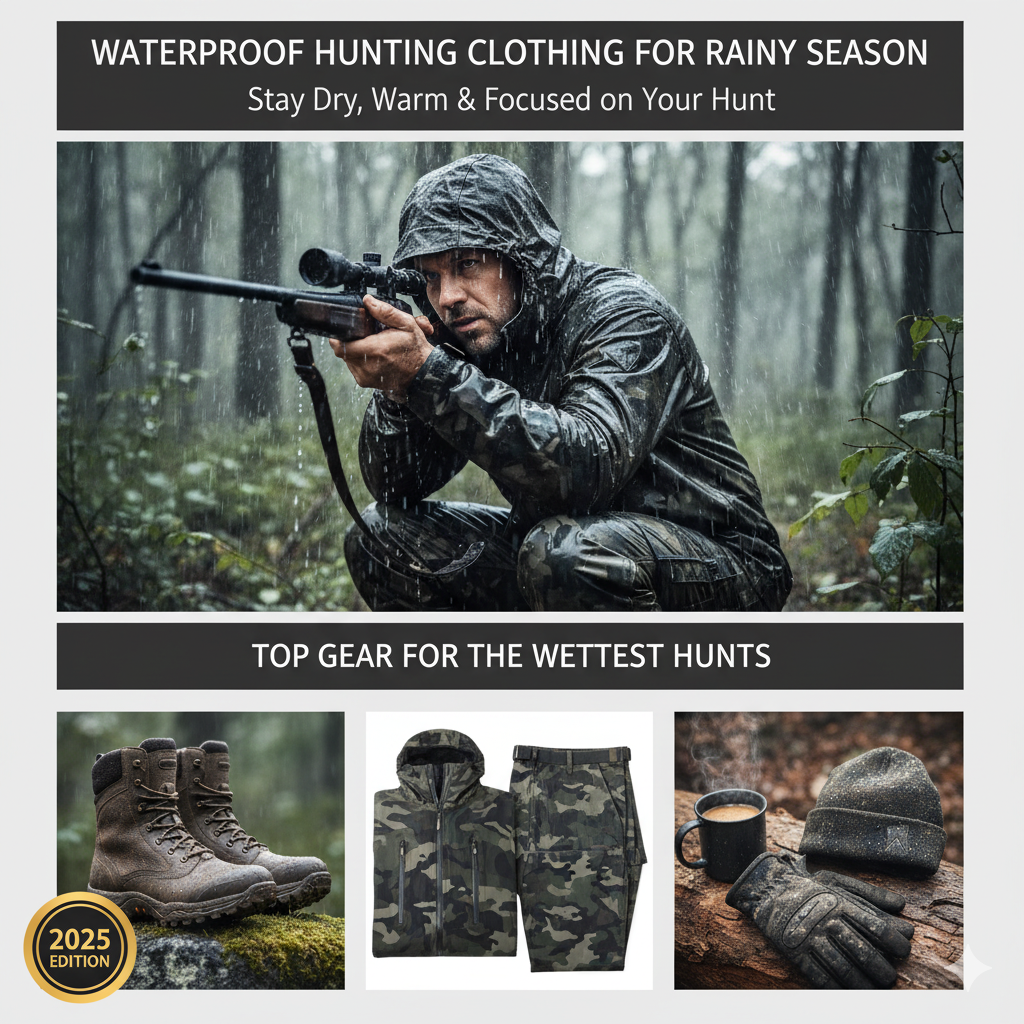
However, there’s one thing that can make or break your hunt: your clothing. Without the right waterproof hunting gear, you’ll end up soaked, cold, and uncomfortable within minutes forcing you to leave the field early. On the other hand, high-quality waterproof hunting clothing allows you to stay dry, warm, and focused even during hours of steady rain.
In this guide, we’ll explore the best waterproof hunting clothing for the rainy season, how to choose the right materials, and how to layer effectively to stay comfortable no matter what Mother Nature throws your way.
Key Features to Look for in Waterproof Hunting Clothing
When it comes to hunting gear, “waterproof” doesn’t just mean keeping the rain off your shoulders. The ideal rain gear must repel water, allow breathability, and maintain silence all while providing comfort and flexibility for long days outdoors.
Let’s break down the must-have features.
1. Breathability and Waterproof Rating
One of the biggest mistakes hunters make is assuming all waterproof materials are equal. Some repel rain effectively but trap heat and sweat inside, leaving you just as wet from condensation. That’s why breathability is as important as waterproofing.
Modern hunting jackets and pants use laminated membranes like GORE-TEX®, eVent®, or Toray Dermizax®, which feature microscopic pores that block rain but allow vapor from sweat to escape.
When checking specs, you’ll often see a waterproof rating (in millimeters).
10,000mm – Handles light to moderate rain.
20,000mm or higher – Suitable for heavy downpours and long exposure.
For rainy-season hunting, aim for at least 15,000mm waterproofing and 15,000g breathability to stay comfortable through changing weather conditions.
2. Quiet Fabric Technology
Every hunter knows that noise kills opportunity. You could have the best rain protection in the world, but if your jacket sounds like a plastic bag every time you move, you’ll spook your prey instantly.
This is where quiet fabric technology becomes essential. Look for soft-shell or brushed polyester outer layers designed to be silent even in motion. Many premium brands like Sitka Gear and First Lite use specially engineered materials that combine waterproof membranes with ultra-quiet outer shells giving you stealth and protection simultaneously.
3. Camo Patterns That Work in Wet Conditions
The rainy season changes the environment. Greens turn darker, and reflective surfaces appear on leaves and mud. Choosing the right camouflage pattern can make all the difference in blending with your surroundings.
Some effective options include:
Realtree MAX-5®: Perfect for wetlands, marshes, and waterfowl hunting.
Mossy Oak Bottomland®: Ideal for wooded areas and forest floors.
Sitka Subalpine™: Great for stalking in open grasslands or mountain slopes.
When selecting your rain gear, match your camo pattern to the terrain you hunt most often it’s not just about looks, it’s about invisibility.
The Ideal Layering System for Wet Weather Hunts
Even the best rain jacket won’t perform well without a smart layering system underneath. Layering helps you regulate temperature, wick moisture, and stay dry inside and out.
Here’s how to layer effectively for rainy-season hunts.
Base Layer – The Moisture-Wicking Foundation
Your base layer is the clothing that sits directly against your skin. Its job is to pull sweat away from your body and keep you dry.
Avoid cotton at all costs once it gets wet, it stays wet and quickly chills your body. Instead, opt for materials like merino wool or synthetic blends (polypropylene or polyester). These fabrics wick away moisture while maintaining warmth, even when damp.
Brands like Icebreaker, Smartwool, and Under Armour Base 3.0 are excellent for moisture control and comfort during long hunts.
Mid Layer – The Insulating Core
The mid layer provides insulation, trapping body heat while still allowing moisture to escape. It’s your temperature control layer you can remove or add it as the weather changes.
Popular mid-layer options include fleece pullovers, lightweight down jackets, or synthetic insulated vests.
Pro Tip: Synthetic insulation like Primaloft® performs better than natural down in wet environments because it retains warmth even when damp.
Think of the mid layer as your “thermal buffer” it’s what keeps you comfortable when the temperature drops during a rainy morning hunt.
Outer Layer The Waterproof Shell
Your outer layer is your main defense against rain and wind. This is where waterproofing really matters.
A good hunting rain jacket should feature:
Fully sealed seams to prevent leaks
Adjustable cuffs, hoods, and waist to block out rain
Waterproof zippers for total protection
Look for options like:
Sitka Downpour Jacket: Lightweight, ultra-quiet, and highly breathable.
KUIU Chugach TR Rain Gear: Exceptional weather protection without bulk.
Frogg Toggs Pro Action Suit: Budget-friendly and surprisingly effective.
Cabela’s Space Rain Jacket: Packable, waterproof, and perfect for travel.
Your outer shell should allow flexibility while providing coverage long enough to overlap your pants, preventing rain from sneaking in.
Waterproof Hunting Pants and Bibs for the Rainy Season
Hunting Pants That Move with You
Hunting often involves crouching, crawling, or hiking over uneven terrain which means your pants must offer freedom of movement. Waterproof hunting pants should be stretchable, breathable, and reinforced at key wear points like the knees and seat.
A high-quality pair will also have side zippers or vents for airflow, keeping you from overheating during physical activity.
Top-rated waterproof hunting pants include:
Sitka Stormfront Pants: Rugged, quiet, and fully seam-sealed.
First Lite Seak Stormtight Pants: Designed for heavy rain and high activity.
Badlands Pyre Bibs: Ideal for extreme weather with built-in insulation.
Why Bibs Are Better for Wet Conditions
Waterproof bibs cover your torso and prevent water from seeping in between your jacket and pants a common problem during extended hunts.
Bibs also provide extra warmth and protection when sitting on damp ground or wading through brush. The shoulder straps keep them in place, so they never slide down or expose your lower back.
If you often hunt in heavy rain or wetlands, waterproof bibs are well worth the investment.
Waterproof Accessories Every Hunter Should Own
When you’re preparing for wet weather, don’t forget the smaller essentials. Accessories can make a huge difference in your comfort and endurance.
Waterproof Gloves
Cold, wet hands can ruin your accuracy and control. A good pair of waterproof gloves should provide insulation without sacrificing dexterity.
Some great options include:
Sitka Delta Deek GTX Gloves: Gore-Tex protection with grip and warmth.
Under Armour Storm Gloves: Lightweight, waterproof, and breathable.
Look for gloves with touchscreen fingertips, grip textures, and adjustable cuffs to seal out moisture.
Waterproof Hats and Hoods
Keeping your head dry is crucial for body temperature regulation. A wide-brim hat or waterproof hood prevents water from running down your face and neck.
Brands like Outdoor Research and Drake Waterfowl offer hunter-friendly designs with camo patterns and breathable fabric linings.
Pairing a hat with a neck gaiter also helps protect exposed skin from cold rain and wind.
Waterproof Boots
Nothing ends a hunt faster than soaked boots. Wet feet not only cause discomfort but can lead to blisters or hypothermia in colder climates.
Choose rubber or neoprene hunting boots with insulated linings and aggressive tread patterns for muddy terrain.
Top picks include:
Muck Boot Wetland Series: 100% waterproof and designed for marshy hunts.
LaCrosse Alphaburly Pro: Durable, comfortable, and scent-free.
Irish Setter VaprTrek Waterproof: Lightweight with superior traction.
Add a pair of wool socks for maximum moisture management and warmth.
Maintaining Your Waterproof Hunting Gear
High-end waterproof gear can last years if you take care of it properly. Here’s how to extend the life of your investment.
1. Clean with Care
Never throw your rain gear into the wash with regular detergent. Use a specialized cleaner like Nikwax Tech Wash or Granger’s Performance Wash.
Avoid bleach, softeners, or high-heat drying, as they can damage the waterproof membrane.
2. Reproof When Needed
Over time, rainwater may start soaking into your gear instead of beading off. This means it’s time to reproof. Apply a DWR (Durable Water Repellent) spray to restore your gear’s water-shedding capabilities.
3. Dry and Store Properly
After every hunt, hang your gear in a well-ventilated area to dry completely. Storing damp clothing can cause mildew and ruin the fabric. Keep everything in a cool, dry place until your next adventure.
Final Thoughts
Rainy days can offer some of the best hunting opportunities if you’re prepared. With the right waterproof hunting clothing, you’ll stay dry, warm, and focused no matter how hard it pours.
Invest in breathable, quiet, and durable rain gear, use smart layering, and don’t forget waterproof boots and gloves. The better your gear, the longer you can stay in the field and the greater your chances of success.
Hunting regulations change by state, species, zone, weapon type, land type, and season. The safest rule is simple: before every hunt, verify the current regulation from the official state wildlife agency or the federal land/refuge manager for the exact place and species you plan to hunt. Keep that habit every season.
This guide is an evergreen checklist, not legal advice and not a substitute for your current rulebook. Use it to know what to check before you buy tags, pack gear, or step into the field.
Before hunting, confirm five things from official sources: the open season date, the legal species and zone, the license or tag requirement, the legal hunting method, and any reporting or check-in rule. If any one of those is unclear, do not hunt until you verify it.
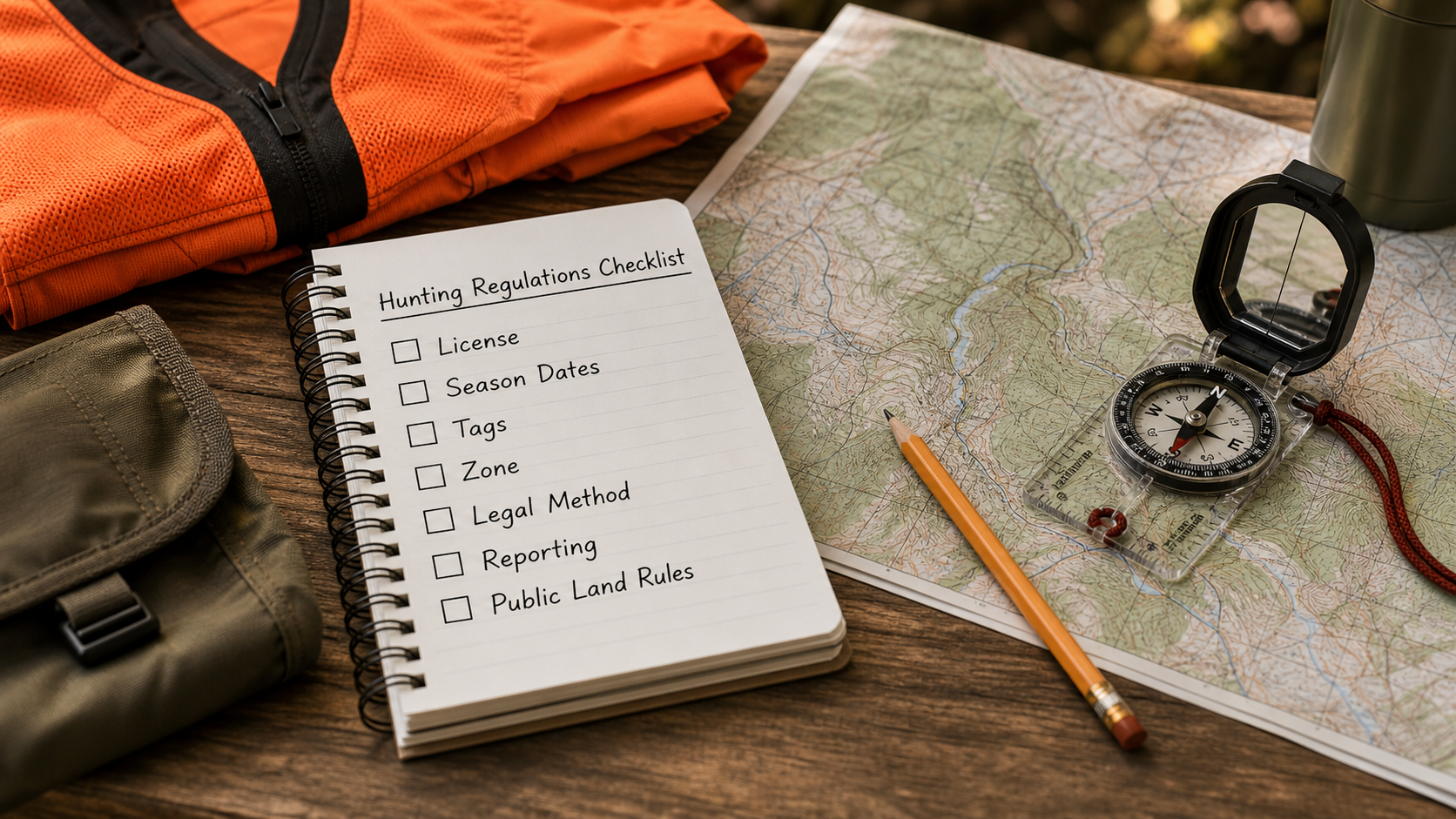
Use a regulations checklist before each hunt: license, season dates, tags, zone, legal method, reporting, and land-specific rules.
Hunting Regulations Checklist
A good regulation check starts before you buy gear. Work through this list for the exact hunt you are planning, not for a general state or species page you read weeks earlier.
Species: Confirm the exact animal, sex, age class, and any antler or size rule.
Season: Check opening and closing dates, including youth, archery, muzzleloader, firearm, and special seasons.
Zone: Verify the unit, county, zone, wildlife management area, or refuge boundary.
License and tags: Confirm what you need before hunting and whether tags are limited, draw-only, over-the-counter, or landowner-specific.
Reporting: Know whether harvest reporting, check stations, tagging, telecheck, or biological sampling is required.
Land rules: Separate statewide rules from public-land, private-land, federal refuge, and local access rules.
Where to Verify Rules
Your state fish and wildlife agency should be the first source for seasons, bag limits, licenses, and harvest reporting. Federal lands may add separate rules, so check the managing agency for national wildlife refuges, national forests, military lands, and other special areas. The U.S. Fish and Wildlife Service hunting page is a useful starting point for refuge-related hunting information.
Do Not Rely on Old Screenshots
Regulation screenshots, social media posts, forum comments, and old PDF downloads can be outdated. Save the current official PDF or page for your hunt, but also check for emergency changes, closures, disease-related rules, fire restrictions, and access updates before you leave.
Call When a Rule Is Unclear
If a rule is confusing, contact the agency or local conservation officer before hunting. A quick call is better than guessing. This matters most for boundary questions, weapon rules, public-land access, baiting, night hunting, transport rules, and special permits.
Season Dates and Zones
Season dates can change between species, zones, and weapon types. A deer archery season may not match firearm season. A turkey spring season may have different dates from fall. Waterfowl seasons may be split by zone or flyway. Small-game seasons can also have exceptions by land type.
Pay attention to the map. A county line, river, highway, or refuge boundary can change what is legal. If you use a mapping app, confirm that its boundary data matches the official agency map for the current season.
Licenses, Tags, and Reporting
A license alone may not be enough. Many hunts require a species tag, permit, stamp, draw result, habitat validation, hunter education proof, or land access permit. Some states also require immediate tagging or electronic harvest reporting within a set time.
Keep Proof With You
Carry the proof required by your state, whether that is a paper license, mobile app, tag, permit, or confirmation number. If your phone is your proof, consider battery life and service. Some areas have poor reception, and you still need to follow the reporting rule.
Legal Methods and Equipment
Legal methods can include weapon type, caliber or gauge limits, archery equipment rules, crossbow rules, broadhead requirements, ammunition restrictions, suppressor rules, magazine limits, blaze orange, baiting, dogs, calls, drones, thermal devices, and night-hunting rules. Do not assume that legal gear in one state is legal in another.
General safety rules still apply even when the method is legal. Review the NSSF firearm safety rules for firearm hunts and complete the hunter education required by your state before going afield.
Public Land vs. Private Land
Public land may have special access hours, parking rules, quota permits, weapon restrictions, check-in requirements, closed areas, or species-specific rules. Private land may require written permission, landowner tags, or different access rules. Do not treat a statewide season as permission to hunt any property.
Ethical hunting includes legal access, safe shot selection, respect for other users, and a plan for recovery. Hunter education resources such as Hunter Ed can help newer hunters think beyond the minimum rulebook and prepare responsibly.
Day-Before Verification
Regulation checks should not happen only once at the start of the season. The day before a hunt, confirm the official page still shows the same season, boundary, access, and reporting information. Check for emergency closures, wildfire restrictions, flooding, road closures, disease-control zones, refuge notices, quota updates, and weather-related access changes.
If you hunt with a group, make sure every person has the same current information. One hunter using last year’s map or an old screenshot can create problems for everyone. Save the official page or PDF for reference, but treat the live agency notice as the stronger source when it has been updated.
Common Regulation Mistakes
The most common mistakes are preventable. Hunters often read last year’s rules, hunt the wrong zone, forget a tag, miss a reporting deadline, rely on a non-official app, or assume a weapon rule applies statewide. Another common mistake is checking rules at home but not checking local closures or access notices the day before the hunt.
Build a pre-hunt habit: official rulebook, official map, license and tags, legal method, land access, reporting requirement, and emergency changes. If the hunt involves another state, new public land, a new species, or a new weapon type, slow down and verify everything twice.
FAQ
Where can I find current hunting regulations?
Start with your official state fish and wildlife agency. For federal refuges or special public lands, also check the managing agency page for that property.
Do hunting regulations change every year?
They can. Dates, zones, bag limits, reporting rules, disease restrictions, and weapon rules may change. Check the current season before each hunt.
Can I trust hunting apps for regulations?
Use apps as planning tools, not final legal authority. Verify regulations, boundaries, and access rules with official agency sources before hunting.
What if the regulation book is confusing?
Contact the state wildlife agency, local conservation officer, or property manager before hunting. Do not guess when a rule affects legality or safety.
Final Takeaway
The best regulation habit is boring and reliable: check the official source, match the rule to your exact species and location, carry the required proof, and verify changes before you hunt. That protects you, the resource, and the future of legal hunting access.
Technology is revolutionizing the way we hunt and shoot. From GPS mapping and ballistics calculators to wind readings and shooting logs your smartphone has quietly become one of the most powerful tools in your hunting pack.
In 2025, mobile apps for hunters and shooters are smarter, faster, and more data-driven than ever before. Whether you’re chasing elk in rugged terrain or fine-tuning long-range accuracy at the range, the right app can mean the difference between success and frustration.
In this guide, we’ll explore the best mobile apps for hunters and shooters 2025, both free and premium, designed for Android and iOS users alike. We’ll also share expert insights, selection tips, and how to avoid common mistakes so you can make the most of your digital hunting companion.
Why Mobile Apps Matter for Modern Hunters and Shooters
The digital landscape has completely transformed hunting and shooting. A decade ago, shooters relied on paper maps, printed range cards, and handwritten logs. Today, mobile technology provides real-time data that improves accuracy, safety, and efficiency.
Here’s why mobile apps for hunters and shooters 2025 are game-changers:
Real-time ballistics & weather data: Adjust your aim based on precise wind, temperature, and elevation metrics.
Offline GPS tracking: Navigate remote hunting areas even without network coverage.
Digital shot logs: Track every session to improve consistency and marksmanship.
Community & learning tools: Connect with expert shooters, share data, and get training resources.
In short, these apps are no longer “nice to have.” They’re essential tools for serious outdoorsmen.
How to Choose the Right App for Your Needs
Not all apps are created equal. Whether you’re a hunter or precision shooter, your priorities may differ. Before downloading anything, consider these key factors:
1. Purpose
Are you looking for:
Hunting tools (maps, game tracking, moon phases)?
Shooting apps (ballistics calculators, wind meters, range logs)?
All-in-one solutions that combine both?
2. Device Compatibility
Most apps are optimized for Android and iOS, but some perform better on specific devices. Check the version compatibility before installing.
3. Offline Functionality
When you’re deep in the woods, signal is unreliable. Always look for apps with offline maps and tracking features.
4. Accuracy and Updates
Choose apps that offer regular updates, verified ballistics libraries, and community-verified accuracy reports.
5. User Interface
Hunting and shooting often happen in harsh conditions cold, rain, gloves on. A clean, simple interface is vital for quick, no-nonsense access.
Top Mobile Apps for Hunters and Shooters 2025
Below are the standout options based on performance, popularity, and expert testing covering both free and premium tools.
1. BallisticARC (Best Long Range Shooting App 2025)
Overview: BallisticARC remains a favorite among competitive shooters and hunters who demand accuracy at long distances. This app combines ballistic solvers, wind meters, and GPS overlays in one sleek interface.
Key Features:
Advanced ballistic solver with G1/G7 drag models
Offline range cards and drop charts
Wind correction calculations based on real-time weather
Rangefinder integration (Kestrel, Leica, etc.)
Why It’s Great: For anyone serious about long range shooting apps, BallisticARC delivers precise data that rivals dedicated handheld ballistics computers.
2. HuntStand 2025 (Best Overall Hunting App)
Platform: Android, iOS Price: Free with optional subscription
Overview: HuntStand is a powerhouse for hunters offering everything from mapping and stand placement to weather forecasts and property boundary data.
Top Features:
Detailed 3D satellite and topo maps
Real-time wind and weather overlays
Land ownership boundaries (US-only)
Hunt area sharing with groups
Why It’s Great: It’s like carrying an entire hunt management system in your pocket. The 2025 update adds faster map loading and improved GPS accuracy.
3. Strelok Pro+ (Precision Ballistics App)
Platform: Android Price: Paid (worth every cent)
Overview: Strelok Pro+ continues to dominate the mobile apps for hunters and shooters 2025 Android category. It supports over 700 reticles and integrates with top optics brands.
Key Features:
Supports multiple ballistic coefficients and rifle profiles
Reticle visualization and zoom
Adjustable zeroing tools
Wind, spin drift, and Coriolis effect calculations
Why It’s Great: If you value accuracy over aesthetics, this is the go-to ballistic calculator. Perfect for reloaders and competitive shooters.
Overview: onX Hunt has long been a staple for serious hunters. It provides offline GPS navigation, detailed land ownership info, and custom waypoint tracking.
Key Features:
High-resolution offline maps
Public and private land boundaries
Real-time GPS tracking and sharing
Waypoint marking and trail tracking
Why It’s Great: Ideal for backcountry hunters who venture off the grid. The new 2025 version adds expanded map coverage across North America.
5. Shooter’s Diary (Best Free Mobile App for Tracking Progress)
Platform: Android Price: Free
Overview: A simple yet effective tool that helps shooters log every range session. You can track weapon configurations, ammunition, targets, and group size.
Top Features:
Custom rifle profiles
Range and accuracy statistics
Ammunition performance tracking
Visual charts for improvement
Why It’s Great: If you want a free mobile app for hunters and shooters 2025 that focuses on skill improvement, Shooter’s Diary is perfect for beginners and advanced users alike.
6. Windy (Best App for Wind & Weather Data)
Platform: Android, iOS Price: Free
Overview: Accuracy starts with understanding your environment. Windy provides hyperlocal wind, temperature, and barometric data ideal for long-range shooting adjustments.
Key Features:
Live wind direction and speed mapping
Multi-layer radar visualization
Offline mode and customizable alerts
Why It’s Great: Combining Windy with a ballistics app like Strelok or BallisticARC gives shooters unmatched precision.
Bonus: Other Notable Mentions
Geo Tracker: Reliable for hunters needing breadcrumb trails in remote zones.
BaseMap: Great for scouting new hunting territories with integrated topo layers.
Range Buddy: Ideal for precision shooters testing new ammunition.
Free vs. Paid Mobile Apps: What’s Worth It in 2025
Pro Tip: Start with free apps like HuntStand or Shooter’s Diary, and upgrade once you identify your specific needs.
Essential Features to Look For in 2025 Apps
When downloading any app, prioritize these must-have features to ensure reliability in the field:
✅ Offline mapping — For remote hunting areas
✅ Ballistic calculator — Essential for accurate long-range shots
✅ Weather data integration — Temperature, pressure, wind, and humidity
✅ Custom rifle/ammo profiles — For precise shot predictions
✅ GPS tracking & waypoint marking — To trace routes and stands
✅ Cloud backup — Prevents data loss
Tips for Getting the Most Out of These Apps
Keep your data updated: Regularly input your rifle zero, new loads, and environmental changes.
Use external sensors: Pair with devices like Kestrel wind meters for enhanced precision.
Test before the hunt: Don’t wait until game day familiarize yourself with the app’s layout and features.
Download offline maps early: Always prepare for no-signal areas.
Stay battery smart: Keep a power bank; mapping and GPS features drain your phone fast.
Common Mistakes Hunters Make with Mobile Apps
Even the best app won’t help if used incorrectly. Avoid these frequent pitfalls:
❌ Relying solely on digital tools: Always carry a physical map and compass backup.
❌ Ignoring calibration: Re-zero and calibrate your rifle data after every major weather change.
❌ Using outdated versions: Apps evolve fast; outdated ones can produce errors.
❌ Not testing offline mode: Always verify that key functions work without connectivity.
Expert Insights: What’s Next for Hunting & Shooting Apps
2025 marks a shift toward AI-assisted ballistics and augmented reality (AR) integration. Expect apps to:
Provide real-time AR overlays showing bullet trajectories through your phone camera.
Sync directly with smart scopes and wearable sensors.
Offer AI-based shooting recommendations (e.g., “Adjust 0.5 MOA left due to wind”).
The future of mobile shooting assistance is about merging data, precision, and accessibility right in your pocket.
Final Thoughts: The Smart Shooter’s Advantage
In 2025, the line between shooter and technologist is blurring fast. The best hunters and marksmen aren’t just relying on skill they’re leveraging data-driven tools that amplify their performance.
Whether you prefer the all-in-one management of HuntStand, the pinpoint ballistics of Strelok Pro+, or the navigation power of onX Hunt, today’s mobile apps for hunters and shooters 2025 can take your accuracy, safety, and success to new heights.
👉 Check out our latest gear reviews, tech breakdowns, and pro tips at TheShootingGears.com.
Or subscribe to our newsletter for exclusive updates on hunting technology, optics, and precision shooting equipment.
Quick Summary Table
Category
Best App
Key Strength
Overall
HuntStand
All-in-one hunting management
Long-Range
BallisticARC
Precision ballistic calculations
Mapping
onX Hunt
Offline GPS navigation
Android Ballistics
Strelok Pro+
Professional-grade solver
Free App
Shooter’s Diary
Shot tracking & improvement
Weather
Windy
Real-time environmental insights
Conclusion
The evolution of mobile apps for hunters and shooters 2025 has completely changed how enthusiasts plan, shoot, and succeed in the field. These digital tools have become indispensable combining precision, convenience, and real-time intelligence to enhance every moment of your hunt or shooting session.
Whether you’re mapping terrain with onX Hunt, analyzing long-range ballistics through BallisticARC or Strelok Pro+, or logging your progress with Shooter’s Diary, each app gives you a tactical edge. The best part? Most of these tools are free or affordable, and many work seamlessly offline, making them perfect for any outdoor environment.
But remember technology is only as effective as the shooter using it. Spend time testing these apps, input accurate data, and practice regularly to build trust in your digital tools. When combined with skill and experience, they’ll help you shoot more precisely, hunt more efficiently, and stay safer in the wild.
As the 2025 season unfolds, don’t fall behind. Download one or two of these best mobile apps for hunters and shooters 2025, experiment with their features, and see how they elevate your performance.
The best hunting boots for cold weather depend on how you hunt. If you sit still for hours in wet, freezing conditions, a tall insulated rubber boot usually makes more sense. If you hike, glass, climb, or cover uneven ground, an insulated leather lace-up gives better support and control. This guide keeps the list to seven boots because those are the rows with the strongest source and buyer-path evidence in this update.
Insulation grams are comparison points, not temperature guarantees. Your socks, circulation, activity level, wind, moisture, and how long you sit still all change how warm a boot feels. We do not claim current price, stock, Prime status, ratings, or review counts here because live Amazon availability could not be reliably refreshed during this pass.
Affiliate disclosure: As an Amazon Associate, TheShootingGears.com earns from qualifying purchases.
Table of Contents
Quick Picks
Best active mountain boot: Kenetrek Mountain Extreme 400.
Best traditional leather lace-up: Irish Setter Elk Tracker XD.
Best cold, wet stand-sit boot: LaCrosse Alphaburly Pro 18-inch 1600G.
Best colder active mountain boot: Kenetrek Mountain Extreme 1000.
Best crossover utility boot: Muck Arctic Sport Mid.
Best women’s active lace-up: Irish Setter VaprTrek Women’s.
We built this update from manufacturer spec pages and a prior ASIN identity review, not from hands-on field testing. We prioritized cold-weather roles that readers actually need: active mountain lace-ups, traditional leather hunting boots, tall insulated rubber boots, wet-cold utility boots, and women’s-specific options.
We excluded old products from the previous live article when the row did not match the stronger seven-product route. We also excluded old product images because the current package does not document image rights or exact variant proof for those files. That is why this version uses direct Amazon CTAs and original non-branded editorial visuals instead of individual product photos.
Best Hunting Boots for Cold Weather
Best Active Mountain Boot: Kenetrek Mountain Extreme 400
Best for: active mountain and backcountry cold-weather hunts where lace-up support matters more than maximum insulation.
The Kenetrek Mountain Extreme 400 is the lighter-insulation mountain boot in this lineup. Manufacturer specs list 400 grams of Thinsulate insulation, a 2.8mm leather upper, Windtex waterproof and breathable membrane, K-Talon outsole, 10-inch height, and 4.2 pounds per pair. It also lists Medium, Narrow, and Wide width options, which helps when fit matters on long hikes.
This is the boot to consider when you move enough to generate heat but still need insulation, waterproofing, ankle support, and traction. It is not the best choice for a motionless all-day stand sit in deep cold because 400 grams is moderate insulation compared with the higher-gram rubber boots below.
Best Traditional Leather Lace-Up: Irish Setter Elk Tracker XD
Best for: hunters who want a traditional 10-inch leather lace-up with waterproofing, insulation, and rough-terrain support.
The Irish Setter Elk Tracker XD, Style 3983, is the more traditional leather boot in this group. Manufacturer specs list 400 grams of PrimaLoft insulation, UltraDry waterproofing, waterproof nubuck leather, a Vibram Bulls-Eye Air Bob Aggressive outsole, 10-inch height, and men’s sizes 8-14 in Regular D and Wide EE. Weight was not source-backed in this pass, so we are not listing one.
Compared with the Kenetrek Mountain Extreme 400, the Elk Tracker XD feels like the conventional hunting-boot lane: leather support, aggressive outsole, and wide sizing without the same mountain-stiff identity. It is still a 400-gram active-use boot, not a deep-cold stationary rubber boot.
Pros: traditional leather support; Wide EE option; waterproofing system; aggressive outsole.
Cons: no source-backed weight in this pass; no temperature guarantee; not a tall rubber boot.
Skip this if: you mostly hunt flooded fields, deep snow, or long stationary sits.
Best for Cold, Wet Stand Sits: LaCrosse Alphaburly Pro 18-inch 1600G
Best for: very cold, wet stand sits, muddy whitetail hunts, and tall rubber-boot coverage.
The LaCrosse Alphaburly Pro 18-inch Realtree Edge 1600G is the dedicated cold-and-wet rubber boot in this article. Manufacturer specs list 1600 grams of Thinsulate Ultra insulation, waterproof hand-laid premium natural rubber over insulating neoprene, Alpha Construction, jersey liner, Burly Pro outsole, 18-inch height, and 5.5 pounds per pair.
This boot is built for wet ground and still cold sits rather than long, steep hikes. The height and rubber build help with mud and snow, but the slip-on fit will not feel as precise as a lace-up on sidehills. Also remember that waterproof construction does not stop water from entering over the top or sweat from building inside.
Best Colder Active Mountain Boot: Kenetrek Mountain Extreme 1000
Best for: colder active mountain hunts where you still need lace-up support and terrain control.
The Kenetrek Mountain Extreme 1000 keeps the mountain-support role of the 400-gram model but steps insulation up to 1000 grams of Thinsulate. Manufacturer specs list a 2.8mm leather upper, Windtex waterproof and breathable membrane, K-Talon outsole, 10-inch height, 4.5 pounds per pair, and men’s Medium width in sizes 8-12, 13, and 14.
This is the Kenetrek choice when temperatures drop but you are still moving through mountain terrain. It is not as width-flexible as the 400-gram model in this source pass, and the added insulation can be too warm for mild days or constant uphill movement.
Pros: warmer than the 400g version; mountain-support build; waterproof/breathable membrane; durable leather role.
Cons: Medium-width-only verified; heavier and warmer; still not a tall rubber boot.
Skip this if: you need multiple width options or you overheat easily while hiking.
Best Crossover Utility Boot: Muck Arctic Sport Mid
Best for: mud, snow, chores, lowland hunts, and wet/cold utility use when you want easy on/off convenience.
The Muck Arctic Sport Mid is the crossover boot here. Manufacturer specs list fleece and warm lining, a 5mm neoprene bootie, 2mm thermal foam under the footbed, 100% waterproof and MUCKPROOF rubber/neoprene construction, MS-1 lug outsole, 12-inch full height, and average weight of 2.50 pounds for a men’s size 10. Muck lists a comfort range, but we treat that as manufacturer guidance rather than a TSG guarantee.
This boot makes sense when you want a wet/cold boot for mixed duties. It is easier than tall rubber boots for quick use, but it offers less height than 15- or 18-inch options and less fitted support than a leather lace-up.
Pros: easy on/off; waterproof rubber/neoprene construction; useful mid-height role; lighter than many tall rubber boots.
Cons: less coverage than tall boots; not a lace-up support boot; manufacturer comfort range is not a guarantee.
Skip this if: you need either maximum stand-sit warmth or mountain-boot ankle support.
Best Women’s Active Lace-Up: Irish Setter VaprTrek Women’s
Best for: women hunters who want a lighter lace-up boot for active cold-weather hunts.
The Irish Setter VaprTrek, Style 3945, is the women’s active lace-up row in this guide. Manufacturer specs list 400 grams of PrimaLoft insulation, UltraDry waterproofing, full-grain waterproof leather, abrasion-resistant nylon, Rubber Hex Lite outsole, 8-inch height, and women’s sizes 5-11 in Regular B and Wide D. Weight was not source-backed in this pass.
This boot fits the mobility lane: more precise than a slip-on rubber boot, easier for active walking, and available in women’s Regular and Wide widths. It does not have the height or heavy insulation of the tall rubber options, so it is not the best fit for long cold sits in wet ground.
Pros: women’s-specific sizing; Regular and Wide widths; active lace-up role; waterproof leather/nylon upper.
Cons: only 8-inch height; 400g insulation is moderate; no source-backed weight.
Skip this if: you need tall rubber coverage for deep mud, wet snow, or cold still sits.
Best for: women hunters who need a tall insulated rubber boot for cold, wet ground.
The LaCrosse Women’s Alpha Agility 15-inch 1200G is the women’s tall rubber option. Manufacturer specs list 1200 grams of Thinsulate Ultra insulation, waterproof premium hand-laid rubber over 5mm neoprene, jersey liner, Alpha Construction, and 15-inch height. Weight and exact width options were not resolved in this source pass, so verify fit on the live listing before buying.
This is the better women’s choice for cold wet grass, mud, shallow snow, and lower-movement hunts. It is not meant to replace a fitted leather lace-up for steep hikes or sidehill-heavy terrain.
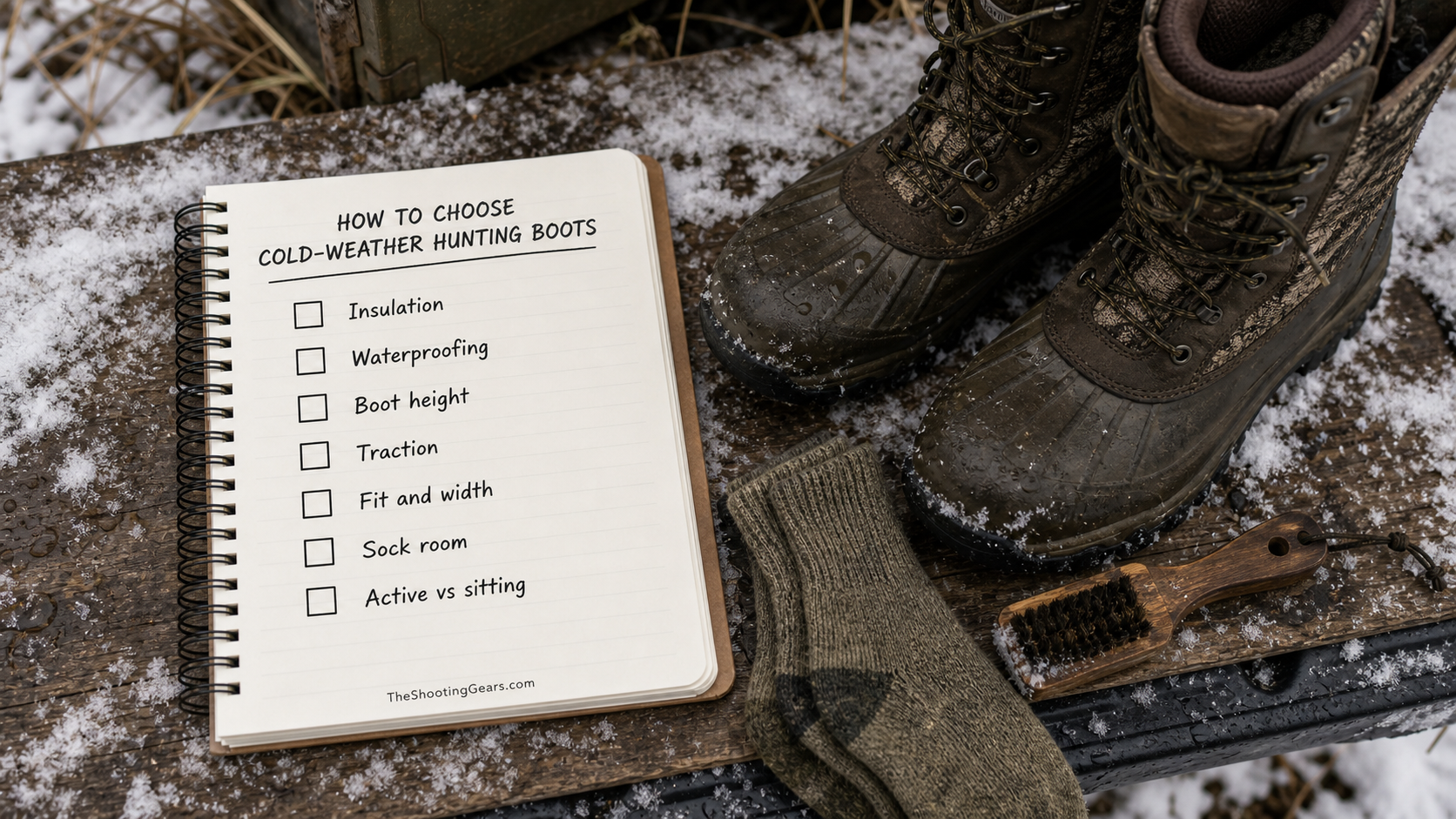
Buying Guide: How To Choose Cold-Weather Hunting Boots
Start with the way you hunt. A boot that is perfect for a tree stand can feel miserable on a mountain hike. A supportive lace-up that feels great while moving may not hold enough warmth when you sit still for hours.
Insulation
Lower insulation, such as 400 grams, usually fits active hunters better. Higher insulation, such as 1000 to 1600 grams, makes more sense for colder and lower-movement hunts. Treat the gram number as a comparison tool, not a comfort promise.
Rubber vs leather
Rubber boots are strong for wet ground, mud, and still sits. Leather lace-ups are better for sidehills, long walks, and precise fit. Many serious hunters eventually keep one of each because the roles are different.
Boot height
An 8- to 10-inch boot is easier to walk in and still gives ankle coverage. A 15- to 18-inch rubber boot is better for mud, snow, and shallow water, but it adds weight and bulk.
Fit and sock room
Cold-weather boots should leave room for your actual hunting socks without crushing your toes. Tight boots can reduce comfort and make feet feel colder. Width options matter, especially if you wear thicker socks or have wider feet.
For broader cold-weather planning, the CDC/NIOSH cold stress guidance explains why keeping extremities dry and protected matters in cold conditions. The National Shooting Sports Foundation is also a useful broader resource for responsible hunting and shooting-sports preparation.
Cold-Weather Foot Safety
Cold feet are a comfort and safety concern. Keep feet dry, avoid socks that bunch or crowd your toes, and carry spare dry socks on long wet hunts. If your feet become numb or painful, warm up and reassess instead of pushing through.
Waterproof boots reduce water entering through the boot material, but they do not make your feet dry in every situation. Water can enter over the top, and sweat can build inside during hard hiking. Boot choice, sock choice, and pacing all work together.
Frequently Asked Questions
How many grams of insulation do I need for cold-weather hunting?
Active hunters often do better with moderate insulation, while hunters who sit still in deep cold often prefer higher insulation. Use the gram rating to compare boots, not as a guaranteed temperature rating.
Are rubber boots or leather boots warmer?
Neither material is automatically warmer. Insulation, fit, sock system, and activity level matter more. Rubber boots shine in wet, stationary conditions; leather lace-ups shine when you need support and control while moving.
Do waterproof hunting boots keep feet completely dry?
Not always. Waterproof construction helps stop water from soaking through the boot, but water can still enter over the top, and sweat can collect inside. Carrying dry socks helps on long hunts.
Can one pair of boots work for both hiking and stand sits?
A crossover boot can work for mixed use, but no single boot is perfect for steep active hunts and long deep-cold sits. If you do both often, consider an active lace-up and a tall insulated rubber boot.
Should women choose a women’s-specific hunting boot?
If the fit is better, yes. Women’s-specific sizing and width options can help, but the same rules apply: match insulation, height, support, and waterproofing to the way you hunt.
Final Recommendation
For active mountain hunts, start with the Kenetrek Mountain Extreme 400, or step up to the Kenetrek Mountain Extreme 1000 when colder conditions call for more insulation. For traditional leather support, the Irish Setter Elk Tracker XD is the most familiar lace-up option here.
For cold, wet, lower-movement hunts, the LaCrosse Alphaburly Pro 18-inch 1600G is the strongest stand-sit choice. The Muck Arctic Sport Mid is the easiest crossover utility boot. Women hunters should compare the Irish Setter VaprTrek for active lace-up hunts against the LaCrosse Women’s Alpha Agility for cold, wet rubber-boot use.
In today’s age of high-tech hunting, drones have transformed the way hunters scout terrain, locate game trails, and evaluate hunting zones. From aerial mapping to monitoring animal movement, drones offer a distinct advantage in planning a successful hunt.
However, before taking flight over your favorite hunting area, it’s crucial to understand the complex web of legal restrictions, ethical considerations, and hunting regulations surrounding drone use. Misusing a drone could lead to heavy fines, revoked hunting licenses, or even criminal charges.
This article dives deep into how hunters are using drones to scout hunting grounds and the legal issues every outdoorsman should be aware of.
1. The Rise of Drones in Hunting Scouting
Drones (or Unmanned Aerial Vehicles, UAVs) have become valuable tools for hunters and wildlife managers. Equipped with 4K cameras, GPS, and thermal imaging, modern drones can:
Capture aerial views of hunting grounds to analyze terrain and vegetation density.
Help identify animal trails, feeding areas, or bedding zones without physically disturbing the area.
Record data over multiple seasons to observe migration or population patterns.
Improve safety and navigation in remote locations.
For pre-season scouting, this technology can save countless hours of on-foot exploration. But while drones bring efficiency, regulators view them carefully due to potential misuse during actual hunts.
2. The Legal Framework: Federal and State Drone Regulations
🛑 Federal Laws
At the national level, drone usage is primarily regulated by the Federal Aviation Administration (FAA). Under FAA Part 107, recreational and commercial drone pilots must:
Fly below 400 feet above ground level.
Maintain visual line of sight at all times.
Avoid restricted airspace (such as national parks or military zones).
Never operate drones in a way that endangers wildlife or other people.
Violating FAA regulations can lead to fines up to $27,500 (civil) or $250,000 (criminal) and imprisonment.
State and Local Hunting Laws
Where things get more complicated is at the state level. Every U.S. state (and Canadian province) has its own hunting-related drone laws.
In most regions, using drones to locate, track, or harass wildlife during an active hunting season is illegal. For example:
Colorado prohibits using drones to locate or drive game animals.
Alaska bans spotting game with drones on the same day of the hunt.
Montana and Idaho restrict the use of any aircraft for game-scouting within 48 hours of hunting.
Ontario (Canada) prohibits using drones to disturb or locate animals for hunting purposes.
In short: while drone scouting is legal for land survey and terrain mapping, using a drone to gain a real-time advantage during hunting season is usually a violation of fair chase principles.
3. “Fair Chase” and Ethical Hunting
The concept of Fair Chase, established by the Boone and Crockett Club, emphasizes equal opportunity between the hunter and the hunted. Using drones to spot or track animals violates this principle because it:
Removes the natural challenge of locating game.
Increases success rates unfairly.
Disturbs wildlife behavior.
Even where not explicitly illegal, many hunting associations condemn drone use during active seasons. Ethical hunters often use drones only for off-season land scouting, property boundary checks, or habitat restoration surveys.
4. Acceptable Uses of Drones for Hunters
Despite restrictions, there are legally acceptable and highly beneficial applications for drones in the hunting ecosystem:
✅ Off-Season Scouting
Use drones to map trails, identify water sources, or measure field coverage before the season starts. This gives hunters valuable insights while staying compliant with local laws.
✅ Land & Property Management
Landowners can use drones to:
Inspect fences, tree stands, and blinds.
Monitor erosion, flooding, or forest health.
Evaluate food plots and planting zones.
✅ Wildlife Conservation
Drones help biologists and conservation agencies track herds, identify disease spread, or monitor habitats — a practice often permitted with special authorization.
✅ Safety & Search Missions
Some jurisdictions allow drones for search and rescue or game recovery (after a legal harvest), provided they’re not used to pursue live animals.
5. Common Legal Pitfalls to Avoid
Before flying, ensure you’re not crossing any legal lines. Here are common mistakes that lead to penalties:
Mistake
Legal Consequence
Flying drones over wildlife refuges or national parks
Federal violation (hefty fines)
Using drones to flush, locate, or chase animals
Illegal in most states
Filming other hunters or private property without permission
Privacy law violations
Failing to register drone or obtain FAA certification
Civil fines up to $27,500
Flying during restricted hours or zones
Confiscation or license suspension
Always consult your local wildlife agency or state hunting department before operating drones in the field.
6. How to Stay Compliant
Follow these best practices to stay within legal and ethical bounds:
Check state regulations before each scouting trip.
Fly only in off-season or non-hunting days.
Avoid flying directly over wildlife or nesting areas.
Obtain landowner permission when flying over private land.
Label and register your drone per FAA or Transport Canada requirements.
Keep video footage for personal land management use only, not for real-time game spotting.
Join conservation organizations to stay updated on changing drone policies.
7. The Future of Drones in Hunting and Conservation
The future of drones in hunting looks promising yet tightly regulated. As technology advances, drones are being used not only for scouting but also for wildlife population surveys, reforestation, and fire management.
Some states are considering permit-based drone programs for ethical scouting or conservation monitoring. Others may introduce geo-fencing systems that automatically restrict flight zones near active hunting areas.
Ultimately, the responsible use of drones can make hunters more informed stewards of the land as long as the line between technology and fair chase remains respected.
Conclusion
Drones are powerful tools that can revolutionize pre-season scouting, land management, and conservation efforts. But their misuse can just as easily lead to legal trouble and ethical controversy.
For every hunter, understanding and respecting both FAA flight laws and state wildlife regulations is essential before taking off. By flying responsibly, you ensure that drone technology enhances your hunting experience without compromising ethics, legality, or wildlife well-being.