


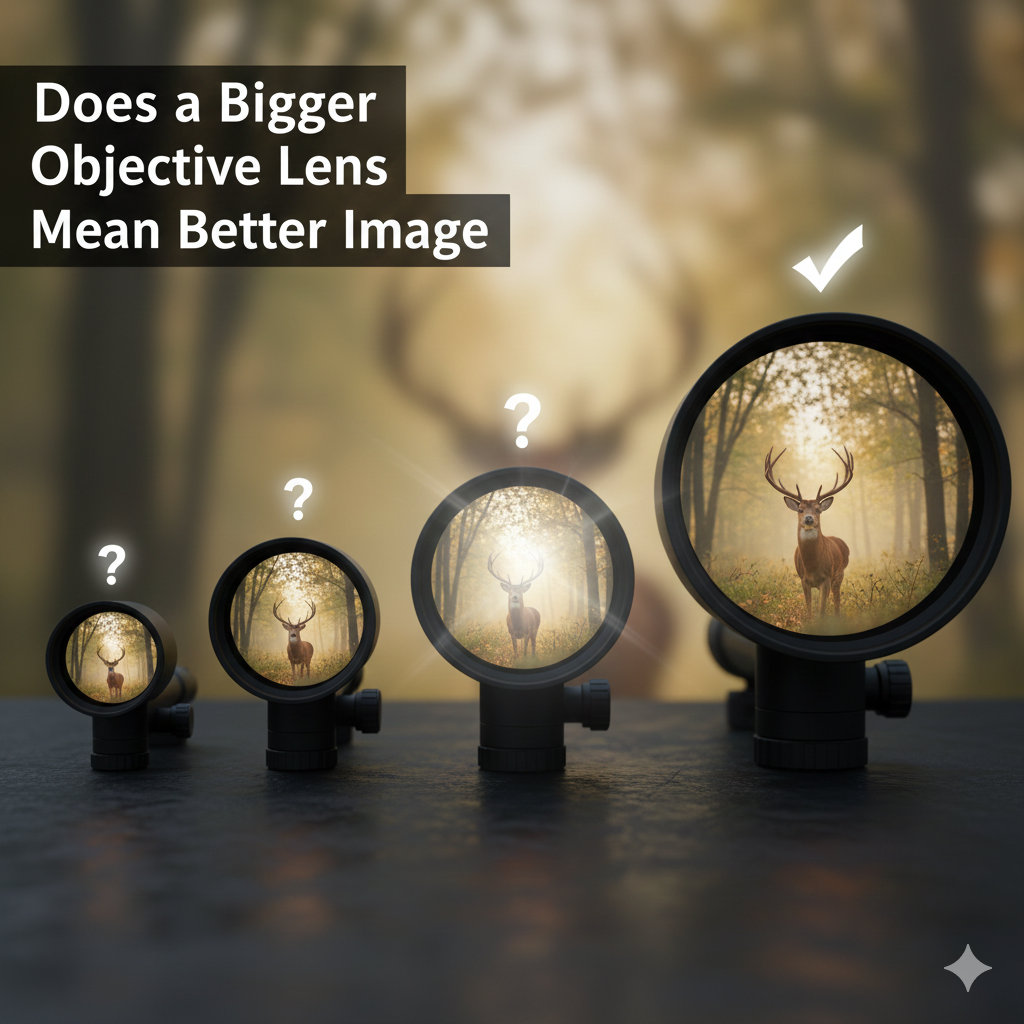
A bigger objective lens does not automatically give you a better image. A larger objective can gather more light, which may help in dim conditions, but it also adds weight, raises the scope higher on the rifle, and only delivers a brighter view up to the point your eye can actually use. The right objective size is the one that balances brightness, exit pupil, weight, and mounting for how you actually shoot, not the largest number on the spec sheet.
Table of contents
Quick answer
A larger objective lens gathers more light and can produce a brighter image in low light, but it is not a guarantee of a better view. Glass quality, coatings, magnification, and your own eye all affect what you see, and a bigger objective adds weight and forces a higher mount. For most hunters and range shooters, a moderate objective with good glass is a smarter choice than the largest objective available.
The myth in one sentence
“Bigger objective equals better image” is an oversimplification, because brightness is only useful up to what your eye can take in, and the larger lens brings real tradeoffs in weight and mounting. Size is one factor among several, not the whole answer.
What the objective lens actually does
The objective lens is the front lens of a scope or binocular, and its diameter is the second number in a spec like 4-16×50, where 50 is the objective diameter in millimeters. Its job is to gather light and form the image the rest of the optic magnifies. A larger objective can collect more light, which is why people associate big objectives with bright images.
Light gathering is only part of the system
How much of that gathered light reaches your eye usefully depends on the magnification, the coatings, the glass quality, and your pupil. A big front lens paired with mediocre glass can still produce a dimmer or less clear view than a smaller objective with excellent glass and coatings.
Exit pupil and your eye
Exit pupil is the column of light that leaves the eyepiece and enters your eye, and it explains most of the objective-size confusion. The optical concept is commonly defined as the diameter of the beam leaving an optical instrument, as summarized in this neutral exit pupil reference. You calculate it with simple arithmetic: divide the objective diameter by the magnification. A 50mm objective at 10x produces a 5mm exit pupil, while the same 50mm objective at 25x produces only a 2mm exit pupil.
How exit pupil affects brightness
A larger exit pupil sends more light to your eye and looks brighter, especially in low light. This is why brightness depends on the relationship between objective size and magnification, not on objective size by itself. At high magnification, even a large objective produces a small exit pupil.
Your pupil sets the ceiling
The human pupil opens wider in the dark, commonly toward roughly 5 to 7mm in dim light for many adults, and narrows in bright light. If the exit pupil is larger than your eye’s pupil can use, the extra light spills around your iris and is wasted. That is the core reason a bigger objective does not keep adding usable brightness without limit.
Where extra brightness stops helping
Once the exit pupil meets or exceeds what your pupil can open to, a larger objective gives little or no extra usable brightness for that magnification. In daylight, when your pupil is small, even a modest objective already delivers more exit pupil than your eye needs. The advantage of a big objective is mostly a low-light, lower-magnification situation.
Daylight shooting
In bright daylight, the difference between a moderate and a large objective is often hard to notice, because your pupil is constricted and cannot use a large exit pupil anyway. The weight and height penalties of the bigger lens remain even though the brightness benefit largely does not.
Low light and dawn or dusk
At dawn, dusk, or under heavy cover, a larger objective at lower magnification can produce a noticeably brighter image. This is where a bigger front lens earns its tradeoffs, if low-light use is genuinely part of how you hunt or shoot.
Glass quality often matters more
For overall image quality, the quality of the glass and coatings often matters more than raw objective size. Good lens coatings improve light transmission, reduce glare, and sharpen contrast, and quality glass reduces color fringing and edge distortion. A well-made smaller-objective optic frequently outperforms a cheap larger-objective one. That is why objective diameter should be read alongside glass quality, coating quality, magnification range, and how the optic actually fits the rifle.
Coatings and light transmission
Fully multi-coated lenses transmit more light through each glass surface than uncoated or partially coated ones. Two optics with the same objective size can deliver clearly different brightness and clarity based on coatings alone, which is another reason size is not the whole story.
Contrast and resolution
Contrast and resolution determine how clearly you can pick out detail, especially in flat light or against busy backgrounds. These depend heavily on glass and design, not objective diameter. A bright but low-contrast image can be harder to use than a slightly dimmer, sharper one.
Weight and mounting tradeoffs
A larger objective adds weight to the front of the optic and requires taller rings to clear the barrel. Both have practical consequences for how the rifle handles and how comfortably you can shoot it. These tradeoffs are easy to overlook when you focus only on brightness.
Added weight and balance
Extra glass up front makes the rifle heavier and more front-heavy, which matters on a carry rifle over a long day. For a stand or bench setup the weight matters less, but for a mountain or walking hunt a lighter optic often serves better.
Higher mounting and cheek weld
A bigger objective bell needs higher rings so it clears the barrel, which raises the scope and can hurt your cheek weld. A poor cheek weld makes it harder to get behind the scope consistently, which can cost you more accuracy than the brightness gain provides. Mounting an optic as low as it clears, with a solid cheek weld, is usually better than maximizing objective size.
How to choose an objective size
Choose an objective size by matching it to your conditions, your magnification range, and your rifle setup. Start from how and where you shoot, then pick the smallest objective that meets your low-light needs without adding weight and height you do not want.
Match it to your use
- Daytime range or general hunting: a moderate objective with quality glass is usually plenty.
- Frequent low-light hunting: a somewhat larger objective at lower magnification can help.
- Lightweight carry rifle: favor a smaller objective and a low mount for handling.
- Fixed stand or bench: you can accept more weight if low-light brightness matters to you.
Do the exit-pupil math
Before buying, divide the objective by the magnification you will actually use to see the exit pupil. If that number already meets your eye’s needs in low light, a larger objective adds weight without adding usable brightness for you. This simple arithmetic prevents overbuying on objective size.
Frequently asked questions
Does a bigger objective lens always mean a brighter image?
No. A bigger objective can gather more light, but brightness depends on exit pupil, glass quality, coatings, and your pupil size. Past the point your eye can use, extra objective size stops adding usable brightness.
How do I calculate exit pupil?
Divide the objective diameter in millimeters by the magnification. A 50mm objective at 10x gives a 5mm exit pupil. At higher magnification the exit pupil shrinks, which reduces low-light brightness.
Is a 50mm objective better than a 40mm for hunting?
Not necessarily. A 50mm can help in low light but adds weight and a higher mount. For many hunters a 40mm or 42mm with good glass and a low mount handles better and is bright enough.
What matters more than objective size?
Glass quality, coatings, the right magnification, and a low, solid mount with a good cheek weld often matter more than raw objective diameter for the view and for hitting your target.
Final takeaway
A bigger objective lens is a tool with tradeoffs, not a shortcut to a better image. It can help in low light, but its benefit is capped by your eye, and it costs you weight and a higher mount. Use the exit-pupil math, weigh glass quality over size, and match the objective to how you actually shoot. For most hunters and range shooters, a moderate objective with quality glass mounted low is the better-handling and equally clear choice.