


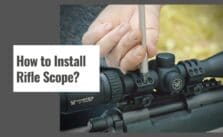
Installing a rifle scope is mostly about alignment, fit, and verification. The short version: use the right base and rings, keep the rifle unloaded, level the scope, set eye relief, tighten screws evenly to the manufacturer’s torque specs, then confirm zero at the range before hunting or relying on the setup.
This guide is written as a practical checklist, not a substitute for your firearm manual, optic manual, or a qualified gunsmith. If a mount does not fit cleanly, screws feel wrong, or the rifle has heavy recoil, get the setup checked before firing.
Table of Contents
Quick Scope Install Checklist
| Step | What to confirm | Why it matters |
|---|---|---|
| Unload and clear | Magazine out, chamber clear, muzzle pointed in a safe direction | Every setup job starts with firearm safety. |
| Match base and rings | Correct action, rail style, tube diameter, ring height, and recoil rating | Wrong parts cause poor fit, scope movement, or damage. |
| Dry-fit first | Base, rings, optic, bolt clearance, and objective clearance | Catches fit issues before thread locker or final torque. |
| Set eye relief | Full sight picture from your real shooting position | Reduces scope bite risk and makes the rifle easier to mount. |
| Level reticle | Rifle level and reticle vertical/horizontal | A canted reticle can cause misses, especially at distance. |
| Torque screws | Use the optic or mount manufacturer’s inch-pound specs | Over-tightening and under-tightening both create problems. |
| Boresight | Initial alignment before live fire | Saves ammunition and gets shots on paper faster. |
| Live zero | Confirm zero with the ammunition you will use | The rifle is not ready until it is verified at the range. |
Before You Start
Start by making the firearm safe. Remove the magazine, open the action, confirm the chamber is empty, and keep the muzzle pointed in a safe direction. The NSSF firearm safety rules are a good baseline for handling habits during any setup or maintenance task.
Gather the manuals for your firearm, scope, base, and rings. You need exact fit and torque information. Generic torque numbers found online can be wrong for your hardware, especially with lightweight rings, aluminum parts, or optics with thin tubes.
Choose the Right Base and Rings
The base must match the rifle action, and the rings must match both the base style and the scope tube diameter. Common tube diameters include 1 inch, 30 mm, and 34 mm, but you should verify your specific scope. Ring height should give the objective bell enough clearance while keeping the scope low enough for a natural cheek weld.
Do not force parts together. If screws bind, a rail rocks, or the rings leave uneven marks, stop and diagnose the fit. For hard-recoiling rifles, confirm that the mount is rated for that recoil level and that any recoil lug or crossbolt seats correctly.
Set Eye Relief From a Real Shooting Position
Eye relief is the distance between your eye and the ocular lens where you see a full, clear image. Set it while holding the rifle the way you actually shoot: shoulder position, cheek weld, clothing thickness, and shooting stance all matter.
Move the scope forward and backward in the rings until the sight picture is full without stretching your neck. Leave enough clearance to reduce the chance of the scope contacting your eyebrow under recoil. This matters most on lightweight rifles, steep-angle shots, and heavier cartridges.
Level the Rifle and Scope
Leveling keeps the reticle aligned with the rifle. Use a stable rest, a small level, or a scope leveling kit. The goal is not just making the scope look straight; it is making the reticle track vertically when you dial elevation or hold for distance.
Take your time here. Many poor scope installs come from rushing the reticle alignment, then compensating later with awkward holds. If your rifle has a canted rail or unusual stock geometry, visual alignment can be misleading, so use a repeatable leveling method.
Tighten Screws Evenly and Check the Fit
Tighten ring screws in small, even steps so the gap stays balanced on both sides. Use an inch-pound torque driver and follow the mount or scope manufacturer’s spec. Over-tightening can crush or mark a scope tube; under-tightening can let the scope shift under recoil.
After tightening, check that the magnification ring turns freely, the bolt cycles without contacting the scope, the safety works, and the objective bell does not touch the barrel or rail. If you use thread locker, use only the type recommended by the mount manufacturer and keep it away from the optic body.
Boresight and Zero at the Range
Boresighting is only a starting point. It helps you get on paper, but it does not replace live-fire zeroing. Once you reach the range, confirm zero with the ammunition you plan to use. Different loads can shift point of impact, even from the same rifle.
For ammunition and pressure terminology, SAAMI is a useful industry reference. For safe range habits and responsible firearm handling, Project ChildSafe is also worth keeping in your resource list.
Common Rifle Scope Installation Mistakes
- Using rings that are too high or too low for the rifle and objective bell.
- Forgetting to set eye relief from a real shooting position.
- Cranking screws by feel instead of using an inch-pound torque driver.
- Leveling the scope by appearance only.
- Skipping live-fire zero confirmation.
- Assuming one ammunition load will hit the same point as another.
Related Scope Guides
- How To Sight In a Rifle Scope Step by Step
- Rifle Scope Mounting Mistakes
- How To Adjust Scope Parallax
- Rifle Scope vs Red Dot for Hunting
FAQ
Can I install a rifle scope without a gunsmith?
Many shooters can install a scope with the right tools, manuals, and patience. Use a qualified gunsmith if parts do not fit cleanly, you lack torque specs, the rifle has heavy recoil, or you are not confident about safe firearm handling.
Do I need a torque driver for scope rings?
Yes, a torque driver is strongly recommended. Scope rings and bases often use inch-pound specs, and guessing can either loosen the mount or damage the optic.
Should the scope be mounted as low as possible?
Usually the scope should be low enough for a natural cheek weld, but it still needs clearance for the objective bell, bolt handle, caps, and barrel. The lowest possible ring is not always the right ring.
Is boresighting the same as zeroing?
No. Boresighting is a rough alignment step. Zeroing requires live fire at the range with the ammunition you plan to use.
Final Recommendation
A good scope install should feel boring: safe firearm handling, correct parts, careful eye relief, level reticle, proper torque, and verified zero. Do those steps patiently and the rifle will be easier to shoot well. Rush them, and even an expensive scope can perform like a poor setup.