


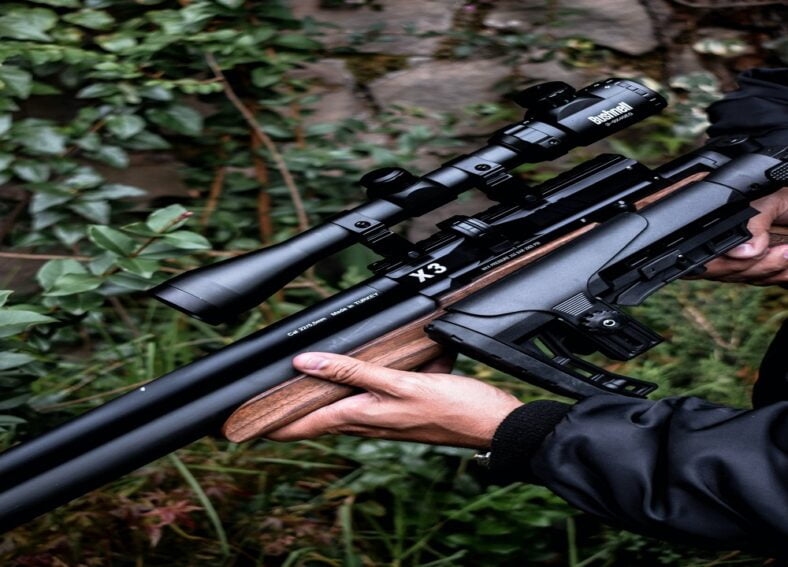
Scope parallax adjustment helps reduce aiming error when your eye is not perfectly centered behind the scope. If your scope has a side-focus or adjustable-objective control, the practical goal is to make the reticle stay still on the target when your eye moves slightly behind the eyepiece.
This guide explains parallax in practical shooter language. It is not a replacement for your optic manual, safe firearm handling, or live-fire confirmation. Start with the NSSF firearm safety rules before any scope setup or range work.
Table of Contents
Quick Parallax Adjustment Checklist
| Step | What to do | Why it matters |
|---|---|---|
| Confirm safety | Unload during setup and follow range commands during live fire | Optic adjustment never comes before firearm safety. |
| Set reticle focus | Adjust the diopter so the reticle looks sharp | A blurry reticle makes parallax harder to judge. |
| Set magnification | Use the magnification you plan to shoot or test | Parallax sensitivity can feel different at higher power. |
| Aim at target | Use a stable rest and a clear target at known distance | A stable rifle makes reticle movement easier to see. |
| Move eye slightly | Shift your eye behind the scope without moving the rifle | Reticle movement on target shows parallax error. |
| Adjust side focus/AO | Turn until the reticle appears stable on the target | This reduces aiming error from imperfect eye position. |
| Confirm with shots | Verify groups at the range | Adjustment is only useful if real shots confirm it. |
What Scope Parallax Is
Parallax happens when the target image and reticle do not appear on the same optical plane. When that happens, the reticle can seem to shift on the target as your eye moves behind the scope, even if the rifle itself has not moved.
Parallax is not the same as focus, but the controls can feel related. Reticle focus is usually adjusted with the diopter near the eyepiece. Parallax or side-focus adjustment is usually on the side turret or objective bell when the scope includes that feature.
When Parallax Matters
Parallax matters more at longer distances, higher magnification, and smaller targets. It is less noticeable at short distances or low magnification, but it can still affect precision. Many hunting scopes are factory-set for a common distance and may not have a parallax control.
If your scope does not have a parallax adjustment, focus on consistent cheek weld, proper eye relief, and confirmed zero. Those fundamentals still matter even with an adjustable scope.
How To Adjust Scope Parallax
Set up on a stable rest with the firearm pointed safely at the target. Make sure the reticle is sharp first. Then aim at a clear target at the distance you plan to shoot. Without touching the rifle, move your eye slightly up, down, left, and right behind the scope.
If the reticle appears to move across the target, adjust the side-focus or adjustable objective control. The distance numbers on the knob are a starting point, not a guarantee. The practical test is whether the reticle stays still on the target as your eye moves slightly.
Common Parallax Mistakes
- Using the side-focus knob only to make the target look sharp.
- Skipping reticle focus before checking parallax.
- Trusting the knob’s yardage number without verifying on target.
- Trying to diagnose parallax while the rifle is wobbling.
- Ignoring cheek weld and eye position.
Parallax and Zero
Parallax adjustment does not replace zeroing. You still need to confirm point of impact with live fire at the range. For ammunition terminology and standards, SAAMI is a useful authority reference, but your actual zero comes from your rifle, scope, ammunition, and shooting position.
When testing zero, use careful groups instead of single shots. If groups shift when your eye position changes, parallax or inconsistent cheek weld may be part of the issue.
Field Use
In the field, you may not have time for perfect adjustment. Set the scope for a practical distance range, keep magnification reasonable, and build a repeatable cheek weld. For formal marksmanship pathways and training culture, USA Shooting is a useful resource.
For hunting, the ethical choice is always to pass on shots where distance, target ID, backstop, or stability are uncertain. Parallax adjustment helps precision, but it cannot fix unsafe conditions.
Related Guides
- How To Use a Rifle Scope for Accuracy and Precision
- How To Sight In a Rifle Scope
- Rifle Scope Mounting Mistakes
- Ballistic Coefficient Explained
FAQ
What does scope parallax look like?
It looks like the reticle moving across the target when your eye shifts behind the scope, even though the rifle is still.
Is parallax the same as focus?
No. Focus makes the reticle or target look sharp. Parallax adjustment helps align the reticle and target image so the reticle does not appear to shift with eye movement.
Do all rifle scopes have parallax adjustment?
No. Many hunting scopes are factory-set and do not include a side-focus or adjustable objective control. In that case, consistent eye position is especially important.
Can parallax cause missed shots?
Yes, especially at longer distances, high magnification, or on small targets. It is one possible source of error along with wind, zero, ammunition, trigger control, and shooting position.
Final Recommendation
Adjust parallax by watching reticle movement, not just by reading the yardage number on the knob. Set reticle focus first, use a stable position, verify with live-fire groups, and keep your safety and shot conditions ahead of any optic setting.

