


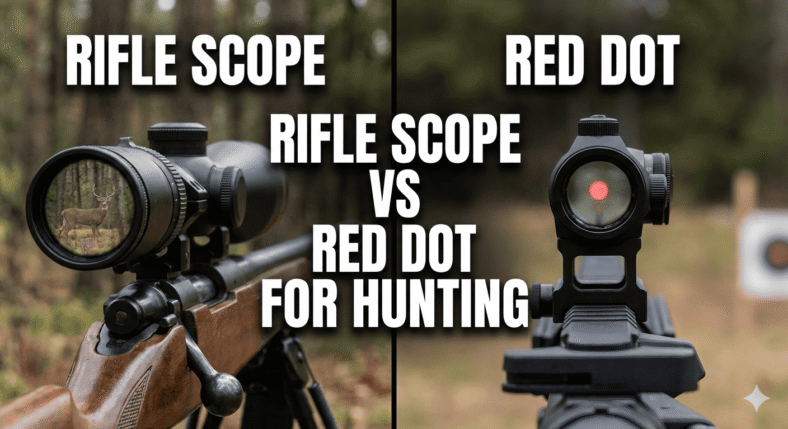
No single optic is best for every hunt. A magnified rifle scope, an LPVO, and a red dot sight each fit different scenarios. A magnified scope gives reach and detail for open country. A red dot gives a fast, both-eyes-open aiming reference for close cover. An LPVO sits between them, offering a wide 1x view and modest magnification when needed.
The right choice depends on terrain, how far you need to identify game, low-light conditions, weight, battery needs, eye relief, and your exact firearm/optic setup. This comparison is general guidance, not a universal recommendation. Always follow safe handling rules, confirm target and backstop, and check your state hunting regulations before the hunt.
Table of Contents
What Is a Magnified Rifle Scope?
A magnified rifle scope uses lenses to enlarge the target image and shows an aiming reticle. Magnification may be fixed or variable, such as a 3-9x range. Higher magnification helps you see detail at distance, while narrowing field of view and making head position more important.
Magnified scopes have defined eye relief, which is the distance your eye sits behind the scope to see a full image. See your exact optic manual for its magnification range, eye relief, reticle, and adjustment details. For related basics, read our guide to rifle scope magnification and our explanation of eye relief.
What Is a Red Dot Sight?
A red dot sight uses an illuminated aiming dot and is usually non-magnified. The main advantages are a wide view, fast aiming reference, and more forgiving head position than a magnified scope. That can help in close cover where speed and awareness matter.
The tradeoff is limited magnification for studying detail at distance. A red dot also depends on battery power and brightness settings, so check the optic before a hunt and carry a spare battery. If you want a related primer, see our reflex sights vs red dot guide.
What Is an LPVO?
An LPVO, or low-power variable optic, is a scope whose range starts at or near 1x and rises to a modest top end such as 1-4x, 1-6x, or 1-8x. At low power it can feel closer to a both-eyes-open optic, while higher power gives more detail than a non-magnified red dot.
LPVOs still have scope-style eye relief and are often heavier than red dots. The Vortex LPVO 101 guide explains the bridge concept well, but you should confirm exact weight, magnification, reticle, and eye relief against the specific model. Our article on 1-4×24 LPVOs for hunting also covers the practical tradeoffs.
Rifle Scope vs LPVO vs Red Dot: Comparison Matrix
This matrix summarizes typical traits. It is not a ranking, and it is not a performance promise. Confirm specs with the manufacturer, and use your own terrain and legal hunting conditions as the final filter.
| Factor | Magnified Rifle Scope | LPVO | Red Dot |
|---|---|---|---|
| Magnification | Fixed or variable, mid to high | 1x to modest top end | Usually non-magnified |
| Field of view | Narrows as power increases | Wide at 1x, narrower zoomed | Wide, both eyes open |
| Eye relief | Defined; head position matters | Defined; head position matters | More forgiving |
| Low-light identification | Can help study detail at distance | Flexible, depending on glass and magnification | Fast dot, limited detail at distance |
| Battery dependence | Usually none unless illuminated | Often illumination optional | Battery required for dot |
| Typical terrain fit | Open country, longer identification | Mixed terrain | Dense cover, closer shots |

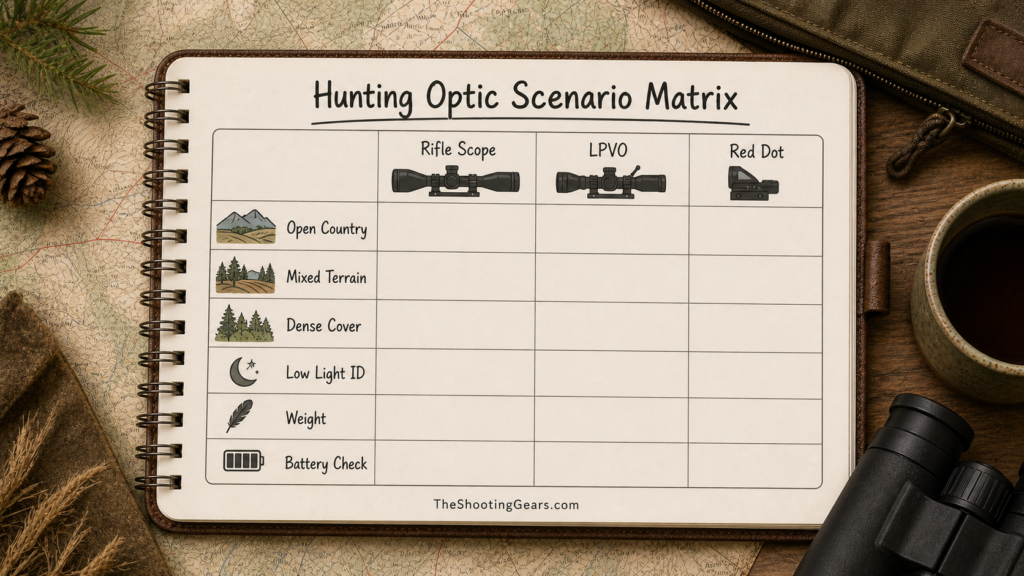
Field of View, Eye Relief, and Low-Light ID
Field of view, eye relief, and low-light identification often decide the optic choice. A red dot gives the widest and most forgiving close-cover view, but it does not magnify distant detail. A magnified scope gives reach for identification and observation, but it narrows the view as magnification increases. An LPVO offers a flexible middle ground.
In low light, magnification can help you study detail, but no optic guarantees identification. Glass quality, conditions, legal shooting light, and your own judgment all matter. The Leupold glossary is useful for checking optic terms, and our reticle guide explains reticle choices in more detail.
Comparison by Hunting Scenario
Use this scenario map as a starting point, not a rule. Your terrain, eyesight, firearm setup, and local rules matter more than any label.
| Scenario | Often Fits | Why | Watch Out For |
|---|---|---|---|
| Dense woods | Red dot or LPVO at 1x | Wide view and fast acquisition | Limited reach to study distant detail |
| Mixed terrain | LPVO | Close-view flexibility plus modest magnification | Weight and eye relief |
| Stand hunting | Magnified scope or LPVO | More time to settle and identify | Head position and field of view |
| Open country | Magnified scope | More reach for observation and identification | Narrower view at higher power |
| Low-light identification | Magnified scope or LPVO | Magnification can help study detail | No optic replaces legal light or target ID |
| Battery simplicity | Non-illuminated scope | Usable reticle without battery | Less illuminated aiming help |
Weight, Battery, and Maintenance Notes
A red dot is usually the lightest and most compact, but it depends on a battery. A magnified scope varies widely by model and may work without a battery if the reticle is etched. An LPVO is flexible but often heavier than a red dot. Keep lenses clean, verify mounts are secure, and follow manufacturer torque and setup guidance.
Safe firearm handling still comes first. The NSSF primary firearm safety rules are worth reviewing before any range or hunting setup work.
Frequently Asked Questions
Is a rifle scope or red dot better for hunting?
Neither is better for all hunting. A magnified scope suits open country and longer identification, a red dot suits close cover and fast aiming, and an LPVO bridges the two.
Can you hunt with a red dot sight?
Yes, many hunters use red dots in dense woods or close cover. The main tradeoffs are limited magnification for distant detail and dependence on battery power.
Is an LPVO good for hunting?
An LPVO can work well in mixed terrain because it offers a wide low-power view and modest magnification. It also carries scope-style eye relief and is often heavier than a red dot.
Are red dot sights parallax-free?
Some manufacturers describe red dots as having minimal parallax across a usable range, but treat any parallax-free wording as a design-specific manufacturer claim, not an absolute. Check the specific optic documentation.
Which optic is best in low light for hunting?
No optic guarantees low-light identification. A magnified scope or LPVO can help you study detail, while a red dot gives a fast, wide view with limited magnification. Legal shooting light and target/backstop identification still control the decision.
Final Takeaway
Choose a hunting optic by scenario. Use a magnified rifle scope when distance and detail matter most, a red dot when close-cover speed and a wide view matter most, and an LPVO when you need flexibility between the two. Then verify the exact model’s specifications, mount setup, battery needs, and legal hunting rules before relying on it in the field.

