
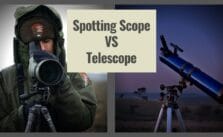
Choose a spotting scope for daytime outdoor viewing, hunting observation, birding, target checks, and rugged field use. Choose a telescope for astronomy, night-sky viewing, and high-magnification observation of the moon, planets, and deep-sky objects. A spotting scope is the practical field tool; a telescope is the better astronomy tool.
This comparison explains the difference without turning the page into a product roundup. The best choice depends on what you want to observe, where you will use the optic, and whether you need portability, weather resistance, angled/straight viewing, or astronomy-style mounting.
Table of Contents
Quick Comparison
| Factor | Spotting scope | Telescope |
|---|---|---|
| Best role | Daytime field observation | Astronomy and night-sky observation |
| Typical subjects | Targets, birds, wildlife, terrain, distant objects in daylight | Moon, planets, stars, nebulae, astronomy targets |
| Portability | Usually more field-friendly | Varies, but many astronomy setups are bulkier |
| Weather use | Often built for outdoor field conditions | Depends on model; many are less field-rugged |
| Mounting | Tripod or compact field support | Astronomy mount or tripod designed for sky tracking |
| Beginner choice | Better for hunters, birders, range users, and hikers | Better for astronomy learners |
What A Spotting Scope Does Better
A spotting scope is designed as a compact field optic. It usually gives more magnification than typical binoculars while staying more portable and field-oriented than most astronomy telescopes.
Daytime field viewing
Spotting scopes are strong for daylight tasks: checking distant targets, observing wildlife, scanning terrain from a fixed point, or studying birds from a blind, overlook, or shoreline.
Portability and ruggedness
Many spotting scopes are built for outdoor movement, compact tripods, and field conditions. They are still more demanding than binoculars, but they are usually easier to carry and deploy than a full astronomy telescope setup.
Range and hunting observation
For shooting ranges and hunting glassing points, a spotting scope makes more sense than a telescope. It is easier to aim at ground-level subjects, easier to pack, and more aligned with daytime outdoor use.
What A Telescope Does Better
A telescope is the better choice when the job is astronomy. Telescopes are built around sky viewing, specialized mounts, and higher-magnification or larger-aperture setups that are not usually practical for a hunter or range user.
Astronomy and night-sky detail
If your main goal is looking at the moon, planets, stars, or other sky objects, a telescope is the correct tool. NASA’s Hubble overview is a useful reminder that telescope design is fundamentally tied to observing distant astronomical objects.
Aperture and specialized mounts
Many telescopes use larger apertures and astronomy mounts that make sense for sky viewing. Those advantages matter at night, but they also make many telescopes less convenient for a backpack, blind, truck seat, or shooting bench.
Not ideal for quick field scanning
A telescope can sometimes view daytime objects, but it is usually not the best tool for moving wildlife, range checks, or rough outdoor use. A spotting scope is faster and more practical in those situations.
Which Should You Buy First?
Buy a spotting scope first if your main use is hunting, target shooting, birding, wildlife observation, or outdoor travel. Buy a telescope first if your main use is astronomy. If your use case includes both, decide which activity you will actually do more often.
For many outdoor users, binoculars come first, a spotting scope comes second, and a telescope is only necessary if astronomy becomes a separate hobby. For astronomy users, the order is different: a telescope and stable mount matter more than a compact field optic.
Use-Case Guide
For hunting and scouting
Use a spotting scope. It is easier to carry, easier to aim at terrestrial subjects, and better matched to daylight field observation.
For target shooting
Use a spotting scope on a stable tripod or bench support. It can help you check targets without walking downrange, but it never replaces range commands or safe range procedure.
For birding and wildlife
Use a spotting scope when you are stationary and need detail at distance. Use binoculars for scanning and moving subjects. A telescope is rarely the first choice for this use.
For astronomy
Use a telescope. A spotting scope can show the moon or bright objects casually, but it is not the right long-term replacement for an astronomy telescope and mount.
Mistakes To Avoid
- Buying a telescope for hunting or shooting-range target checks.
- Buying a spotting scope and expecting it to perform like a dedicated astronomy telescope.
- Ignoring tripod or mount quality.
- Comparing magnification only and ignoring field use, weight, eye relief, and viewing angle.
- Forgetting that daylight field use and night-sky use are different jobs.
Frequently Asked Questions
Can a spotting scope be used for astronomy?
Yes, casually. A spotting scope can view the moon and some bright objects, but it is not a full substitute for an astronomy telescope if night-sky viewing is your main hobby.
Can a telescope be used as a spotting scope?
Sometimes, but it is usually awkward. Many telescopes are less rugged, less portable, and less convenient for daytime terrestrial viewing than a spotting scope.
Which is better for shooting range use?
A spotting scope is usually better for range use because it is designed for terrestrial viewing and works well on a bench or tripod. A telescope is better saved for astronomy.
Which is better for beginners?
For outdoor viewing, a spotting scope is easier to justify. For astronomy, a beginner telescope is the better match. The right beginner tool depends on whether your first priority is daytime field use or night-sky viewing.
Final Recommendation
For hunting, birding, wildlife observation, and shooting-range target checks, choose a spotting scope. For the moon, planets, stars, and astronomy, choose a telescope. The simplest decision rule is this: spotting scopes are for daytime field detail; telescopes are for the sky.