


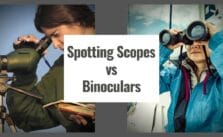
Choose binoculars when you need fast, handheld scanning and a wider view. Choose a spotting scope when you need more magnification for distant targets, birds, wildlife, or terrain and you are willing to use a tripod. Most hunters, birders, and range users eventually understand the split this way: binoculars find things faster; spotting scopes inspect distant detail better.
This comparison explains the practical difference between spotting scopes and binoculars without turning the page into a product roundup. If you are shopping later, use this guide to decide which optic type fits the job before comparing brands, prices, or models.
Table of Contents
Quick Comparison
| Factor | Binoculars | Spotting scope |
|---|---|---|
| Best role | Fast scanning, walking, glassing, general observation | Detailed viewing at longer distance |
| Typical handling | Handheld | Tripod or steady support |
| Field of view | Usually wider and easier to scan | Usually narrower, especially at higher magnification |
| Magnification | Moderate and easier to stabilize by hand | Higher magnification for detail work |
| Portability | Easier to carry all day | Bulkier once scope and tripod are included |
| Best for beginners | Usually the first optic to buy | Better as a second optic when distance detail matters |
What Binoculars Do Better
Binoculars use two optical tubes so both eyes can view at once. In the field, that makes them comfortable for scanning, tracking movement, and checking a wide area without setting up a tripod.
Faster scanning
Binoculars are usually the better tool when you are searching for movement, following birds, glassing a hillside, or checking multiple lanes at a range. You can raise them quickly, scan, lower them, and move without rebuilding your setup.
Better portability
A pair of binoculars is usually easier to carry than a spotting scope plus tripod. That matters on long walks, public-land hunts, scouting trips, travel, and casual nature observation.
More forgiving handheld use
Moderate magnification is easier to hold steady. Once magnification gets high, every hand movement is more obvious. This is one reason binoculars are often the first optic for beginners.
What Spotting Scopes Do Better
A spotting scope is built for higher-magnification observation. It is not as fast or as portable as binoculars, but it can show detail that ordinary handheld binoculars may not resolve at distance.
More detail at distance
Use a spotting scope when your main question is not “where is it?†but “what exactly am I looking at?†This can matter for reading target impacts, judging distant wildlife detail, watching birds from a fixed position, or glassing terrain from an overlook.
Tripod-supported viewing
Higher magnification works best when the optic is steady. A tripod turns a spotting scope from a shaky high-power tube into a useful observation tool. The tradeoff is that tripod setup adds weight, bulk, and time.
Better for fixed observation
If you are staying in one spot and need to study a distant subject, the spotting scope has the advantage. If you are moving constantly or scanning close-to-medium range, binoculars are usually easier.
Which Should You Buy First?
Most people should buy binoculars first unless they already know they need high magnification from a fixed position. Binoculars cover more everyday use: scouting, hiking, birdwatching, hunting, travel, and general outdoor viewing.
A spotting scope makes more sense when you already have binoculars and keep running into the same problem: the subject is too far away for the detail you need. At that point, a scope and tripod can be a useful second optic.
Use-Case Guide
For hunting
Binoculars are usually the first hunting optic because they are faster and easier to carry. A spotting scope can be useful for open-country glassing, long-distance observation, or situations where you plan to sit and study terrain for a while.
For birdwatching and wildlife viewing
Binoculars are better for moving subjects and casual birding. A spotting scope is stronger from a fixed location, such as shorebirds, waterfowl, raptors, or distant wildlife where detail matters more than speed.
For shooting range use
At closer ranges, binoculars may be enough for quick target checks. At longer distances, a spotting scope on a stable tripod can make it easier to see impacts without walking downrange. Always follow range commands and never use optics as a substitute for safe range procedure.
Mistakes To Avoid
- Buying a spotting scope when you really need a lightweight scanning optic.
- Buying high-magnification binoculars that are too shaky to handhold comfortably.
- Forgetting that a spotting scope usually needs a tripod to perform well.
- Comparing only magnification and ignoring field of view, weight, eye relief, and low-light needs.
- Assuming one optic is always better; the right choice depends on the task.
Frequently Asked Questions
Are spotting scopes better than binoculars?
Spotting scopes are better for detailed long-distance viewing from a steady position. Binoculars are better for handheld scanning, portability, and general outdoor use. Neither is automatically better for every person.
Can binoculars replace a spotting scope?
Binoculars can replace a spotting scope for general scanning and moderate-distance viewing. They usually cannot match a tripod-mounted spotting scope when you need high magnification and fine detail at longer distances.
Do spotting scopes need a tripod?
Most spotting scopes are much more useful on a tripod or stable support. Higher magnification makes hand movement obvious, so support matters more as power increases.
What is better for beginners?
Binoculars are usually better for beginners because they are easier to carry, easier to aim, and more useful across many outdoor activities. A spotting scope is a good second optic when distance detail becomes the limiting factor.
Final Recommendation
If you can only choose one, start with binoculars for general outdoor use. Add a spotting scope when you need a tripod-supported optic for distant detail. The simplest rule is still the best one: binoculars help you find and follow; spotting scopes help you study from farther away.

