


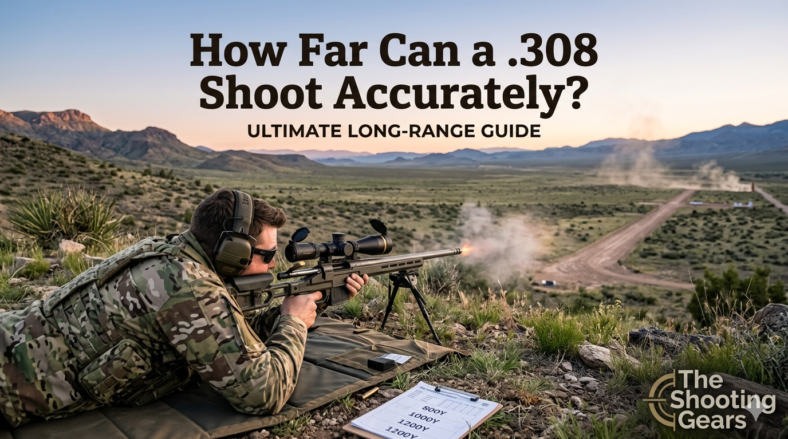
There is no single distance at which a .308 stops being accurate, because effective range is set by the whole system, not just the cartridge. The rifle, the ammunition, the optic, the conditions, and above all the shooter’s skill decide how far you can place repeatable, confident hits. The .308 Winchester is a capable, popular cartridge, but the honest answer to how far it shoots accurately is the distance at which you can consistently hit your intended target from realistic positions. For hunting, that distance is also limited by your duty to make a clean, ethical shot.
Table of contents
Quick answer
The accurate range of a .308 depends on the shooter, the rifle, the load, the optic, and the conditions working together. Many capable shooters with quality equipment can keep hits on a reasonable target at several hundred yards under good conditions, while a new shooter or rough conditions can shrink that distance considerably. Rather than chasing a maximum number, define the distance where you can repeat clean hits from the positions you actually use, then stay inside it.
Why a fixed number is misleading
A single advertised yardage ignores the variables that decide a real shot. The same rifle and load can produce tight groups one day and scattered hits the next, depending on wind, position, fatigue, and light. Treat any maximum-range claim with caution and prove your own limit on paper before you rely on it.
What “accurate” actually means
Accuracy is the ability to place shots where you intend, repeatedly. A rifle that prints a tight group at the bench is mechanically capable, but practical accuracy in the field also depends on whether you can repeat that result under pressure, in wind, and from unsupported or improvised positions. The distinction between bench accuracy and field accuracy matters a lot when you set a personal limit.
Group size and consistency
Consistency over many shots tells you more than a single small group. A rifle that groups well across several strings, days, and positions gives you a dependable basis for an effective range. One lucky group does not.
Shooter skill is the biggest factor
The shooter is usually the largest variable in effective range. Trigger control, breathing, position, follow-through, and the ability to read conditions separate a confident hit from a missed or wounded animal. Skill is built through practice, not bought with equipment.
Fundamentals first
Solid fundamentals at moderate distance extend your effective range more than any single piece of gear. If your groups open up at a given distance from field positions, that is your honest limit, regardless of what the rifle can do off a bench.
Position matters
A supported prone position is far steadier than a quick standing or kneeling shot. Practice in the positions you will actually use, because a benchrest result does not transfer directly to a tree stand, a hillside, or a hasty rest in the field.
The rifle and its setup
The rifle and how it is set up shape what is possible. Barrel quality, a good trigger, a stable stock, and a properly mounted scope all contribute to repeatable accuracy. A well-built, well-maintained rifle gives you a consistent platform to work from.
A solid zero and mounting
A confirmed zero and a correctly mounted, torqued scope are the foundation. A loose mount or an unconfirmed zero will scatter shots no matter how good the rifle and load are. Confirm your zero before each season and after any travel or rough handling.
Fit and comfort
A rifle that fits you, with a comfortable length of pull and manageable recoil, is easier to shoot well over many rounds. Recoil that punishes you encourages flinching, which hurts accuracy long before the cartridge runs out of capability.
Ammunition consistency
Consistent ammunition produces consistent results. The .308 Winchester is a standardized cartridge, and you can review its standardized chamber and pressure data through SAAMI, the organization that publishes voluntary industry standards for ammunition. Pick a quality load your rifle shoots well and stick with it once you confirm it on paper.
Find what your rifle likes
Different rifles prefer different loads. Testing a few quality factory options and choosing the one with the best, most repeatable groups in your rifle is a practical way to improve real accuracy. Always follow the ammunition and firearm manufacturer’s guidance, and do not chase performance with unsafe or unverified handloads.
The optic
A clear, appropriate optic lets you aim precisely at distance. The right magnification, a reticle you understand, and a scope that holds zero all support accurate shooting. The optic does not add capability the shooter lacks, but a poor or unreliable optic can take capability away.
Match magnification to the task
Enough magnification to identify and aim at your target clearly is useful, but more power magnifies wobble and narrows your view. Choose a magnification range that fits the distances and conditions you actually shoot rather than the highest number available.
Wind and conditions
Wind is one of the hardest variables to manage and one of the most likely to cause a miss at distance. Light, mirage, temperature, and terrain also affect both your ability to see the target and the bullet’s path. Conditions can shrink a confident range quickly.
Reading the wind
Wind effect grows with distance and with crosswind strength, so the same breeze that is trivial up close can move a shot well off target far away. Learning to observe and estimate wind is a core long-range skill. The National Weather Service offers general wind safety information that can help you think about how wind behaves outdoors.
Light and visibility
Poor light and heavy mirage make target identification harder and reduce your effective range. If you cannot clearly identify the target and confirm what is beyond it, the shot is not within your safe range, period.
Ethical hunting range
For hunting, the effective range is limited not just by what you can hit but by your responsibility to make a quick, clean shot. An ethical hunting range is the distance at which you can reliably place a shot in the vital area from your real field position, under the conditions present, with margin for error. That distance is usually shorter than the maximum distance you can hit a paper target.
Set a personal limit
Decide your maximum hunting distance based on honest practice results, not on what the cartridge can theoretically do. If you cannot keep every practice shot in a vital-sized area at a given distance from field positions, that distance is beyond your ethical limit for that day and those conditions.
Pass on marginal shots
If wind, light, angle, or your own steadiness is questionable, the ethical choice is to pass. A clean miss is recoverable, but a poorly placed shot is not. Good hunters are defined as much by the shots they decline as the ones they take. If you are unsure, wait and get closer.
Range safety and knowing your backstop
A .308 carries a long way, so safe shooting depends on always knowing your target and what lies beyond it. Review and follow the firearm safety fundamentals from the NSSF, including treating every firearm as loaded, keeping the muzzle pointed in a safe direction, and being certain of your backstop before any shot.
Practice at a proper range
Build distance skills at a supervised range with adequate backstops and clear distance markers. Confirming your real accuracy on paper at known distances is the safe way to learn your limits before applying them in the field. Keep a simple range log with distance, position, group size, wind, and load, because written results are more honest than memory when you decide where your limit really is. Follow all range rules and any local regulations.
Frequently asked questions
What is the maximum range of a .308?
A .308 bullet can travel a very long distance, but maximum travel is not the same as accurate range. Your accurate range is the distance at which you can place repeatable hits, which is set by skill, equipment, and conditions, not by the cartridge alone.
Is a .308 good for long-range shooting?
It is a capable, popular cartridge with widely available quality ammunition. How far you can shoot it accurately depends on your practice, rifle, optic, and the conditions on the day, not on the cartridge name.
How do I find my own effective range?
Shoot at a range at increasing distances from the positions you actually use, in realistic conditions. Your effective range is the farthest distance where you can keep every shot in a vital-sized or appropriate target area, repeatedly.
Does the scope change how far a .308 can shoot accurately?
A good optic helps you aim precisely and hold a steady zero, which supports accuracy. It does not create skill the shooter lacks, but an unreliable optic can reduce accuracy you would otherwise have.
Final takeaway
How far a .308 shoots accurately is a question about the whole system and the person behind the rifle, not just the cartridge. Build your skills, set up a reliable rifle and optic, choose consistent ammunition, learn the conditions, and confirm your real limits on paper. For hunting, let ethics tighten that limit further so every shot you take is one you can make cleanly. Know your target and your backstop, and when anything is in doubt, hold off.