


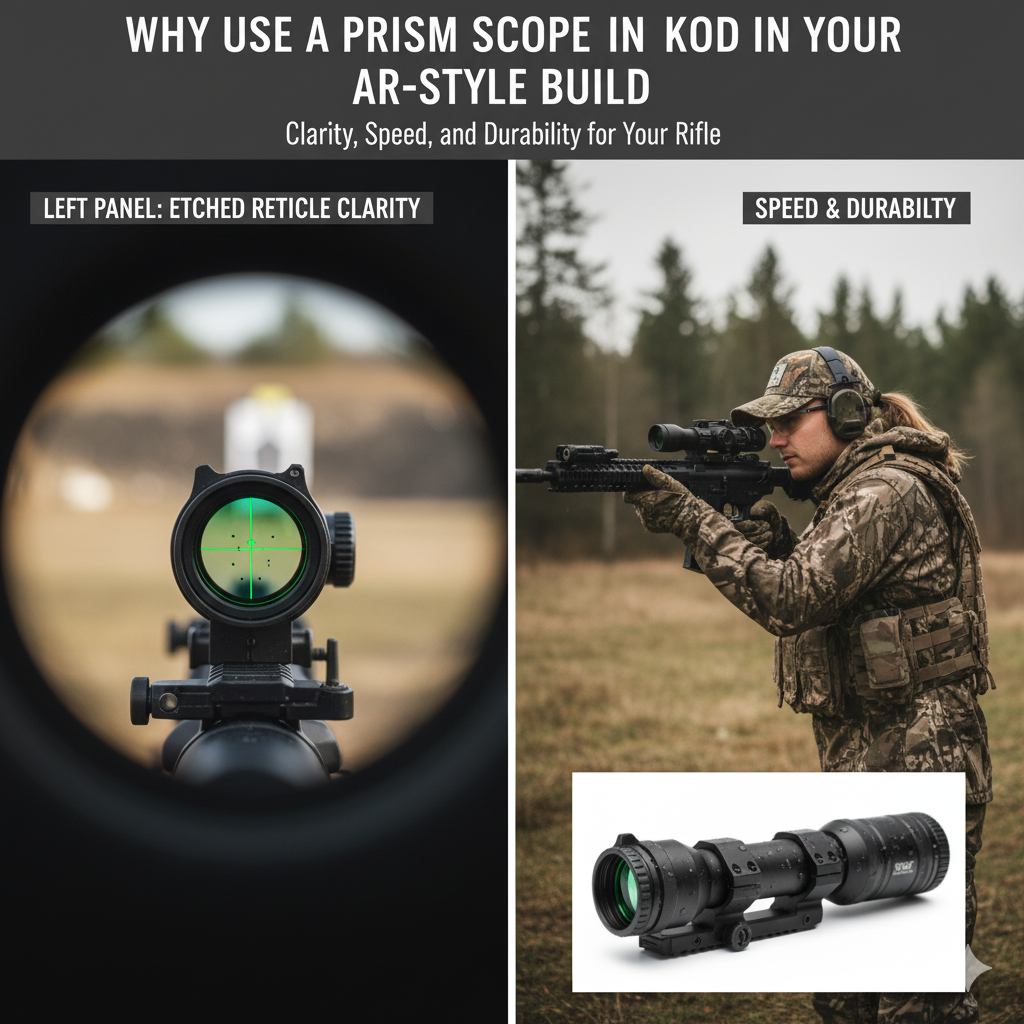
A prism scope is a compact optic that uses a glass prism instead of a series of lenses to focus the image, and it suits an AR-style build when you want a fixed low magnification, an etched reticle that stays visible even with battery failure, and an image that many shooters with astigmatism find cleaner than a red dot. It is a practical choice for range practice and close to mid range hunting where you do not need variable magnification. This guide explains where a prism scope helps, where it does not, and how to decide if one fits your rifle.
Table of contents
What Is a Prism Scope
A prism scope is a sealed optic that focuses light through a single prism rather than the longer lens stack found in a traditional rifle scope. That design lets the optic stay short and light while still offering true optical magnification, usually in a fixed power such as 1x, 3x, or 5x. Most prism scopes use a glass-etched reticle, which means the aiming mark is physically engraved on the glass and stays usable even when the illumination is off or the battery dies.
Because the reticle is etched, a prism scope can offer a more detailed aiming pattern than a simple dot. Many models include holdover marks, ranging brackets, or a center chevron. For general firearm safety and handling context before you mount any optic, the National Shooting Sports Foundation firearm safety rules are a useful reference.
Prism Scope vs Red Dot vs LPVO
A prism scope sits between a red dot and a low power variable optic in capability. A red dot has no magnification and a very wide field of view, which makes it fast at close range, but it relies entirely on a projected dot that some eyes do not see cleanly. A low power variable optic, often called an LPVO, gives you a magnification range such as 1x to 6x but is longer, heavier, and usually more expensive. A prism scope offers a single fixed magnification with an etched reticle, splitting the difference for a shooter who wants a little magnification and a crisp aiming point in a compact package.
When each makes sense
- Red dot: fastest target acquisition at close range, lightest, simplest, but no magnification and dot quality depends on your eyes.
- Prism scope: fixed magnification, etched reticle visible without power, compact, good for a shooter who wants a defined aiming point at known distances.
- LPVO: most flexible across distance, but heavier, longer, and a larger investment.
Why Shooters With Astigmatism Often Prefer a Prism Scope
Shooters with astigmatism often see a red dot as a smear, starburst, or comet tail rather than a clean round dot, because the projected dot relies on the eye’s own focusing. A prism scope places the reticle on a fixed glass surface that the eye focuses on like any printed image, so the aiming mark stays sharp regardless of astigmatism. Many shooters who struggle with red dots find this the single most useful reason to choose a prism optic.
If you are unsure whether astigmatism is affecting how you see a dot, an eye care professional can confirm it. Adjusting the optic’s diopter or reticle illumination brightness can also help, but the etched reticle remains the core advantage for this group.
Fixed Magnification and the Etched Reticle
A prism scope’s fixed magnification is both a strength and a constraint. The strength is simplicity: there is no zoom ring to manage, the optic is shorter, and the reticle is calibrated for that single magnification, so holdover marks read consistently. The constraint is that you cannot dial down to a true 1x for very fast close work or zoom up for longer shots. You pick the magnification that matches your most common distance and accept the tradeoff.
Choosing a magnification
- 1x prism: behaves much like a red dot but with an etched reticle, best for close range and fast shooting.
- 3x prism: a common all-around choice for range work and close to mid range field use.
- 5x prism: more reach for known mid range targets, but a narrower field of view and slower up close.
Eye Relief and Mounting on an AR-Style Build
Prism scopes generally have shorter and less forgiving eye relief than a full size variable scope, meaning your eye needs to sit within a fairly specific distance and position behind the optic to see a full, clear image. On an AR-style platform the flat-top rail makes mounting straightforward, but you should confirm the optic’s eye relief works with your cheek weld and stock length before you settle on a position. For more on this measurement, see our explanation of what eye relief is.
Mount the optic so your head sits naturally on the stock and the full sight picture appears without straining forward or back. Follow the optic and mount manufacturer’s torque guidance, and confirm the rifle is unloaded before any mounting or sighting work. Use the optic maker for model-specific mounting height and eye relief figures, then confirm fit at the range before hunting with it.
Where a Prism Scope Falls Short
A prism scope is not the right pick for every shooter. The fixed magnification limits flexibility, the field of view is narrower than a red dot, and the eye relief is less forgiving, which can slow you down at close range. Prism optics also tend to be a little heavier than a compact red dot of the same footprint. If your main need is the widest possible field of view, the fastest close range speed, or a single optic that covers everything from point blank to long range, a red dot or an LPVO may serve you better.
Who a Prism Scope Suits
A prism scope suits a civilian shooter who wants a compact optic with a sharp etched reticle for range practice or close to mid range hunting, and it is especially worth considering for anyone whose eyes do not resolve a red dot cleanly. It is a sensible choice when you mostly shoot at a consistent distance and value a durable, simple optic over zoom flexibility. If you need long range reach or maximum close range speed, look at a variable scope or a red dot instead.
Frequently Asked Questions
Is a prism scope good for astigmatism?
Yes, many shooters with astigmatism prefer a prism scope. Its reticle is etched on the glass, so the eye focuses on it like any printed image instead of relying on a projected dot that astigmatism can blur. An eye care professional can confirm whether astigmatism is affecting your sight picture.
Does a prism scope work without a battery?
Yes. Because the reticle is physically etched on the glass, you can still aim with a prism scope when the illumination is off or the battery is dead. The illumination only makes the reticle brighter in low light or against dark targets.
What magnification should I choose for a prism scope?
Match the magnification to your most common distance. A 1x behaves like a red dot for close range, a 3x is a flexible all-around choice, and a 5x gives more reach for known mid range targets at the cost of field of view and close range speed.
Can I use a prism scope for hunting?
A prism scope can work for close to mid range hunting where its fixed magnification covers your expected distances. Confirm legal optic and equipment rules with your state wildlife agency before any hunt, since requirements vary by location and season.
Final Takeaway
A prism scope earns its place on an AR-style build when you want a compact optic with a fixed magnification and a crisp etched reticle, and it is one of the best options for shooters whose eyes do not see a red dot cleanly. Weigh the narrower field of view and tighter eye relief against the clarity and simplicity it offers, match the magnification to how you actually shoot, and confirm any hunting equipment rules with your state wildlife agency before heading afield.