


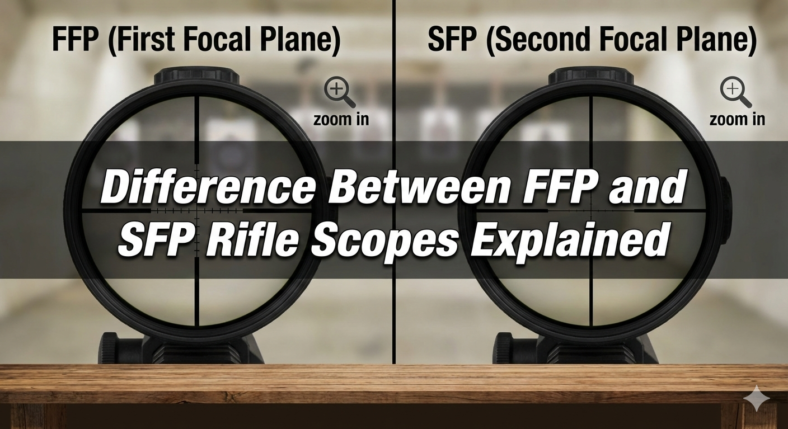
The difference between a first focal plane (FFP) and second focal plane (SFP) rifle scope is how the reticle behaves when you change magnification. In an FFP scope, the reticle grows and shrinks with the image, so hold marks keep the same value at any power. In an SFP scope, the reticle stays the same visible size, so hold marks are exact only at one calibrated magnification, usually the highest.
That one behavior drives most of the practical choice. FFP is useful when you rely on reticle holds at changing magnification. SFP is often simple and visible for general hunting where many shots use a center aim. This article explains the tradeoffs without ranking products or recommending brands.
Table of Contents
How a First Focal Plane (FFP) Scope Works
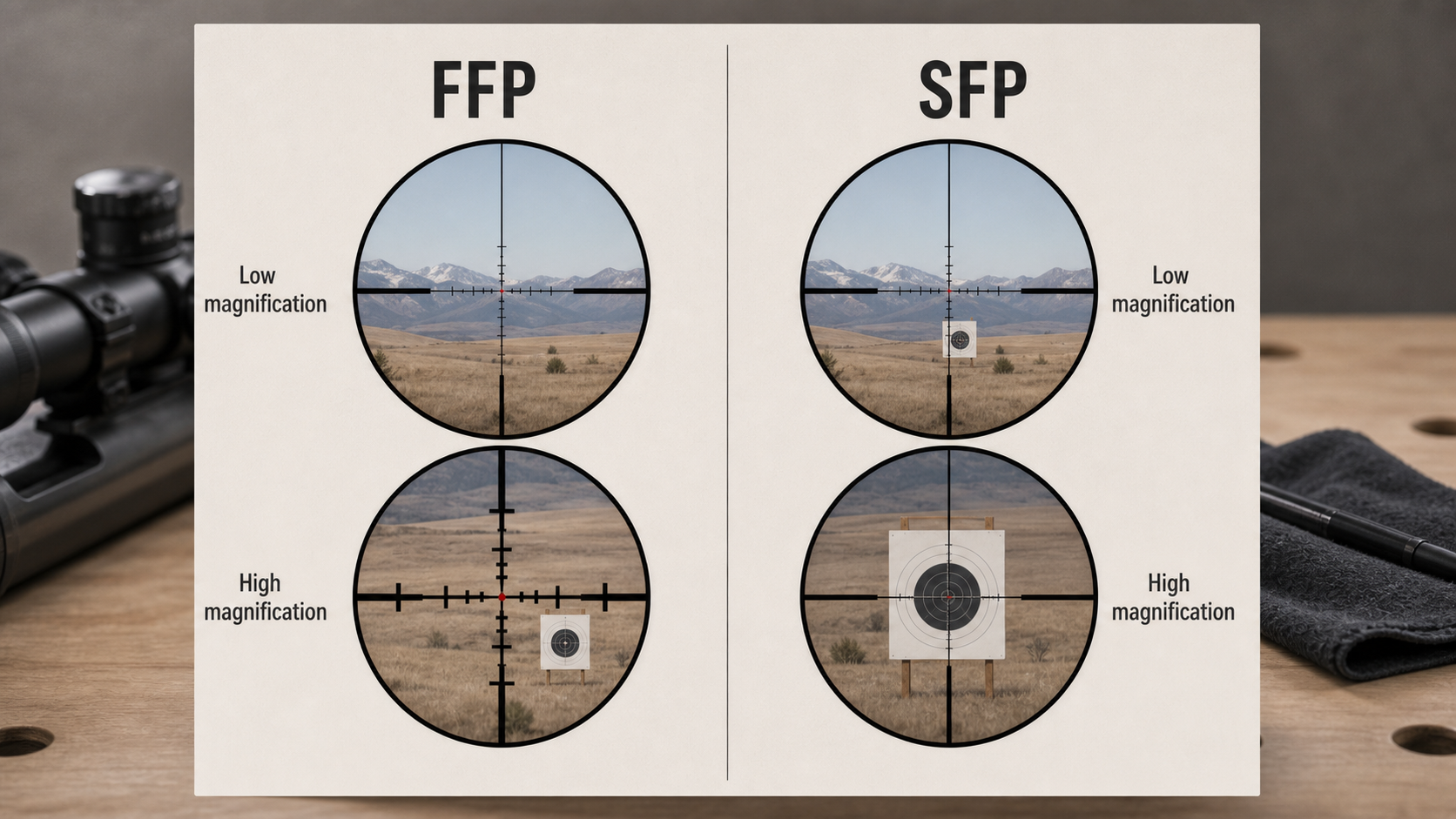
In a first focal plane scope, the reticle is positioned so it scales with the target image as magnification changes. When you zoom in, the reticle appears larger. When you zoom out, it appears smaller. Because the reticle and image scale together, the spacing between the reticle marks stays correct relative to the target at every magnification.
What FFP Means in Practice
The main benefit is consistency for reticle holds. If a reticle mark represents a certain angular value, that value remains useful across the zoom range. The tradeoff is visibility. At low magnification the reticle can look very thin, while at high magnification it can look thick enough to cover small details.
That does not automatically make FFP the premium choice for every shooter. It simply means the scope is more forgiving when you change magnification and still want to use the reticle for wind or elevation holds. The best fit depends on whether you actually use those marks in the field or mostly dial, center-hold, and shoot at familiar distances.
How a Second Focal Plane (SFP) Scope Works
In a second focal plane scope, the reticle stays the same visible size while the target image grows and shrinks as you zoom. That makes the reticle look familiar at every power, but it also means the spacing between hold marks is exact only at one calibrated magnification.
What SFP Means in Practice
The practical benefit is a reticle that remains easy to see at low power and does not become overly thick at high power. The tradeoff is that holdover and ranging marks need the correct calibrated power. If you use those marks at the wrong magnification, they can mislead you.
This is why many hunting scopes still use SFP. A visible reticle at dawn, dusk, or inside cover can matter more than all-power hold accuracy. If you mostly use the center crosshair, or if you keep the scope on its highest calibrated power before using hold marks, SFP can be simple, predictable, and easier to read quickly.
For basic definitions, neutral references such as telescopic sight and reticle explain the terms at a high level. For your own scope, the manual is still the authority for calibrated magnification and reticle subtensions.

FFP vs SFP for Hunting
For general hunting, SFP remains popular because the reticle is easy to see at low magnification, especially in timber, low light, and fast target-acquisition situations. If most shots use a center aim and happen at moderate distance, the calibrated-power limitation may not matter much.
When a Hunter Might Prefer FFP
A hunter who regularly uses holdover marks at changing distances may prefer FFP because the marks stay valid as magnification changes. The tradeoff is that the reticle can be harder to see on the lowest powers. If you hunt with LPVOs, our guide on whether a 1-4×24 LPVO is good for hunting adds more low-power context.
For woods hunting, short lanes, and quick shots, SFP often feels more natural because the reticle remains bold enough to pick up fast. For open-country hunting, mixed distances, or situations where you may hold for wind without touching the turrets, FFP can reduce mental steps. The practical question is not which focal plane is more advanced; it is which one gives you fewer mistakes under your normal shot conditions.
FFP vs SFP for Range and Target Shooting
For range work with varied distances, reticle holds, and target transitions, FFP can be easier to manage because the marks remain valid across the zoom range. You can choose the magnification that gives the best target view without changing what the marks mean.
When SFP Still Works Well at the Range
SFP can still work well for known-distance shooting, especially when you keep the scope at one magnification or use turret adjustments instead of reticle holds. If your magnification stays constant and your target distance is known, focal plane becomes less important than clear tracking, a good zero, and repeatable fundamentals.
Target size also matters. On small aiming points at high magnification, some shooters prefer the finer apparent reticle of an SFP scope. On varied target arrays where you move between magnifications, FFP can be easier because the reticle math does not change. Either way, confirm the scope on paper before trusting a reticle chart or ballistic app.
Reading Holdover and Ranging Marks Safely
Holdover and ranging marks are only useful when you know how your scope calibrates them. On an SFP scope, check the manual for the exact magnification where the reticle subtensions are correct. On an FFP scope, marks scale across magnification, but you still need to understand the reticle unit and confirm your zero.
Focal plane does not replace sight-in work. Zero the rifle normally and verify your setup before relying on any reticle mark. Our step-by-step rifle scope sight-in guide covers the zeroing side of the process.
Before buying, look for three details in the product manual or reticle guide: the reticle unit, the calibrated magnification if it is SFP, and whether the reticle design is visible enough at the lowest power you expect to use. Those details are more useful than marketing labels because two scopes can both be FFP or SFP and still feel very different behind the rifle.
FFP vs SFP Comparison Table
| Feature | First Focal Plane (FFP) | Second Focal Plane (SFP) |
|---|---|---|
| Reticle size as you zoom | Grows and shrinks with magnification | Stays the same visible size |
| Hold marks accurate at | Any magnification | One calibrated power, often highest |
| Low-power visibility | Can look thin | Usually easier to see |
| High-power appearance | Can look thick | Stays fine and consistent |
| Common strength | Varied-distance holdover use | Simple hunting visibility |
| Main caution | Reticle visibility at extremes | Marks can mislead at wrong power |
Related Rifle Scope Guides
Frequently Asked Questions
What is the main difference between FFP and SFP scopes?
FFP reticles scale with magnification, so reticle marks stay valid at any power. SFP reticles stay the same visible size, so reticle marks are exact only at one calibrated magnification.
Is FFP or SFP better for hunting?
Neither is always better. SFP is common for general hunting because the reticle stays easy to see. FFP can help hunters who use hold marks at changing magnification and varied distances.
Do SFP reticle marks work at all magnifications?
No. SFP hold and ranging marks are exact at the scope’s calibrated magnification. Check the manual for that power before relying on the marks.
Why does an FFP reticle look thin at low power?
Because an FFP reticle scales down as magnification decreases. That scaling keeps the marks valid, but it can make the reticle harder to see at the lowest powers.
Does focal plane affect my zero?
No. Focal plane affects reticle behavior as magnification changes. You still zero the scope normally and verify the setup with live-fire confirmation.

