


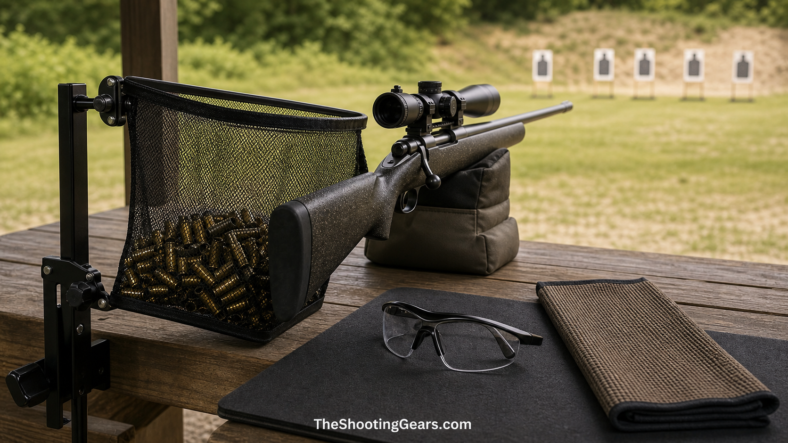
A brass catcher is a mesh or bag accessory that collects spent cartridge cases as they eject. It can save cleanup time, help reloaders keep their brass together, and reduce the chance of cases rolling across a bench or into the dirt. The important catch is compatibility: a brass catcher must fit your firearm and must not interfere with ejection, controls, sight setup, or safe operation.
This guide explains what brass catchers do, who they help, and the checks to make before buying one. It is a benefits-and-features explainer, not a product roundup, and it does not claim any one catcher fits every firearm.
Table of Contents
What a Brass Catcher Does
A brass catcher collects spent cases as the firearm ejects them, usually into a mesh basket or fabric bag mounted near the ejection port. Instead of brass scattering across the ground, a bench, or a neighboring lane, the cases land in the catcher for easier collection.
Manufacturers such as Caldwell treat brass catchers as a standard range-gear category, and designs vary by firearm type, attachment point, and ejection pattern.
Main Benefits of a Brass Catcher
The core benefit is convenience. A brass catcher reduces cleanup time, keeps your shooting area tidier, and helps prevent brass from rolling away or landing where it is hard to retrieve.
For shooters who reload, it also keeps spent cases together and cleaner than brass that has scattered across dirt, sand, or gravel. It can also reduce the nuisance of hot brass bouncing around a covered bench, though it does not replace eye protection, safe handling, or normal range awareness.
Where Brass Catchers Help Most
Brass catchers help most in a few specific situations. High-volume range shooters save the most cleanup time. Reloaders benefit from keeping their own cases separated and cleaner. Shooters at shared benches may also appreciate not sending brass into neighboring lanes.
If you only shoot a few rounds occasionally and do not reload, the convenience may matter less. In that case, the decision is mostly about range etiquette and cleanup preference rather than necessity.
Compatibility Checks Before Buying
Compatibility is the most important thing to check because no brass catcher fits every firearm. Catchers are designed around specific attachment points and ejection patterns. Some mount to a rail, some attach around the receiver, and some are made for a narrower firearm family or ejection-port design.
Before buying, confirm the catcher is intended for your firearm type and that it will sit where your gun actually ejects. Check rail or mount type, optic clearance, charging-handle access, ejection pattern, and manufacturer guidance. When a listing is vague about fit, verify with the manufacturer instead of assuming it will work.
Safety and Function Checks
A brass catcher must not compromise how your firearm operates. Before relying on one, confirm at the range that it does not block ejection, interfere with controls, contact the optic or mount, or cause cases to bounce back toward the ejection port.
Follow your firearm manual, the brass catcher maker’s instructions, and the range’s rules. Basic firearm safety still applies whenever the catcher is attached; the NSSF firearm safety rules are a useful baseline. Stop using the catcher if it causes any ejection or handling problem.
Limitations and Common Problems
Brass catchers have real limitations. A poorly fitted catcher can cause cases to bounce back toward the ejection port, fail to clear, or collect in a way that creates a stoppage. Some designs fill up, sag, or shift and need to be emptied or adjusted during longer sessions.
A brass catcher does not improve firearm reliability, does not prevent every hot-brass issue, and will not catch every case in every condition. Treat it as a convenience accessory, not a performance upgrade or a safety device.
Brass Catchers for Reloaders
For reloaders, a brass catcher is mostly about recovery and case condition. Collecting brass directly from the ejection path keeps more of your cases together and cleaner than brass that lands in dirt, sand, gravel, or wet grass.
It does not make any case safe to reuse on its own. Reloading decisions still depend on your own inspection and process. This article does not provide reloading instructions, load data, pressure advice, or case-life claims.
Range Etiquette and Cleanup
Brass catchers can also help with range etiquette. Some ranges ask shooters to clean up their brass, and some have specific rules about equipment on the firing line. A catcher can make cleanup easier where it is allowed, but posted range rules and range officer instructions always come first.
Eye and ear protection still matter around ejected brass and active firing lines. NSSF has a practical overview of why shooters should wear eye and ear protection when shooting. Leaving your bench clean and following commands is part of being a considerate shooter.
Frequently Asked Questions
What is the point of a brass catcher?
A brass catcher collects spent cases as they eject, saving cleanup time and keeping brass together. It is especially useful for high-volume shooters and reloaders who want to recover their cases.
Do brass catchers fit all firearms?
No. Brass catchers are designed around specific attachment points and ejection patterns. Confirm that the catcher is made for your firearm and that it mounts where your gun actually ejects.
Can a brass catcher cause malfunctions?
It can if it is poorly fitted or interferes with ejection. A catcher that blocks the ejection path or bounces cases back toward the port can cause a failure to clear. Stop using it if it interferes with safe operation.
Are brass catchers worth it for reloaders?
For many reloaders, yes, because they keep spent cases collected and cleaner than brass that scatters on the ground. They do not replace careful case inspection before reuse.
Will a brass catcher stop hot brass from burning me?
Not entirely. A catcher can reduce loose brass bouncing around, but it does not prevent every hot-brass issue and does not replace eye protection, safe handling, or attention to the firing line.
Final Recommendation
A brass catcher is a practical convenience for high-volume shooters and reloaders who want less cleanup and cleaner, collected brass. The key is fit: confirm the catcher is intended for your firearm, verify at the range that it does not interfere with ejection or controls, and stop using it if it causes any problem. Chosen and checked carefully, a brass catcher can make range days tidier without changing how your firearm performs.

