



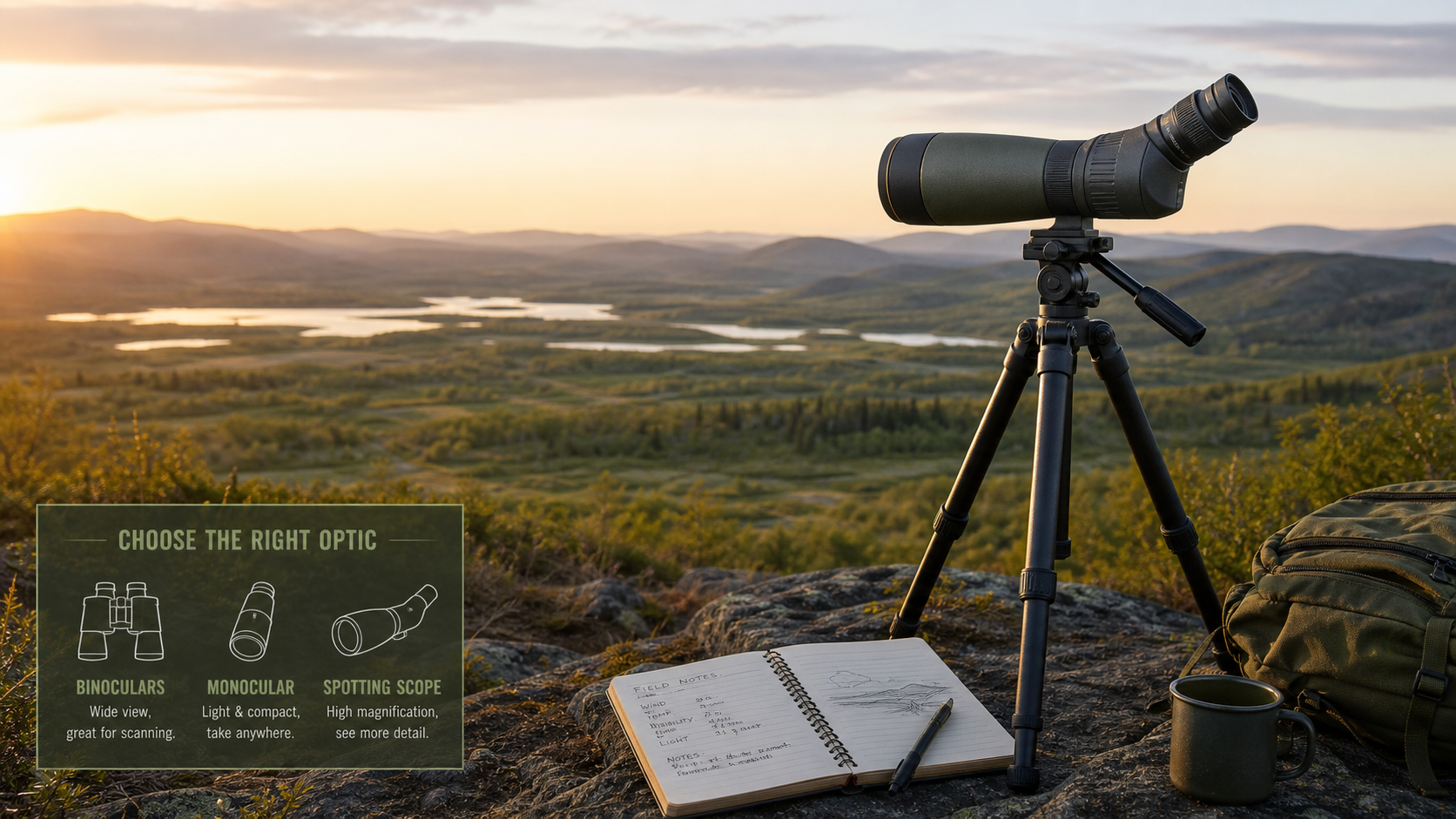
A spotting scope is worth choosing when you need more magnification and detail than handheld binoculars can comfortably provide. It is best for fixed-position viewing: watching distant wildlife, studying birds across open water, checking targets at the range, or glassing far terrain from a stable setup. The tradeoff is simple: a spotting scope gives reach, but it needs a tripod and is slower to use than binoculars or a monocular.
This guide explains seven practical reasons to choose a spotting scope, where it falls short, and how to decide whether binoculars or a monocular would be the better fit. It is an educational buying-support guide, not a product ranking.
Table of Contents
- Should You Choose a Spotting Scope?
- 1. Longer-Distance Observation
- 2. More Detail for Wildlife and Birds
- 3. Easier Range and Target Observation
- 4. Tripod Stability for Long Viewing Sessions
- 5. Angled vs Straight Viewing Options
- 6. Honest Limits Compared With Binoculars
- 7. A Clearer Decision Before You Buy
- Spotting Scope vs Binoculars vs Monocular
- Frequently Asked Questions
Should You Choose a Spotting Scope?
Choose a spotting scope when distance and detail matter more than portability and speed. If you mostly scan while walking, binoculars are usually easier. If you want the smallest possible optic, a monocular is simpler. If you set up in one place and study distant subjects, a spotting scope earns its place.

1. Longer-Distance Observation
The first reason to choose a spotting scope is reach. Most spotting scopes offer much higher magnification than common handheld binoculars, which helps when the subject is far away and mostly stationary. That extra magnification can make terrain features, target impacts, bird markings, and distant movement easier to evaluate.
More magnification is not automatically better, though. High power also narrows field of view and magnifies shake. That is why a spotting scope should be treated as a tripod-supported tool, not a handheld replacement for binoculars.
2. More Detail for Wildlife and Birds
For wildlife watching and birding, detail is often the real advantage. A spotting scope can help you study plumage, body shape, antler structure, or distant movement after you have already found the subject. Birding organizations such as Audubon explain this binocular-plus-scope workflow well: binoculars help you find, and the scope helps you study.
Use Lower Power First
A good habit is to begin at the lower end of the zoom range, find the subject, focus carefully, and then increase magnification only as needed. Starting too high can make the view narrow and frustrating.
3. Easier Range and Target Observation
At a shooting range, a spotting scope can help you observe targets from the bench without walking downrange every time. This can save time during a session and reduce interruptions when the range rules allow observation from the firing line. It is still only an observation tool; it does not change safe range conduct.
For range use, tripod stability, focus control, and eye comfort matter as much as raw magnification. A shaky or uncomfortable scope may look powerful on paper but feel tiring in real practice.
4. Tripod Stability for Long Viewing Sessions
A tripod is not an optional luxury for most spotting-scope use. High magnification needs support. A tripod steadies the image, keeps the optic at a comfortable height, and reduces fatigue during longer glassing sessions. Without support, the high end of the zoom range is usually too shaky to use well.
Tripod Weight Is Part of the System
When comparing spotting scopes, remember to count the tripod in your carry weight and setup time. A compact scope on a poor tripod can be less useful than a slightly heavier setup that stays steady in wind.
5. Angled vs Straight Viewing Options
Spotting scopes commonly come in angled and straight bodies. Angled scopes can be comfortable for sharing, upward viewing, and lower tripod heights. Straight scopes can feel faster to aim and may be easier from vehicles, benches, or higher positions.
Neither design is universally better. The better choice depends on your viewing position, body size, terrain, and whether several people will share the optic. If possible, try both styles before buying.
6. Honest Limits Compared With Binoculars
A spotting scope is not the best tool for every viewing job. It is slower to deploy, less convenient while walking, and narrower in field of view than binoculars. If the subject is moving quickly or close enough for handheld glass, binoculars are usually faster and more natural.
Low-light performance also depends on more than magnification. Objective size, exit pupil, glass quality, coatings, and the magnification setting all affect brightness. Nikon’s optics guide explains field of view, which is one of the key tradeoffs as magnification increases.
7. A Clearer Decision Before You Buy
The final reason to think about a spotting scope is decision clarity. If your main problem is distant detail from one spot, a scope makes sense. If your main problem is scanning while moving, binoculars make more sense. If your main problem is pocketable convenience, a monocular may be enough.
Before buying, answer four questions: how far you usually observe, whether subjects are stationary or moving, whether you are willing to carry a tripod, and whether you need shared viewing. Those answers matter more than chasing the highest zoom number.
Spotting Scope vs Binoculars vs Monocular
| Optic | Best for | Main strength | Main tradeoff |
|---|---|---|---|
| Spotting scope | Fixed-position distant viewing | Highest detail at distance | Needs tripod and setup time |
| Binoculars | Walking, scanning, and general field use | Fast, wide, comfortable two-eye view | Lower magnification than a scope |
| Monocular | Minimal carry and quick checks | Small and simple | Less comfortable for long viewing |
If you are still comparing smaller optics, our monocular vs binocular guide explains that decision in more detail. If you decide binoculars are the better route, our Bushnell binoculars guide gives a product-focused next step.
Frequently Asked Questions
What is the main advantage of a spotting scope?
The main advantage is higher magnification for distant, detailed viewing from a stable position. A spotting scope helps when binoculars do not provide enough reach.
Should I choose a spotting scope or binoculars?
Choose binoculars for fast handheld scanning and moving through the field. Choose a spotting scope for tripod-supported viewing when you want to study distant subjects in detail.
Do I need a tripod for a spotting scope?
In most real use, yes. High magnification magnifies shake, so a tripod is usually necessary for a steady, comfortable view.
Are angled or straight spotting scopes better?
Neither is always better. Angled scopes are comfortable for sharing and upward viewing. Straight scopes can be quicker to aim and easier from certain benches, vehicles, or elevated positions.
Are spotting scopes good in low light?
Some are, but not automatically. Low-light performance depends on objective size, exit pupil, glass quality, coatings, and magnification setting, not just the fact that it is a spotting scope.
Final Recommendation
Choose a spotting scope when you regularly observe distant, mostly stationary subjects from one position and are willing to use a tripod. Choose binoculars or a monocular when speed, movement, and easy carry matter more. The best optic is the one that matches the way you actually look, move, and set up outside.

