



Rifle scope parallax is the apparent movement of the reticle against the target when your eye shifts behind the scope. Parallax adjustment helps bring the target image and reticle into the same visual plane, which can make aiming feel more consistent. Keep safe handling, a stable position, correct eye relief, good fundamentals, and your scope manual at the center of the process.
Table of Contents
Quick Answer
To check rifle scope parallax, aim safely at a clear target, keep the rifle stable, look through the scope, and move your eye slightly behind the eyepiece without moving the rifle. If the reticle appears to drift across the target, parallax is still present. Adjust the side focus or objective adjustment until the target looks sharp and the reticle stays steadier when your eye position changes.

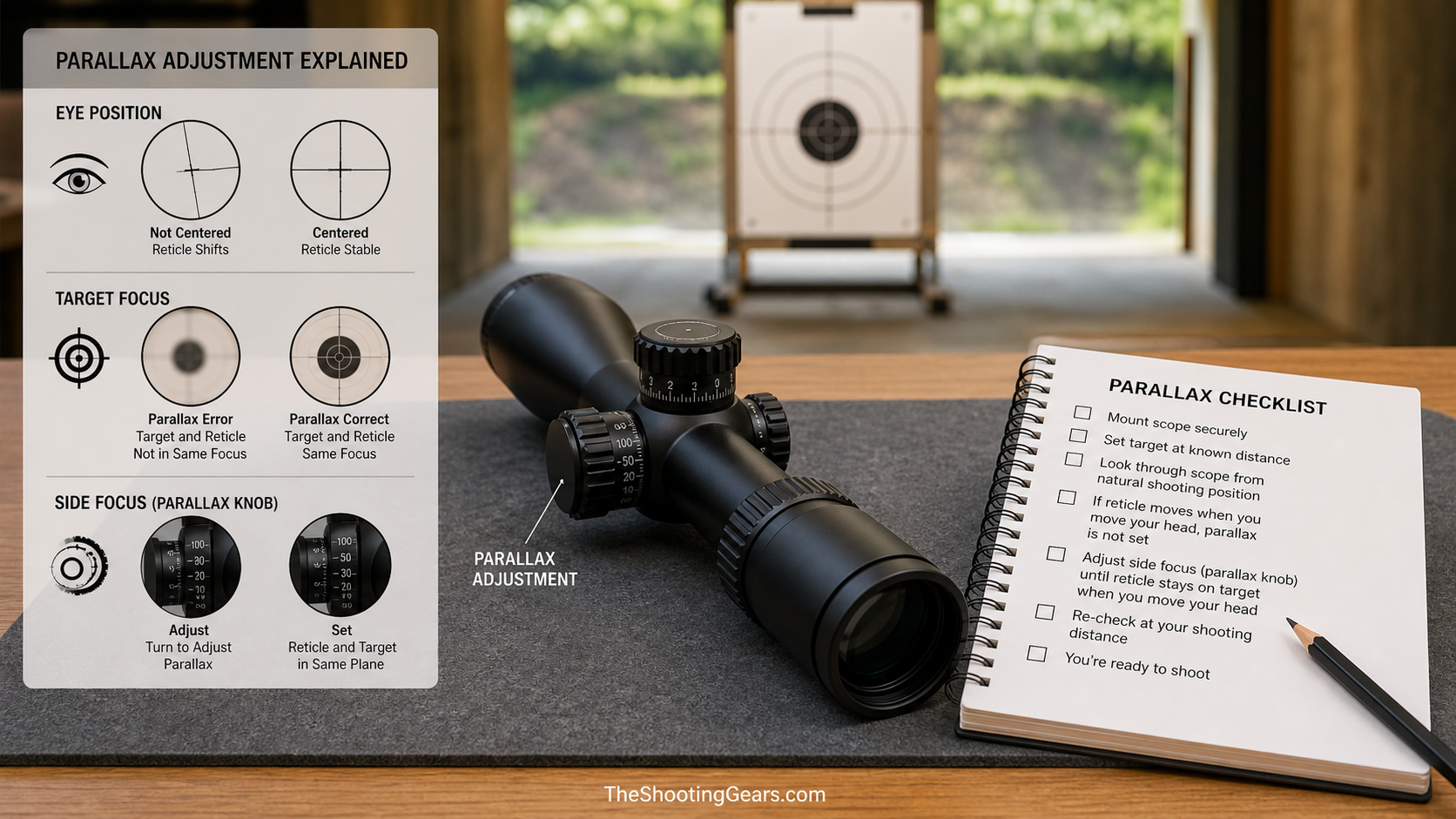
Rifle Scope Parallax Checklist
- Safety first: Follow firearm safety rules and range rules before checking any optic.
- Stable rifle: Use a stable rest so movement comes from your eye position, not the rifle.
- Target clarity: Adjust focus/parallax until the target is clear at the distance you are using.
- Reticle movement: Move your eye slightly and watch whether the reticle appears to shift on the target.
- Manual check: Follow the scope maker’s instructions for your exact model.
- Final confirmation: Confirm the setting during actual safe range use, not only by turning the knob indoors.
For general optic terminology, the telescopic sight overview is useful background. Before any live-fire confirmation, keep the safety layer first; the NSSF firearm safety rules are a good reminder that optic adjustment never comes before safe handling.
What Parallax Means in a Rifle Scope
Parallax is easiest to notice when the rifle is steady but your eye is not perfectly centered behind the scope. If the reticle appears to float or move relative to the target, your aiming reference can feel inconsistent. Adjustable parallax is designed to reduce that apparent shift at a chosen distance.
Parallax is not the same thing as poor trigger control, bad zero, loose mounts, wind, or ammunition variation. Those issues can also move impacts, so do not blame every group problem on parallax. Think of parallax adjustment as one part of an optic setup checklist, not a magic accuracy fix.
Target Focus vs Eyepiece Focus
The eyepiece or diopter is normally used to make the reticle look sharp to your eye. The parallax or side-focus control is used to bring the target image into better alignment at distance. Mixing up those controls can make the scope feel frustrating even when nothing is broken.
How to Check for Parallax
Start with the rifle pointed safely at an appropriate target and supported by a stable rest. Look through the scope in a normal shooting position. Without touching the rifle or changing the target, move your eye slightly up, down, left, and right behind the eyepiece. If the reticle seems to slide across the target, parallax is present.
Use small eye movements for this check. If you move your head dramatically, you may create other sight-picture problems. The goal is not to hunt for perfection; the goal is to reduce visible reticle drift enough that your sight picture is more repeatable.
Why Distance Marks Are Only a Starting Point
Some scopes have yardage marks on the side-focus or objective knob. Treat those marks as a starting reference, not a promise. Lighting, target contrast, your eye, and scope design can all make the best setting slightly different from the number on the dial.
How to Adjust Parallax
Use the adjustment control your scope provides: side focus, adjustable objective, or a fixed setting if the scope has no parallax control. Turn the control slowly while keeping the rifle steady and watching the target. Stop when the target is clear and reticle movement is minimized as your eye shifts slightly.
Do not force a stiff knob, disassemble the scope, or assume every optic adjusts the same way. Your scope manual is the authority for the exact control layout and limitations. If the scope will not focus or the setting seems wildly wrong, check mounting, eye relief, and whether the optic is being used within its intended distance range.
Confirm With Real Range Use
After adjusting, confirm from a safe and stable shooting position. A parallax setting that looks good from the bench should still support a repeatable sight picture when you settle behind the rifle normally. Keep notes if you use the same scope at several distances.
Fixed Parallax vs Adjustable Parallax
Some rifle scopes are set at a fixed parallax distance by the manufacturer. Others use side-focus or adjustable-objective controls. Fixed-parallax scopes can work well inside their intended use, but they give you less control when shooting at distances far from the factory setting.
Adjustable parallax is most useful when target distance changes often, magnification is high, or precision matters. The SAAMI glossary is a useful reference for broader firearm terminology, but your scope manual remains the best source for the specific optic controls.
Common Mistakes
- Using the parallax knob as a substitute for proper eyepiece focus.
- Assuming the yardage number on the knob is a precise promise.
- Checking parallax while the rifle is moving on an unstable rest.
- Blaming parallax for loose mounts, poor zero, wind, or shooter input.
- Forcing a control instead of checking the manual.
- Changing parallax settings but never confirming at the range.
FAQ
Does parallax affect accuracy?
It can affect aiming consistency, especially at higher magnification or longer distances. It is one factor, not the only cause of group size or point-of-impact changes.
Is side focus the same as parallax adjustment?
On many scopes, side focus is the parallax adjustment control. The exact design varies, so check your scope manual for the model-specific explanation.
Should the target always look perfectly sharp?
A clear target is helpful, but the bigger parallax check is whether the reticle appears to shift when your eye moves slightly. Sharpness and reticle stability should both be considered.
Do all scopes need parallax adjustment?
No. Some scopes are fixed at a factory parallax distance and are intended for simpler use. Adjustable parallax is more common on scopes built for higher magnification or more precise distance work.
Final Takeaway
Rifle scope parallax adjustment is about making the reticle and target behave more consistently when your eye position changes. Start with safe handling, set the eyepiece correctly, use the parallax control slowly, check reticle movement, and confirm at the range. It is a useful optic skill, but it works best alongside stable shooting fundamentals and the instructions for your specific scope.