


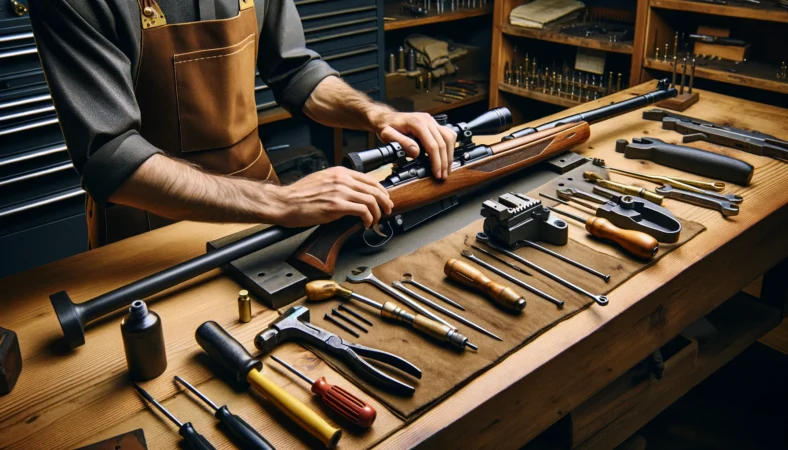
Changing a rifle stock means removing the barreled action from its current stock and securing it into a new one, and the first and most important step is always to confirm the rifle is completely unloaded and the action is clear before touching anything. A stock swap can be straightforward on some rifles and involved on others, and getting the fit, fastener tension, and any bedding correct matters for both safety and accuracy. This overview explains what the job involves, what affects accuracy, and when to hand the work to a qualified gunsmith. It does not provide model-specific disassembly steps, torque values, or bedding instructions, because those belong to your rifle’s manual or a professional.
Table of contents
Safety First: Clear the Rifle Before Anything
Before any work on a rifle, treat it as loaded until you have proven otherwise. Remove the magazine if present, open the action, and visually and physically confirm the chamber is empty. Keep the muzzle pointed in a safe direction and your finger off the trigger throughout. These are the foundation of the basic firearm safety rules published by the National Shooting Sports Foundation, and they apply to maintenance work as much as to shooting.
Work in a clean, well-lit space with no ammunition on the bench, so there is no chance of a round being near the action while you handle it. If at any point you are unsure whether the rifle is clear, stop and recheck.
What a Stock Swap Actually Involves
At a high level, a stock swap separates the barreled action from the stock and reinstalls it in a new stock. The action is usually held by one or more action screws, and on many rifles the trigger guard or floorplate assembly is part of that fastening. The new stock must be made or inletted for your specific action so everything lines up and seats correctly.
The details vary a lot between designs. Some rifles drop into a new stock easily, while others need fitting, careful screw tensioning in a specific sequence, or bedding work to mate the action to the stock properly. Because these specifics differ by model and can affect safety and accuracy, the exact procedure, sequence, and any tensioning values should come from your rifle’s owner manual or a qualified gunsmith, not from a generic guide.
Stock Types and Why Fit Differs
Stocks come in several broad categories, and the category affects how a swap goes.
- Wood stocks: Traditional and attractive, but can be sensitive to moisture and may need fitting or bedding for a precise action mate.
- Synthetic stocks: Lightweight and weather-resistant. Quality and stiffness vary, which can influence how the action settles.
- Laminate stocks: Layered wood that is more stable than solid wood, often used where a steady, rigid platform is wanted.
- Chassis systems: Metal frames, common on precision rifles, that often use a more standardized action interface but still require correct fit and assembly for your specific action.
Whatever the type, the stock must be correct for your exact make and model. A stock that is close but not inletted for your action is a problem, not a shortcut.
What Affects Accuracy After a Swap
A stock change can improve or hurt accuracy depending on how well the action mates to the new stock. The general factors that matter are how evenly and securely the action is seated, whether the barrel is free-floated or contacting the stock as the design intends, and whether the action surfaces bear against the stock consistently. Inconsistent contact or uneven fastening can shift point of impact.
Bedding, which is the process of creating a precise mating surface between the action and stock, is often what makes a swap shoot well. Bedding is a skilled task with materials and steps that vary by setup, and doing it poorly can permanently damage a stock or action fit. If accuracy is a priority, this is a strong reason to involve a gunsmith.
When to Use a Gunsmith or Pro Shop
A qualified gunsmith is the right call whenever the job goes beyond a clean, manufacturer-documented drop-in. Use a professional when any of the following apply.
- The new stock needs fitting, inletting, or bedding to seat the action correctly.
- The manual specifies fastener tensioning steps or tools you do not have or are not confident using.
- The rifle has an integrated trigger, magazine, or safety arrangement that complicates removal.
- Accuracy matters and you want the action bedded properly.
- Anything about clearing, disassembly, or reassembly is unclear to you.
A gunsmith also confirms the rifle functions safely after the swap, including that the action seats correctly and the safety and trigger behave as designed. That verification is part of why professional help is worth it on anything beyond a simple, documented change.
General Considerations Before You Buy a Stock
- Confirm exact compatibility with your rifle’s make, model, and action, including barrel contour and any magazine or trigger guard system.
- Decide your goal, whether weight reduction, weather resistance, fit and ergonomics, or a precision platform, since that guides the stock type.
- Keep the manual handy, because the manufacturer’s instructions are the authority for removal, fitting, and reassembly of your specific rifle.
- Budget for professional fitting if the stock is not a documented drop-in, rather than forcing a fit at home.
Frequently Asked Questions
Can I change a rifle stock myself?
Sometimes, if the new stock is a documented drop-in for your exact rifle and you first confirm the rifle is fully unloaded. If the job needs fitting, bedding, or fastener tensioning you are unsure about, use a gunsmith. Always follow your rifle’s manual for the specific procedure.
Will a new stock improve accuracy?
It can, if the action mates to the new stock consistently and the barrel sits as the design intends. A poorly fitted stock can also hurt accuracy. Proper bedding is often what makes a swap shoot well, and that is best done by a gunsmith.
What is bedding and do I need it?
Bedding creates a precise mating surface between the action and stock for consistent contact. Whether you need it depends on the stock and your accuracy goals. It is a skilled task that can damage parts if done poorly, so it is commonly left to a professional.
How do I know a stock fits my rifle?
Match the stock to your rifle’s exact make, model, and action, plus barrel contour and any magazine or trigger guard system. A stock that is not inletted for your specific action is not compatible. Check the stock maker’s fitment list and your rifle manual.
Final Takeaway
A rifle stock swap starts and ends with safety: confirm the rifle is unloaded and the action is clear before you begin, and verify safe function when you finish. A clean drop-in for your exact rifle may be within reach at home using your manual, but fitting, bedding, and fastener tensioning are skilled tasks where a qualified gunsmith protects both your equipment and your accuracy. When the procedure goes beyond what your manual clearly documents, hand it to a professional.