


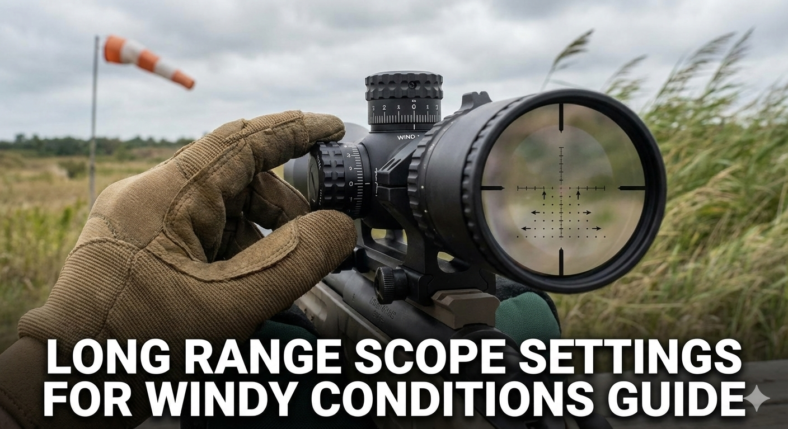
Long-range scope settings in windy conditions are less about finding one perfect number and more about building a repeatable wind process. Start with a confirmed zero, a level scope, correct parallax, reliable ballistic data, and a reticle or turret system you understand. Then estimate wind speed and direction, convert it into a hold or dialed correction, fire carefully, watch impact, and update the correction as conditions change.
For most shooters, the safest and most practical approach is to hold for wind with the reticle when wind is changing, and dial elevation only after the rifle is properly zeroed. Wind can shift between the shooter and target, so a correction that worked one minute may be wrong the next. That is why wind calls should be treated as educated estimates, not permanent settings.
Table of contents
Quick Answer
For windy long-range shooting, confirm your zero first, level the scope, set parallax for the target distance, estimate wind speed and direction, use your ballistic data to convert that estimate into MOA or MIL correction, and favor reticle holds when wind is shifting. Dialing wind can work in steady conditions, but holding is usually faster when the wind changes between shots.
Do not chase wind corrections until your fundamentals are stable. A poor trigger press, inconsistent position, bad zero, loose mount, or parallax error can look like a wind problem. Fix the rifle and shooter system first, then work on wind.
How Wind Affects Long-Range Shots
Wind pushes a bullet sideways while it is in flight. The farther the target, the longer the bullet is exposed to wind. Drift depends on distance, wind speed, wind direction, bullet velocity, ballistic coefficient, air density, and whether the wind is steady or changing along the bullet path.
Full-Value and Half-Value Wind
A wind blowing directly from 3 o’clock or 9 o’clock is often called full-value because it has the strongest sideways effect. A wind from an angle has less effect. A headwind or tailwind usually affects vertical impact more than horizontal drift, though real-world terrain can make wind behave unpredictably.
Wind Is Not the Same Everywhere
The wind at the firing line may not match the wind near the target. Grass, mirage, dust, trees, terrain, and target movement can all show different clues. Weather services such as NOAA/National Weather Service wind safety guidance are useful for understanding wind terms, but range wind still has to be read locally.
Zero, Scope Level, and Parallax
Before adjusting for wind, make sure the rifle and scope are mechanically ready. A bad zero, canted scope, loose mount, or parallax error can create horizontal misses that look like wind drift. That makes learning wind nearly impossible.
Confirm Zero First
Confirm zero on paper before long-range work. If the rifle is not centered at your chosen zero distance, wind practice becomes guesswork. If you need a refresher, see our guide on how to zero a scope for .308; the same basic zeroing discipline applies beyond that cartridge.
Level the Scope
Scope cant matters more as distance increases. If the rifle is tilted, dialing elevation can also move impact sideways. Use a level setup, consistent rifle position, and repeatable cheek weld. A level bubble can help if used without distracting from safety and fundamentals.
Set Parallax Carefully
Parallax error can shift the apparent reticle position if your eye is not centered. Set parallax for the target distance when your scope allows it, then keep your head position consistent. Our rifle scope parallax adjustment guide explains this in more detail.
Reading Wind Speed and Direction
Wind reading is the hard part because wind changes constantly. Use multiple clues: meter readings, grass, leaves, mirage, dust, target movement, flags, and previous impacts. Do not depend on one clue if others disagree.
Estimate Speed
A handheld wind meter can measure wind at your position, but it does not measure wind downrange. Use it as a baseline, then compare with what you see through the scope or spotting optic. Mirage can be especially useful on warm days, though it takes practice.
Estimate Direction
Wind direction matters as much as speed. A 10 mph wind from the side is not the same as a 10 mph wind from behind you. Convert direction into a practical value before applying a correction. Many shooters think in clock positions because it is quick and easy to communicate.
Using Reticle Wind Holds
Reticle holds are often the fastest way to manage changing wind. If your ballistic data says you need 0.6 MIL or 2 MOA of wind, you can hold that amount into the wind using the reticle instead of touching the windage turret.
Why Holding Is Popular
Holding lets you update quickly. If the wind drops or switches, you can change the hold for the next shot without dialing back and forth. This is useful for target shooting, hunting practice, and any situation where wind is not steady.
Know Your Reticle
A wind hold only works if you understand your reticle marks. MIL and MOA systems are both useful, but mixing them carelessly creates mistakes. Match your ballistic data to your scope system and practice reading the reticle before relying on it.
Dialing Wind Corrections
Dialing wind means turning the windage turret to move the point of impact. It can work in steady conditions, especially from a stable position on known-distance targets. The problem is that wind often changes before the next shot.
When Dialing Makes Sense
Dialing may make sense when the wind is stable, the target distance is known, and you have time to reset the turret. It can also help when the correction is large and your reticle hold would be hard to manage precisely.
Risks of Dialing
The main risk is forgetting to return to zero or chasing every wind change with the turret. If you dial wind, keep a clear habit for tracking what is on the turret. Many shooters dial elevation and hold wind to reduce that risk.
Spotting Misses and Updating Corrections
Your first wind call is only a starting point. Watch the bullet trace, splash, target movement, or impact when safe and possible. A spotter can help. If the shot lands left or right and your fundamentals were clean, update the wind hold.
Call the Shot First
Before blaming wind, ask whether the shot broke cleanly. If you pulled the shot or lost position, the impact may not be useful wind data. Good follow-through helps you tell the difference.
Use Small Adjustments
Make measured corrections instead of guessing wildly. If the impact is 0.5 MIL left, add about 0.5 MIL of correction if conditions appear unchanged. If the wind changed during the shot, update based on both impact and observation.
Practice Drills
Wind practice should be structured. Random shooting in wind can teach bad habits if you do not record conditions, holds, and impacts. Use a notebook or app to track your calls.
Known-Distance Drill
Set a known distance, estimate wind, choose a hold, fire a careful shot, and record the result. Repeat after wind changes. The goal is not only hits; it is learning how your estimates compare with real impacts.
No-Turret Wind Drill
Dial elevation only and hold all wind in the reticle. This builds reticle fluency and prevents turret confusion. It also teaches how quickly wind calls can change.
Common Mistakes
The most common mistake is treating wind as a fixed setting. Wind changes. The second mistake is blaming wind for every miss. Poor position, trigger control, zero, mount, ammo, and parallax can all create horizontal error. Build the whole system carefully.
Using Too Much Magnification
High magnification can make mirage and wobble harder to manage. Use enough magnification to aim precisely, but not so much that you lose field of view, target tracking, or stable sight picture. Our guide on how to use a scope for long-range shooting covers broader optic setup habits.
Ignoring Safety
Long-range shooting requires a safe range, safe backstop, known target area, and clear rules. Never shoot at unknown distances or uncertain backgrounds. If you are practicing at a range, follow all range commands and etiquette.
FAQ
Should I dial or hold wind at long range?
Many shooters dial elevation and hold wind because wind changes quickly. Dialing wind can work in steady conditions, but holding is usually faster and easier to update between shots.
What scope setting matters most in wind?
A confirmed zero, level scope, correct parallax, and a reticle/turret system you understand matter most. Wind correction cannot be trusted if the basic scope setup is wrong.
Does wind affect every bullet the same way?
No. Drift depends on velocity, ballistic coefficient, distance, air conditions, and wind. Two cartridges can need very different wind holds at the same distance.
How do I learn to read wind better?
Practice with known distances, record wind estimates and impacts, watch mirage and vegetation, use a wind meter as a baseline, and compare your calls to real results. Wind reading improves through structured feedback.
Can parallax look like a wind problem?
Yes. If parallax is not set correctly and your eye position changes, the reticle can appear to shift on target. That can create horizontal or vertical error that gets mistaken for wind.
Final Thoughts
Windy long-range shooting is a process, not a magic scope setting. Confirm the rifle, level the scope, set parallax, estimate the wind, use reliable ballistic data, hold or dial thoughtfully, and update based on impacts. The more disciplined your process, the less mysterious wind becomes.