


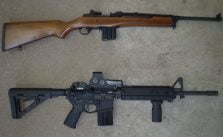
An AR-15 can be a hunting rifle in the right chambering, in the right state, and for the right game. But it is not the same thing as a traditional bolt-action hunting rifle. The biggest differences are action type, cartridge choice, magazine setup, weight, handling, legal rules, and how well the rifle matches the animal you are hunting.
For most hunters, the practical answer is this: choose the rifle around the species, distance, local regulations, and your ability to make a clean shot. A lightweight AR-15-style rifle may be excellent for varmints, predators, hogs, and some deer setups where legal. A traditional bolt-action rifle is still the simpler and more common choice for many big-game hunts because it is widely available in proven hunting cartridges and is easy to set up for accuracy.
Table of contents
AR-15 vs Hunting Rifle: Quick Comparison
The AR-15 is a semi-automatic rifle platform. A hunting rifle is a broader category that includes bolt-action, lever-action, break-action, pump-action, and semi-automatic rifles used for hunting. That means the comparison is not one exact rifle against one exact rifle. It is really an AR-15-style semi-auto compared with the traditional hunting rifles most people picture, especially bolt-action rifles.
| Factor | AR-15-style rifle | Traditional hunting rifle |
|---|---|---|
| Action | Semi-automatic | Often bolt-action, but varies |
| Best fit | Varmints, predators, hogs, some deer setups where legal | Deer, elk, bear, mountain game, and general big-game hunting |
| Strength | Modularity, low recoil, fast follow-up shots | Simple operation, strong cartridge range, field accuracy |
| Main caution | Game laws, magazine limits, cartridge limits, public perception | Slower follow-up shots, less modularity |
| Decision point | Does your chambering and law match the animal? | Does the rifle fit your terrain, recoil tolerance, and shot distance? |
The Simple Buying or Setup Rule
Do not start with the rifle style. Start with the hunt. A coyote stand, a hog hunt in thick cover, and a high-country elk hunt ask very different things from a rifle. Once you know the species, legal cartridge requirements, expected distance, terrain, and carry weight, the better rifle choice becomes much clearer.
What Is an AR-15?
An AR-15-style rifle is a lightweight, gas-operated, semi-automatic rifle platform. Semi-automatic means one round fires with each trigger press, and the rifle uses energy from the fired round to cycle the action and chamber the next round. It is not the same as a fully automatic rifle. The platform is popular because it is modular: stocks, handguards, optics, triggers, barrels, and uppers can often be configured for different uses.
The common .223 Remington or 5.56 NATO AR-15 setup is mild recoiling and easy to shoot well, but cartridge choice matters. Many AR-style rifles are also chambered in hunting-oriented cartridges such as 6.5 Grendel, .300 Blackout, .350 Legend, 6mm ARC, and others. Those chamberings can change the hunting role, but state regulations still control what is legal for a specific animal.
Why Hunters Like the AR Platform
- Low recoil helps many shooters stay on target.
- Adjustable stocks can fit different body sizes and clothing layers.
- Optics, lights where legal, slings, and accessories are easy to mount.
- Fast follow-up shots can help with hogs, coyotes, and multiple-target varmint situations.
- Parts availability makes setup changes easier than on many traditional rifles.
What Is a Hunting Rifle?
A hunting rifle is any rifle set up and legally used for hunting. In everyday conversation, though, most people mean a bolt-action rifle with a sporter stock, a scope, and a cartridge chosen for a specific game animal. This could be a .243 Winchester for deer and antelope, a .308 Winchester for all-around deer and elk work, or a larger cartridge for bigger game and tougher conditions.
Traditional hunting rifles are popular because they are simple, reliable, and available in a huge range of cartridges. A bolt-action rifle does not cycle itself. The shooter manually lifts and runs the bolt to eject the fired case and chamber the next round. That makes follow-up shots slower than a semi-auto, but the design is strong, familiar, and easy to maintain.
Why Hunters Still Choose Bolt-Action Rifles
- They are chambered in many proven big-game cartridges.
- They are simple to load, unload, inspect, and maintain.
- They often deliver excellent practical accuracy.
- They are accepted in nearly every hunting culture and regulation set.
- They can be lighter and cleaner to carry in mountain or timber hunts.
Action Type and Follow-Up Shots
The AR-15’s main mechanical advantage is speed. Because it cycles automatically after each shot, you can make a follow-up shot without moving your firing hand from the grip or manually running a bolt. That can be useful on moving predators, feral hogs, or varmint hunts where several animals may appear at once.
A bolt-action rifle asks more from the shooter between shots. You must run the bolt without losing your position, then reacquire the target. For many big-game hunters, that slower pace is not a weakness. It encourages careful shot placement and pairs well with hunts where the first shot matters most.
Speed Is Not a Substitute for Shot Placement
Fast follow-up shots do not make a poor first shot acceptable. Ethical hunting still depends on knowing your range, understanding the animal angle, using the right bullet, and staying inside your ability. If speed makes you rush, it is not an advantage.
Cartridge and Game Suitability Matter More Than Rifle Style
The old version of this debate often says an AR-15 is only for small game. That is too simple. Some AR-15 chamberings are light for deer-size game in some states, while others are designed specifically to meet straight-wall or medium-game requirements. The right question is not “AR or hunting rifle?” It is “Is this cartridge legal, powerful enough, accurate in my rifle, and paired with the right bullet for this animal?”
A traditional bolt-action rifle usually gives you a wider big-game cartridge range. If you need .270 Winchester, 7mm-08, .308 Winchester, .30-06 Springfield, 6.5 Creedmoor, or larger cartridges, a bolt-action rifle is often the simplest route. For elk, moose, bear, or long-range open-country deer, cartridge selection may push you toward a conventional hunting rifle.
Check Minimum Caliber and Magazine Rules
Many states regulate minimum caliber, bullet type, magazine capacity, straight-wall cartridges, suppressor use, and semi-automatic rifle use for hunting. Read the current state regulation book before assuming your rifle is legal. Public land and special seasons may add more restrictions.
Accuracy, Weight, and Field Handling
Both rifle types can be accurate. A quality AR-15 can shoot very well, and a quality bolt-action rifle can shoot very well. In real hunting, the bigger difference is often handling. The rifle must fit your body, balance with your optic, carry comfortably, and let you get steady from field positions.
AR-15-style rifles can become heavy once you add a scope, mount, rail, bipod, light, loaded magazine, and sling. Traditional hunting rifles can also become heavy with large optics and magnum barrels, but many sporter rifles are built specifically for carry weight. If you hike steep terrain, weight matters. If you hunt from a stand or call predators from fixed sets, weight may matter less.
Optics Can Decide the Practical Difference
A rifle with the wrong optic can feel wrong even if the rifle itself is good. A close-range hog or predator AR may work well with a low-power variable optic or red dot. A deer or elk bolt gun may benefit from a durable hunting scope with enough magnification for your normal distance. If you are comparing optic setups, our guide to choosing a scope for a .308 rifle gives useful crossover principles.
Legal Rules, Safety, and Hunting Ethics
Legal rules can decide the comparison before performance does. Some states restrict semi-automatic rifles for certain seasons or game animals. Some limit magazine capacity. Some require straight-wall cartridges for deer in certain zones. Others allow AR-style rifles if the cartridge and magazine setup meet the rule. Always verify the current regulation, not an old forum answer.
Use official sources when the law matters. Start with your state wildlife agency. For public land, check land-manager guidance such as the U.S. Forest Service hunting guidance. For field safety, review resources such as Project ChildSafe’s Hunt S.A.F.E. guidance and formal hunter education material such as the Hunter-ed firearm safety guide. If you are learning the AR platform, the NSSF modern sporting rifle resource is a helpful industry overview, while your state regulations remain the authority for hunting legality.
Ethics Are Bigger Than Equipment
The ethical rifle is the one you can shoot accurately, legally, and confidently under field conditions. That includes choosing the right cartridge and bullet, practicing from realistic positions, knowing when not to shoot, and respecting the animal. The Boone and Crockett Club is a useful outside reference for fair-chase thinking, and our ethical hunting practices guide is a good companion to any rifle-choice decision.
Which One Should You Choose?
Choose an AR-15-style rifle if your state allows it, your chosen chambering is appropriate for the animal, and you value modularity, low recoil, and fast follow-up shots. It can be a strong fit for coyotes, varmints, hogs, range training, and some deer hunts where the cartridge and law line up.
Choose a traditional hunting rifle if you want the simplest path for deer, elk, bear, mountain game, or broad big-game use. A bolt-action rifle in a proven hunting cartridge is easy to understand, easy to verify legally, and often easier to set up for one clean shot from practical field positions.
Best Choice by Hunting Situation
- Coyotes and varmints: AR-15-style rifle often makes sense.
- Hogs in thick cover: AR-style rifle can be useful if legal and chambered appropriately.
- Whitetail deer: either can work, depending on state law and cartridge.
- Elk or larger game: traditional bolt-action rifles usually give better cartridge options.
- New hunters: start with the simplest legal setup you can shoot well.
FAQ
Is an AR-15 considered a hunting rifle?
It can be used as a hunting rifle when the chambering, magazine setup, and state regulations make it legal and ethical for the game. It is more accurate to call it a semi-automatic rifle platform that can be configured for some hunting roles.
Is an AR-15 good for deer hunting?
Sometimes. It depends on the cartridge, bullet, distance, state law, and deer size. Some AR chamberings are better suited to deer than standard light varmint setups. Always check minimum caliber and cartridge rules first.
Is a bolt-action rifle more accurate than an AR-15?
Not automatically. Both can be accurate. Bolt-action rifles are often chosen for precision and simplicity, but a well-built AR can shoot very well. In the field, shooter skill, ammo quality, optic setup, and position matter just as much.
Why do hunters choose bolt-action rifles?
They are simple, reliable, widely legal, and available in many big-game cartridges. They also encourage careful first-shot discipline, which is valuable in ethical hunting.
Can you hunt elk with an AR-15?
In most cases, a standard AR-15 setup is not the common choice for elk. Elk usually call for more cartridge than the typical .223 or 5.56 setup. Laws and ethical performance should guide the decision, and many hunters choose a bolt-action rifle in a proven elk cartridge.
What matters more: rifle type or cartridge?
Cartridge, bullet choice, legality, and shooter skill usually matter more than the label on the rifle. The rifle style only matters after it supports those basics.
Final Thoughts
The AR-15 vs hunting rifle debate is less about which rifle is universally better and more about matching equipment to the hunt. An AR-15-style rifle can be practical for certain legal hunting situations, especially where low recoil, modular setup, and fast follow-up shots help. A traditional hunting rifle remains the cleaner choice for many big-game hunters because it offers broad cartridge options, simple operation, and field-proven reliability. Pick the rifle that fits the animal, the law, your terrain, and your real shooting ability.