


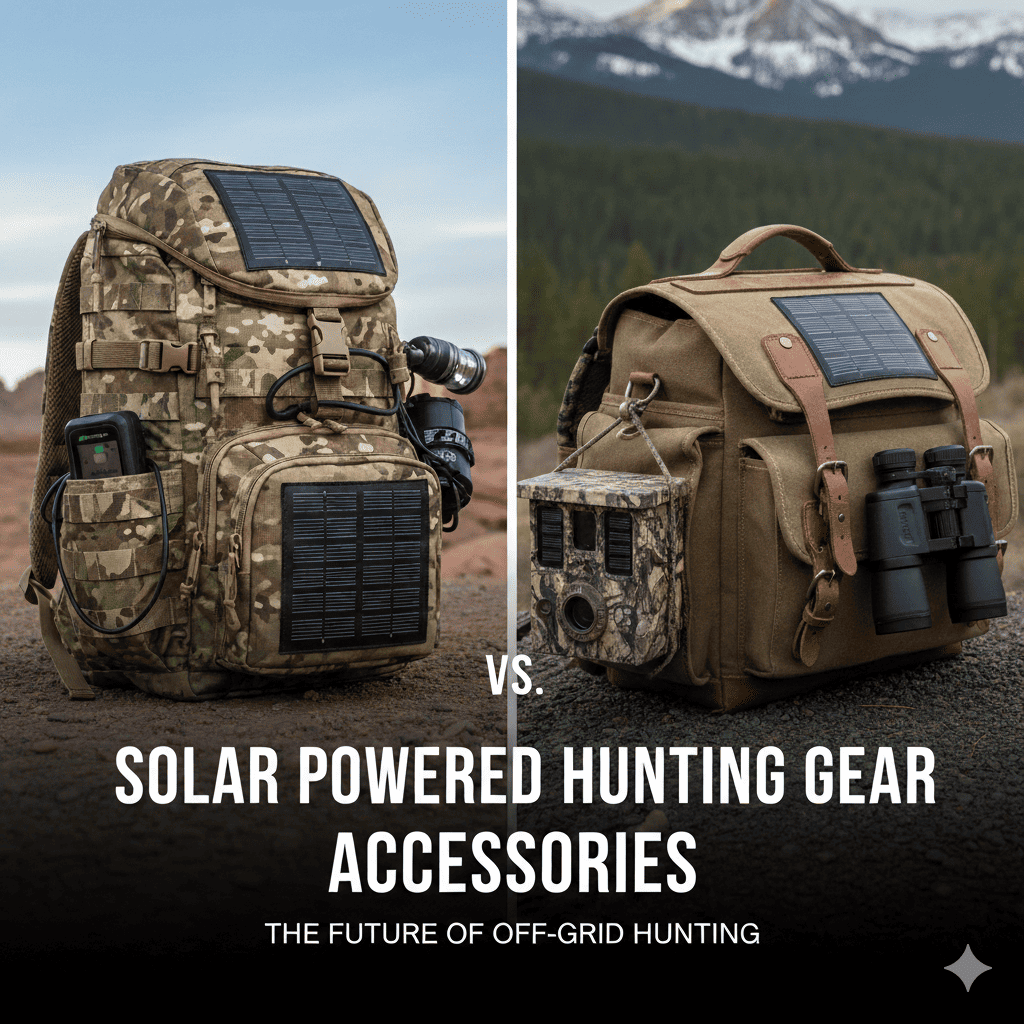
Solar-powered hunting gear lets you recharge phones, GPS units, headlamps, trail cameras, and power banks without an outlet, which matters most on multi-day backcountry trips where there is no other power. The realistic value is steady top-ups in good daylight, not unlimited free energy. Output drops sharply in shade, heavy cloud, short winter days, and cold, so the dependable setup pairs a panel with a battery bank that stores charge for when the sun is not cooperating. This guide covers the main gear categories, where solar actually helps, and the limits worth planning around before you rely on it.
Table of contents
What Counts as Solar-Powered Hunting Gear
Solar-powered hunting gear is any equipment that captures sunlight to generate or store electricity for use in the field. In practice this breaks into two groups: gear that charges other devices, such as foldable panels and solar power banks, and gear with a small built-in panel, such as some headlamps, lanterns, and trail cameras. The charging gear is where most hunters get real value, because a single panel and battery bank can keep an entire kit topped up.
Panel output is rated in watts, and storage is rated in milliamp-hours or watt-hours. For a plain-language overview of photovoltaic basics, Energy.gov explains how solar panels convert sunlight into electricity. A higher watt panel collects more energy per hour of good sun, and a higher capacity bank stores more for cloudy stretches. Matching those two numbers to the devices you actually carry is the core of a setup that works.
Where Solar Helps Most on a Hunt
Solar earns its weight on trips where you are away from vehicles and outlets for more than a day. The longer and more remote the trip, the more a small panel pays off.
Multi-Day Backcountry Trips
On a three-to-seven-day backpack hunt, phones, GPS handhelds, and inReach-style satellite devices drain steadily. A panel strapped to your pack collects energy while you hike, and a power bank stores it for nightly recharging in the tent. This keeps navigation and emergency communication alive without carrying a stack of spare batteries.
Base Camps and Spike Camps
A stationary camp lets you angle a larger panel toward the sun for hours, which is the most efficient way to use solar. Camp lighting, radios, and rechargeable headlamps all benefit. A panel left out during midday glassing sessions can refill a bank by evening.
Trail Cameras on Long Soaks
Trail cameras left out for weeks or months are a strong fit for small built-in or add-on solar panels, since they only need a trickle to offset their low daily draw. Place them where they catch sun for part of the day, not under dense canopy, and follow the camera manufacturer’s guidance on compatible solar accessories.
Solar Panels and Power Banks: How They Work Together
The reliable approach is to treat the panel as the charger and the power bank as the reservoir. The panel charges the bank during the day, and your devices charge from the bank whenever you need them, including at night. Charging directly from a panel to a phone works but is fragile, because passing clouds and changing angles interrupt the device and can stall a charge cycle.
Foldable and Roll-Up Panels
Portable panels for hunting are usually foldable fabric-backed units in the 5 to 30 watt range for personal kits. Smaller panels are lighter and pack flat but charge slowly. Larger panels charge faster and run camp gear but add weight and bulk. Look for sturdy attachment points, water-resistant construction, and standard USB output that matches your devices.
Solar Power Banks
A solar power bank is a battery with a small panel built in. The built-in panel is a backup trickle, not a primary charger, because the panel area is tiny. Choose the bank mainly for its battery capacity and charge it from a wall or a larger panel, then treat its onboard panel as an emergency top-up. For care, storage, and cold-weather behavior of lithium batteries, follow the device maker’s instructions and general battery safety guidance such as the resources from the National Fire Protection Association.
Common Solar Accessory Categories
Beyond panels and banks, several accessory categories use solar in useful ways. These are generic categories, not product picks.
- Solar lanterns and string lights: Collapsible camp lights that charge during the day and light a tent at night. Good for low-draw camp use.
- Solar-assisted headlamps: Headlamps with a small panel or a USB-rechargeable battery that a panel can refill. The panel rarely fully charges a headlamp on its own, so plan to top it from a bank.
- Trail camera solar panels: Small add-on panels that keep a camera running on long unattended soaks. Match the panel to the camera maker’s supported accessories.
- Solar chargers for radios and GPS: Useful for keeping two-way radios and handheld GPS units alive on extended stays, again best routed through a battery bank.
Realistic Limits: Low Light, Cold, and Cover
Solar output depends on how much usable sunlight actually reaches the panel, and hunting conditions often work against it. Knowing the limits keeps you from being stranded with a dead device.
Cloud, Shade, and Dense Cover
A panel in heavy cloud or full shade produces a small fraction of its rated output, sometimes near nothing. Hunting often happens in timber, canyons, and pre-dawn or dusk light, none of which favor solar. Plan to expose the panel during open midday hours and accept that overcast days may add little.
Short Days and Low Sun Angle
Late-season and high-latitude hunts have fewer daylight hours and a lower sun angle, which both cut output. A panel that refills a bank in summer may only partly refill it in November. Carry enough stored capacity to cover several low-yield days.
Cold and Battery Behavior
Solar panels themselves tolerate cold, but the lithium batteries in power banks and devices lose usable capacity and charge slowly in the cold. Keep banks and phones in an inside pocket or your sleeping bag to keep them warm, and let a cold bank warm up before expecting full performance. Follow the manufacturer’s stated temperature range.
Building a Simple Off-Grid Charging Setup
A workable solar kit for a multi-day hunt starts with knowing your daily power draw, then sizing the panel and bank to refill it with margin to spare.
- List your devices and their draw. Note the battery size of each device you must keep alive, such as your phone, GPS, satellite messenger, and headlamp.
- Pick a power bank as the core. Size it to cover at least two to three days of your real draw, so a cloudy stretch does not strand you.
- Add a panel to refill the bank. Match panel watts to how fast you need to top the bank during available daylight. Bigger trips and bigger banks need bigger panels.
- Charge the bank from the panel, devices from the bank. This buffers the unstable panel output and protects your devices from interrupted charging.
- Carry a fallback. Bring spare device batteries or a fully pre-charged second bank for trips where dead navigation or communication would be a safety problem.
For trips where emergency communication matters, treat solar as a top-up, not a guarantee. Pre-charge everything before you leave, and let solar extend that charge rather than replace it.
Frequently Asked Questions
Can a solar panel fully charge my phone on a hunt?
It can in good direct sun, but it is unreliable charging straight to the phone because clouds and angle changes interrupt the cycle. Charge a power bank with the panel during the day, then charge the phone from the bank. That gives a steady, complete charge.
How many watts of solar do I need for backcountry hunting?
It depends on how much you need to recharge and how much daylight you get. A small 5 to 10 watt panel can trickle-charge a bank for phone and GPS use, while 20 to 30 watts refills a larger bank faster. Size it to your real device draw with margin for cloudy days.
Does solar work in cold weather?
The panel works in cold, but the batteries it charges lose capacity and charge slowly when cold. Keep power banks and phones warm in an inner pocket, and follow each device’s stated temperature range.
Are solar trail cameras worth it?
For long unattended soaks they can be, because a small panel offsets the camera’s low daily draw and reduces battery swaps. Place the camera where it gets partial sun, not deep under canopy, and use only the solar accessories the camera maker supports.
Should solar replace spare batteries?
No, treat solar as a top-up, not a replacement, especially when navigation or emergency communication is involved. Start fully charged, carry a fallback, and let solar extend your runtime rather than be your only source.
Final Takeaway
Solar-powered hunting gear is most useful on multi-day, off-grid trips, where a foldable panel feeding a power bank keeps your essential electronics alive. Plan around its real limits in shade, cloud, short days, and cold, size the panel and bank to your actual device draw, and always carry a charged fallback when dead navigation or communication would be a safety issue. Used that way, solar is a dependable extender, not a magic power source.